Sellers comparing ways to resell on Amazon usually face four practical models: wholesale, retail or online arbitrage, private label, and compliant dropshipping. Each model changes how products are sourced, what evidence must be retained, when capital is committed, how much control the seller has, and which failures can interrupt the business.
To resell on Amazon, choose a model that your business can document, finance, and operate. Wholesale offers potentially repeatable supply but usually requires deeper commitments. Retail and online arbitrage support smaller, faster tests but often provide less predictable replenishment and documentation. Private label offers greater product and brand control while adding development and compliance responsibility. Compliant dropshipping can reduce routine inventory handling, but the seller must retain seller-of-record responsibility and control the customer experience. In every model, verify eligibility, source authentic products, preserve records, match the correct listing, model full contribution margin, and test before scaling.
Key takeaways
- The four models are wholesale, retail or online arbitrage, private label, and compliant dropshipping. Retail and online arbitrage are two sourcing variants within the same model, not two separate models in this framework.
- Supply evidence comes before scale. Demand does not make a product defensible if the source, authenticity, product rights, condition, or required documentation cannot be supported.
- Private label and dropshipping change the seller's responsibility in different ways. Private label adds product-development control; dropshipping delegates physical fulfillment while leaving seller accountability in place.
- Fulfillment is a separate decision. Wholesale, arbitrage, and private-label inventory can use FBA, FBM, or a hybrid, while supplier-direct dropshipping needs its own policy controls.
- Compare contribution and cash exposure, not revenue screenshots. The strongest model is the one that survives realistic fees, returns, price pressure, lead times, and documentation risk.
What does it mean to resell on Amazon?
Reselling is an umbrella term for obtaining products from another source and offering them to customers through an Amazon selling account. The source can be a brand, manufacturer, wholesaler, distributor, physical retailer, online retailer, or supplier that ships on the seller's behalf. The commercial relationship changes by model, but the Amazon seller remains responsible for listing the correct product, complying with applicable restrictions, representing condition accurately, choosing fulfillment, serving customers, and preserving evidence that supports the offer.
Amazon's current reselling guide organizes the workflow around researching demand, procuring products, listing them, handling fulfillment, and managing inventory and customer service. It also advises sellers to use reliable sources, verify authenticity and quality, research safety and compliance requirements, and retain transaction records such as purchase orders and invoices.
This article compares four practical routes that sellers often evaluate together. Wholesale and arbitrage are conventional resale models for third-party products. Private label is a build-a-brand model rather than classic resale, but it competes for the same sourcing capital and market opportunity. Compliant dropshipping is a supplier-direct inventory and fulfillment arrangement that can be paired with resale, but it changes the seller's control over packaging, delivery, and returns.
For the account, listing, pricing, and launch sequence that sits above all four models, use the Amazon selling setup guide. The rest of this article focuses specifically on choosing a sourcing and operating model.
Four Amazon business models compared
The comparison should begin with the operating structure, not an assumed income level. Each model creates a different relationship between the seller, the source, the inventory, the customer, and the catalog. The table below uses the four models defined in the original framework.
| Model | Core strength | Main constraint | Evidence priority | Best-fit question |
|---|---|---|---|---|
| Wholesale | Repeatable supplier relationship, business pricing, and potential volume | Capital, approvals, shared-listing competition, minimums, and documentation | Commercial invoices, supplier legitimacy, product rights, authorization where relevant, and chain of custody | Can the supplier and margin remain viable after competition and replenishment? |
| Retail/online arbitrage | Small tests, fast learning, and flexible product discovery | Inconsistent supply, price volatility, inspection workload, and documentation risk | Receipts or invoices, order records, product identifiers, condition evidence, and source details | Can each batch be documented, inspected, and sold before the opportunity disappears? |
| Private label | Product, brand, packaging, listing, and positioning control | Development, testing, compliance, launch, lead time, and inventory capital | Specifications, test records, manufacturing agreements, quality control, claims support, trademark and IP records | Can the team responsibly improve and support a product under its own brand? |
| Compliant dropshipping | Lower routine inventory handling and supplier-direct fulfillment | Supplier control, seller-of-record duties, stock accuracy, delivery, service, and returns | Supplier agreement, packaging standards, test orders, inventory and tracking records, and return workflow | Can the supplier execute the seller's promise without exposing another seller identity or weakening control? |
These are operating profiles, not guaranteed outcomes. Actual eligibility, documentation, fees, product risk, and marketplace performance vary by account, product, source, and country.
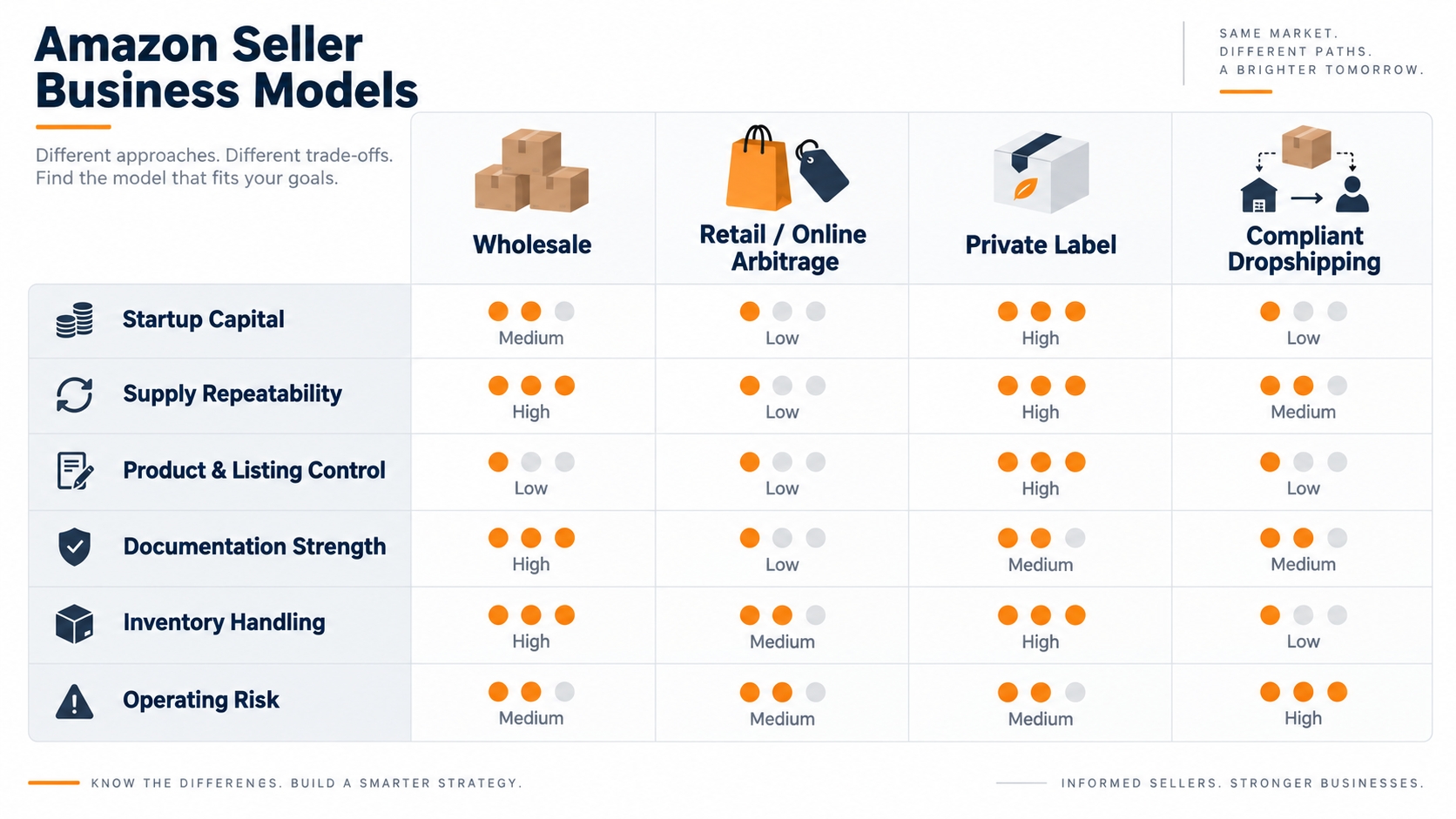
Choose the model by the constraint you cannot ignore
A model can look attractive in isolation and still be wrong for the operator. The fastest way to narrow the choice is to identify the constraint that would stop the business first: documentation, capital, replenishment, product control, physical handling, or supplier execution.
You can qualify suppliers, support business-sized opening orders, retain commercial records, and manage competition on shared listings.
You need smaller experiments and can accept inconsistent sourcing, higher inspection effort, and batch-by-batch documentation decisions.
You can fund product development, testing, branding, inventory, launch, and ongoing quality control in exchange for more product and listing control.
A supplier can pass seller-of-record, packaging, stock, tracking, service, and return controls before the offer receives meaningful traffic.
Do not choose the model with the easiest success story. Choose the model whose weakest requirement your business can still control and document.
Start with product and supply rights
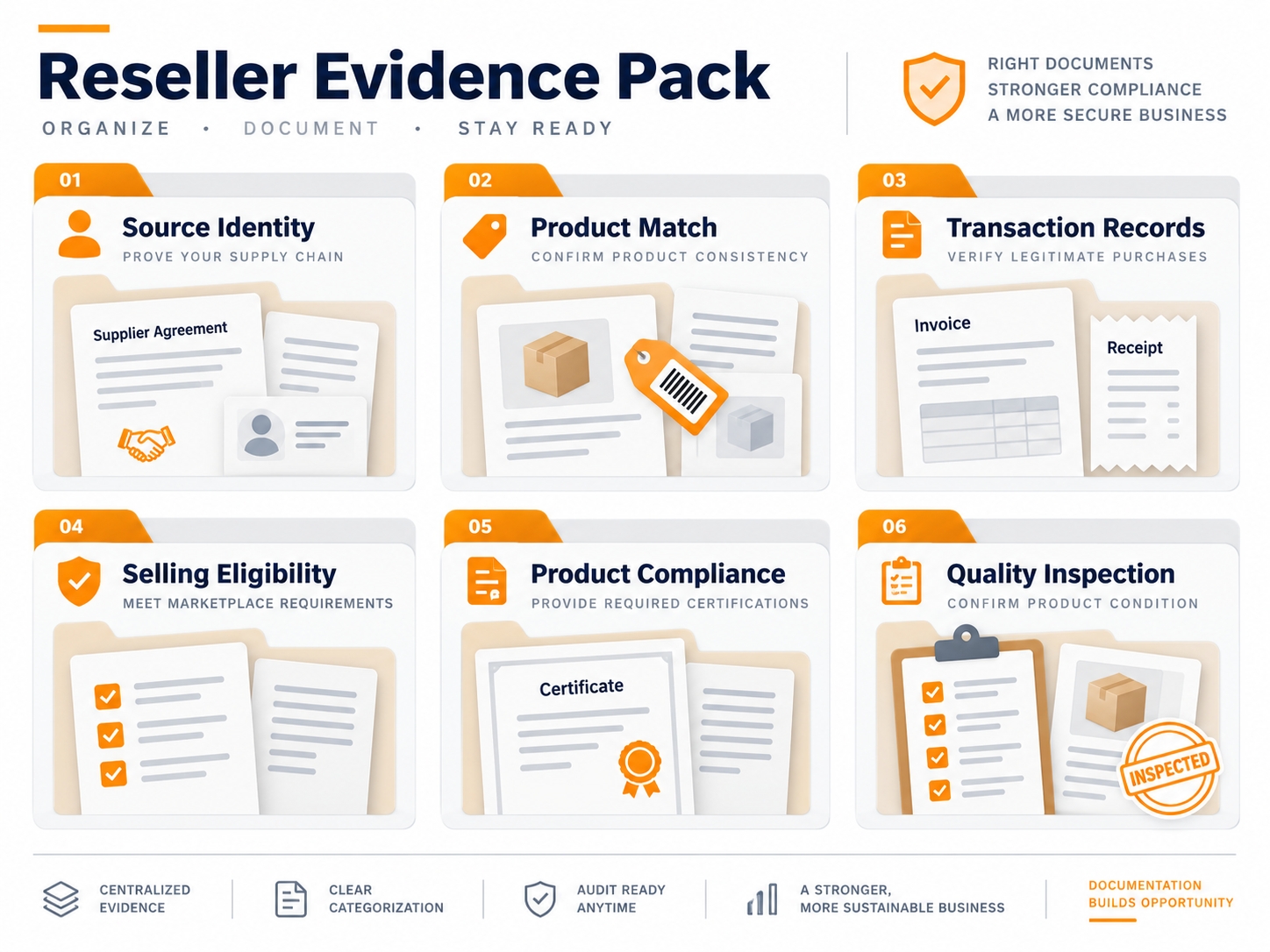
Every model begins with the same question: can the business show where the product came from and why it is entitled to sell that exact item in the stated condition? Amazon's reselling guidance recommends researching manufacturers, resellers, and suppliers; verifying authenticity and quality; checking that products and parts work; researching safety and compliance requirements; and keeping purchase orders, invoices, and other transaction records.
The strongest evidence differs by model. A wholesale relationship may produce commercial invoices, account records, and authorization. Arbitrage may produce retail receipts or online order records that still need to identify the product clearly. Private label requires specifications, manufacturing, testing, and brand evidence. Dropshipping requires a supplier agreement plus proof that the real parcel and service flow match seller-of-record obligations.
| Evidence area | Question to answer | Records to retain | Failure to avoid |
|---|---|---|---|
| Source identity | Who sold or manufactured the product, and can that business be verified? | Legal name, address, contact, website, account record, agreement, invoice, order confirmation, and payment record | Buying from an unverified source whose identity or product chain cannot be explained |
| Product identity | Does the record identify the exact brand, model, variation, quantity, and condition being offered? | UPC or other identifier, SKU map, product images, model, size, color, lot, serial, package quantity, and condition notes | Assuming a similar item is interchangeable with the catalog product |
| Eligibility and rights | Is the seller allowed to offer this product, category, brand, condition, and marketplace? | Category approval, brand authorization where applicable, IP review, product certificates, safety reports, and policy references | Treating product availability as proof of selling permission |
| Quality and condition | Does the delivered or stored product match the listing promise and condition? | Inspection notes, samples, photos, test results, damage records, expiration data, packaging versions, and corrective actions | Listing inventory before the product or supplier process has been inspected |
Wholesale: repeatable supply with higher commitment
Amazon wholesale generally involves buying products in business quantities from a manufacturer, brand, distributor, or wholesaler and reselling them at a markup. The model's main advantage is not simply a lower unit price. It is the possibility of a repeatable commercial relationship with product catalogs, account contacts, purchasing terms, and clearer replenishment than one-off retail deals.
The tradeoff is commitment. Minimum order quantities, case packs, payment terms, approval requirements, lead times, and shared-listing competition can tie up cash before the seller knows how much of the inventory will move at an acceptable contribution. Amazon's 2026 wholesale guidance also emphasizes keeping supplier invoices available for products that require approval and choosing fulfillment separately from the sourcing arrangement.
Wholesale due diligence before the opening order
- Verify the supplier. Confirm legal identity, physical and online presence, account contacts, source relationship, product scope, and whether the supplier is authorized to distribute the brands involved.
- Review invoice quality. The commercial record should clearly identify buyer, seller, date, products, quantities, and relevant business details. Keep the original record and payment evidence.
- Confirm selling eligibility before ordering. Check category, product, brand, condition, and marketplace restrictions from the actual Amazon account.
- Model shared-listing competition. Review price history, seller count, Featured Offer conditions, fulfillment mix, and whether the brand or Amazon also sells the product.
- Stress-test replenishment. Model supplier lead time, reorder minimums, price changes, stock allocation, discontinued products, and cash needed for the next order before the first inventory has fully sold.
Wholesale decision boundary: A repeatable supplier is valuable only when the documentation, product access, listing competition, and cash cycle remain defensible after the opening discount is gone.
Retail and online arbitrage: small tests with inconsistent supply
Amazon arbitrage means purchasing products from retailers at a lower price and reselling them. Retail arbitrage sources from physical stores; online arbitrage sources from ecommerce sites. They belong to one model in this framework because both depend on retail price gaps rather than a negotiated wholesale or manufacturing relationship. The sourcing channel changes the workflow, but the core opportunity and constraints are similar.
Arbitrage can help a new seller learn catalog matching, price analysis, condition grading, prep, and fulfillment with smaller buys. It can also expose the seller to short-lived discounts, purchase limits, order cancellations, split shipments, inconsistent packaging, damaged units, uncertain replenishment, and records that may not satisfy every future approval or authenticity request. Every batch needs its own go or no-go decision.
| Arbitrage variant | Operational advantage | Extra control required | Evidence to preserve |
|---|---|---|---|
| Retail arbitrage | Immediate physical inspection, local clearance discovery, and small batch purchases | Store-specific limits, receipt clarity, condition, hidden damage, stickers, packaging wear, tax treatment, and time spent sourcing | Original receipt, payment record, product identifiers, store details, date, quantity, and inspection record |
| Online arbitrage | Broader source discovery, faster price comparison, and remote purchasing | Order cancellation, split shipment, substitution, delivery damage, packaging version, returns, and inspection after receipt | Order confirmation, final invoice or receipt, payment record, shipment details, product identifiers, and receiving inspection |
Private label: product and brand control with greater responsibility
Private label means a manufacturer produces merchandise that the seller offers under its own brand name, specification, packaging, or positioning. It is not conventional resale of another brand's finished product, but it belongs in this comparison because sellers often decide whether to exploit an existing price gap or invest in an owned product proposition.
Greater control does not remove risk; it changes its location. The seller can influence the specification, quality target, packaging, price, listing, and brand experience, but it also becomes responsible for product claims, safety, testing, labeling, intellectual property, supplier change control, inspection, inventory, and customer outcomes. Amazon's current private-label guidance describes the seller as controlling product specifications, packaging design, pricing, and marketing even when a contract manufacturer produces the item.
Build the evidence before production
Amazon Brand Registry is a separate program for eligible rights owners. Amazon's current page says enrollment requires, among other things, a brand name and logo permanently affixed to products or packaging and a qualifying pending or registered trademark. Verify current country-specific requirements before relying on access to brand tools.
Compliant dropshipping: lower handling with supplier-control risk
In compliant dropshipping, the seller lists and sells a product while an approved supplier holds or controls the inventory and ships after the customer order is received. The model can reduce routine storage and handling, but it does not transfer Amazon responsibility to the supplier. The seller must remain the seller of record and continue to own the offer, customer promise, support, returns, and compliance obligations.
This article treats dropshipping as one of the four business models because it changes inventory ownership and cash timing. Before using supplier-direct fulfillment, verify the current Amazon policy and test the actual parcel, documents, tracking, delivery, service, and return path.
| Area | What dropshipping can reduce | What the seller must still control |
|---|---|---|
| Inventory handling | Routine internal storage, receiving, picking, packing, and carrier handoff | Exact product mapping, available quantity, handling promise, tracking, substitutions, and supplier capacity |
| Upfront stock | Some inventory ownership and warehouse commitment before customer demand | Per-order supplier cost, shipping, cancellations, errors, refunds, support, and economics under real order volume |
| Physical operations | Direct day-to-day labor for warehouse fulfillment | Seller identity, packaging, invoices, customer service, returns, evidence, audit rights, and incident response |
Use the separate seller-of-record guide for the detailed policy, supplier-control, test-order, monitoring, and returns workflow.
How catalog and listing control change by model
Sourcing does not determine whether a product should be matched to an existing detail page or added as a new product. Product identity does. Wholesale and arbitrage sellers commonly compete on existing listings for the exact branded product. Private-label sellers usually create or control a detail page for their own branded product. Dropshipped offers may use either structure depending on what is being sold, but supplier-direct fulfillment does not justify a mismatched listing.
| Model | Typical catalog position | Primary control | Common failure |
|---|---|---|---|
| Wholesale | Offer on an existing detail page for the exact branded product | Exact identifier, model, quantity, condition, variation, and approval | Buying a legitimate product but attaching the offer to the wrong package or variation |
| Retail/online arbitrage | Offer on an existing detail page after receiving and verifying the product | Package version, region, condition, expiration, included items, and retail sticker or damage review | Listing inventory before receiving and inspecting the actual shipment |
| Private label | New detail page for a genuinely new branded product or exact owned product identity | Brand, GTIN or exemption, attributes, claims, images, variations, and product compliance | Using differentiation language that the manufactured product or evidence cannot support |
| Compliant dropshipping | Existing or new detail page, depending on exact product identity and rights | Supplier SKU mapping, live availability, exact shipment, seller identity, and supportable delivery promise | Allowing substitutions or listing a product the supplier cannot consistently fulfill as described |
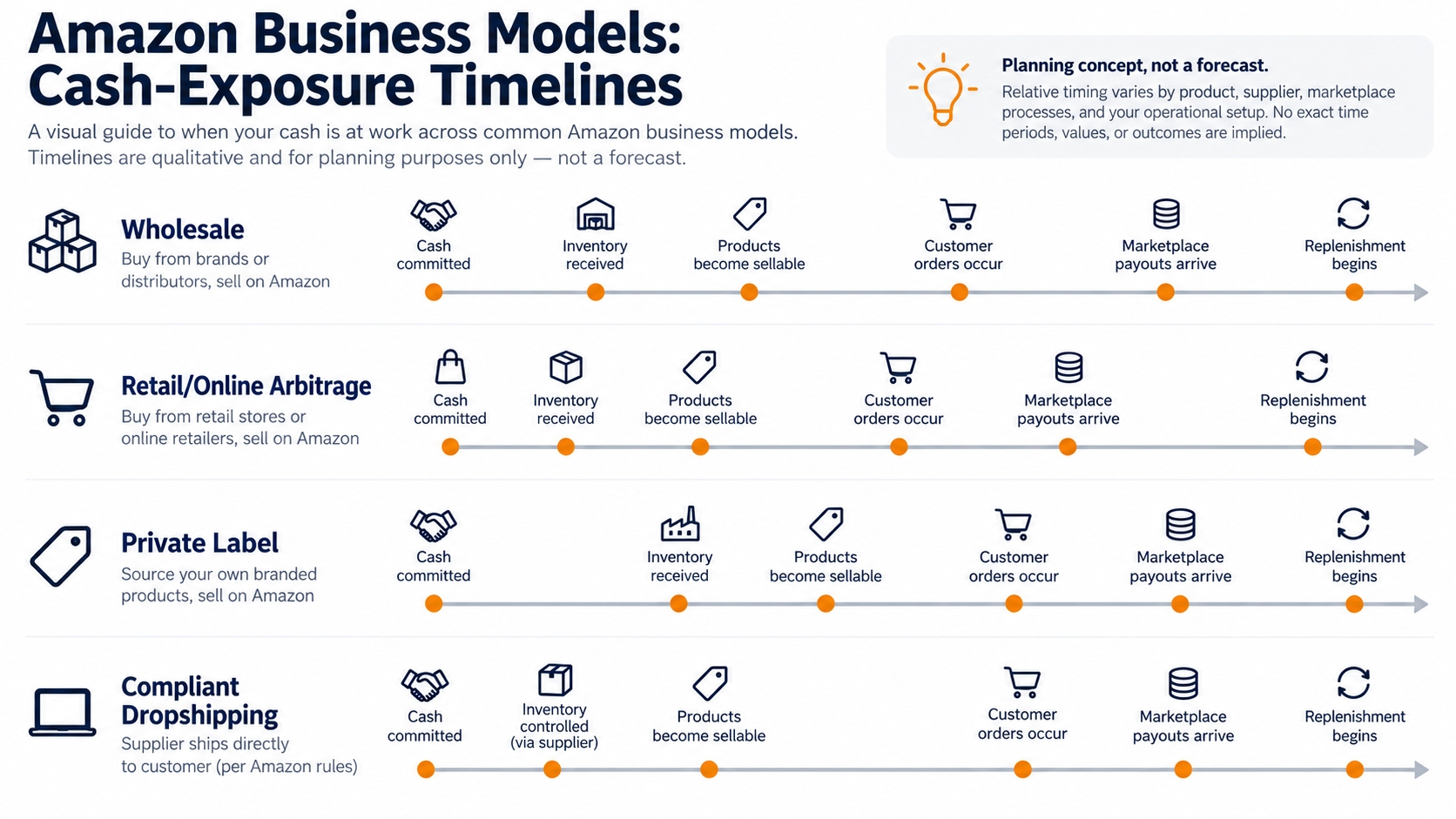
Compare contribution margin and cash exposure, not revenue
Each model can generate sales and still fail for a different financial reason. Arbitrage can hide sourcing labor and unsellable units. Wholesale can improve unit cost while increasing the cash locked in opening orders and reorders. Private label can concentrate capital in development, testing, production, freight, launch, and long lead times. Dropshipping can reduce inventory ownership but expose the business to higher per-order supplier costs, shipping, cancellations, refunds, and exception handling.
Contribution per unit or order = Selling price minus sourcing or product cost, Amazon selling fees, fulfillment, inbound or outbound shipping, storage, prep, advertising, promotions, returns allowance, support, error costs, and other variable expenses.
| Model | Early cash exposure | Cost commonly missed | Downside scenario to test |
|---|---|---|---|
| Wholesale | Opening order, case packs, freight, prep, inbound placement, and cash reserved for replenishment | Price competition, supplier minimums, aged stock, discontinued products, and delayed reorder recovery | Lower selling price, slower sell-through, larger reorder minimum, and supplier price increase |
| Retail/online arbitrage | Smaller product batches, travel or sourcing time, receiving, inspection, prep, and return windows | Canceled orders, damaged units, unsellable packaging, retail stickers, sourcing labor, and non-replenishable wins | Price drops before receipt, reduced sellable quantity, return friction, and no repeat supply |
| Private label | Research, sampling, testing, tooling, packaging, trademark, production deposit, balance, freight, inventory, and launch | Quality failures, certification updates, creative work, returns, warranty, inventory revisions, and long lead-time financing | Lower conversion, higher ads and returns, delayed production, required redesign, and slower reorder cycle |
| Compliant dropshipping | Supplier setup, integration, test orders, product work, advertising, support, and operating reserves rather than bulk stock | Per-order shipping, remote surcharges, cancellations, wrong items, reshipments, refunds, monitoring, and emergency handling | Supplier price increase, stock inaccuracy, late delivery, high support load, and unrecoverable customer remedies |
How to compare the four models with SellerSprite
Marketplace research should answer the same demand and competition questions across all four models, then be combined with model-specific evidence. SellerSprite can help identify categories, products, queries, competitors, price bands, review barriers, and estimated market activity. It cannot prove selling eligibility, supplier legitimacy, invoice sufficiency, product compliance, seller-of-record status, or future profitability.
Add the model-specific question
- Wholesale: Does the opportunity remain attractive when the opening discount, minimum order, shared-listing competition, and reorder cycle are included?
- Retail/online arbitrage: Is the margin still valid after receiving, inspecting, and discarding or returning unsellable units, and can the purchase be documented?
- Private label: Does the market gap justify product development, compliance, quality assurance, inventory, and launch cost?
- Compliant dropshipping: Can the supplier deliver the exact product, parcel identity, service level, and return process required by the offer?
Marketplace estimates help prioritize research. They do not establish authenticity, selling permission, supplier reliability, documentation sufficiency, customer demand for your exact offer, revenue, or profit.
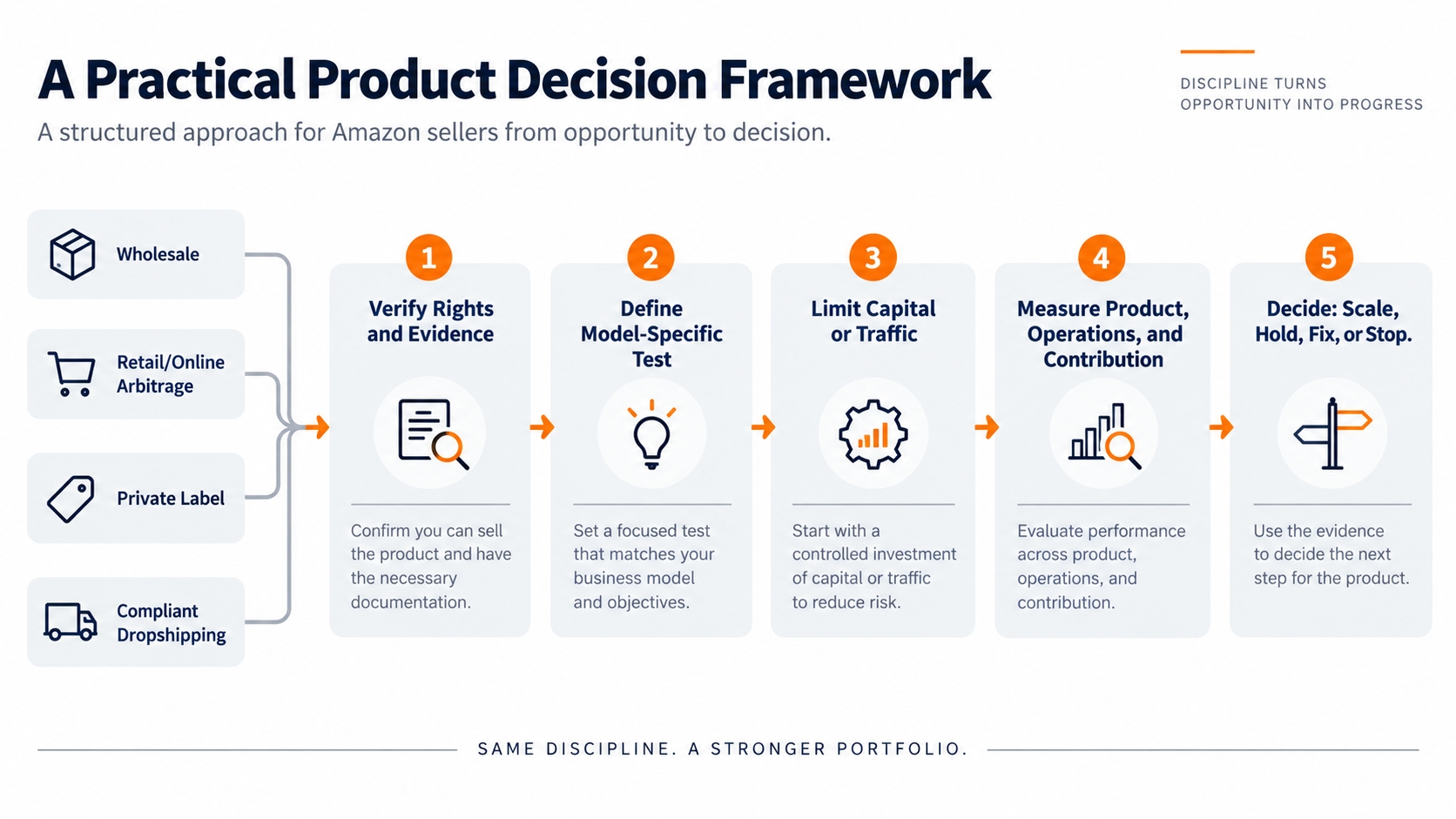
Run a controlled test before scaling
A controlled test is not the same for every model. The test should expose the model's primary uncertainty with limited downside and a written review date. Decide in advance what would justify scaling, holding, fixing, or stopping.
| Model | Controlled test | Evidence to review | Scale or stop question |
|---|---|---|---|
| Wholesale | Use the smallest commercially sensible opening order across a limited SKU set rather than maximizing the initial discount | Invoice quality, product accuracy, prep, listing competition, conversion, contribution, sell-through, and reorder availability | Does the SKU justify the cash and minimum required for repeat supply? |
| Retail/online arbitrage | Buy a small batch, receive and inspect every unit, record sourcing time, and list only confirmed sellable inventory | Final sellable quantity, source record, prep, price movement, contribution, return risk, and repeat availability | Was the realized profit worth the sourcing and documentation effort without assuming replenishment? |
| Private label | Use approved samples, a limited production or pilot batch where feasible, inspection, and a controlled launch with prewritten thresholds | Quality, compliance, listing accuracy, customer questions, conversion, returns, contribution, and product-change needs | Does the product earn the next production commitment without hiding unresolved defects? |
| Compliant dropshipping | Complete authorized test orders and returns, then launch with limited exposure and immediate pause authority | Seller identity, exact product, packaging, tracking, delivery, service, returns, supplier cost, exceptions, and contribution | Can the supplier reproduce the compliant customer experience reliably across real orders? |
Where FBA, FBM, and supplier-direct fulfillment fit
Business model and fulfillment method are separate. Wholesale, arbitrage, and private-label inventory can use FBA, FBM, or a hybrid by SKU. Compliant dropshipping normally involves merchant-fulfilled orders in which a supplier performs physical fulfillment on the seller's behalf. That supplier-direct arrangement still requires the seller to meet applicable Amazon policy and customer obligations.
Choose fulfillment using product dimensions, weight, velocity, storage time, handling complexity, packaging control, delivery promise, returns, internal capacity, and full operating cost. Do not assume the sourcing model automatically determines the right fulfillment route.
Use the separate guide to compare FBA and FBM by SKU after the product and source have passed the evidence and economics gates.
Amazon reseller action checklist
Validate the model before you scale the inventory
Compare market opportunity with sourcing evidence, model-specific operating risk, complete unit economics, and a controlled test before increasing purchase quantity or traffic.
Frequently asked questions
Is it legal to resell products on Amazon?
Reselling can be legitimate, but the seller must follow applicable product, category, condition, intellectual-property, safety, documentation, tax, and marketplace requirements. Availability from a supplier or retailer does not by itself establish permission to sell. Obtain qualified advice for legal questions.
Do I need invoices to resell on Amazon?
Amazon may request invoices or other supporting records for approvals, authenticity review, or account investigation. Keep original and legible transaction records that identify the supplier, buyer, products, quantities, and dates. Follow the exact current request in Seller Central rather than assuming one document type is always sufficient.
Is wholesale better than retail or online arbitrage?
Wholesale is often more repeatable and may provide stronger commercial records, but it normally requires larger commitments and creates more working-capital exposure. Arbitrage can support smaller tests but usually provides less predictable supply and document quality. The better model is the one that meets your evidence, margin, replenishment, and capital constraints.
Is private label the same as reselling?
Not exactly. Traditional reselling offers products produced and branded by another business. Private label uses a manufacturer to produce a product for the seller's own brand or specification. It is included because sellers often choose between exploiting an existing resale opportunity and investing in a product they control.
Is online arbitrage the same as compliant dropshipping?
No. In a conventional online-arbitrage workflow, the seller purchases inventory, receives or controls it, inspects it, and then resells it. In dropshipping, a supplier ships the Amazon customer order directly on the seller's behalf, which creates separate seller-of-record, packaging, tracking, service, and return controls.
Which model is best for a beginner?
There is no universal beginner model. Arbitrage may allow smaller purchases but still requires product eligibility, inspection, records, and margin discipline. Wholesale can be more repeatable but needs supplier qualification and capital. Private label adds product-development responsibility. Dropshipping reduces routine handling but demands strong supplier and policy controls. Choose the smallest test your business can execute correctly.
References
- Amazon: Guide to reselling in Amazon stores
- Amazon: How to sell wholesale on Amazon
- Amazon: Private label products
- Amazon: How to dropship on Amazon
- Amazon: FBA vs FBM
- Amazon: Brand Registry
Scope and limitations: Unless a source states otherwise, Amazon policy, program, and workflow references in this article relate to US public pages reviewed on September 7, 2026. Marketplace, account, product, brand, category, source, documentation, fulfillment, tax, and legal requirements can differ. SellerSprite and other third-party marketplace data are estimates and research inputs, not proof of selling permission, authenticity, supplier reliability, demand, revenue, or profitability. This article is educational and is not legal, tax, accounting, trademark, intellectual-property, product-safety, or financial advice.