Building Your Brand And Business Infrastructure

2025-12-09

Building Your Brand And Business Infrastructure

By this point in the course, you have already used SellerSprite to identify promising products and understand your market. Now it is time to give that business a clear identity and a solid backbone: a name, a logo, the proper legal structure, the right tax basics, and a plan for staying safe as you grow and travel.
This chapter is practical and slightly technical, yet an exciting milestone. You are no longer just "trying Amazon." You are building a brand.
Nothing in this chapter is legal, tax, or financial advice. Just so you know, laws and regulations change, and your situation is unique. You can always discuss your plans with qualified professionals in your country before you take action. Treat this chapter as a structured overview that prepares you to have better conversations with those professionals and to make more confident decisions.

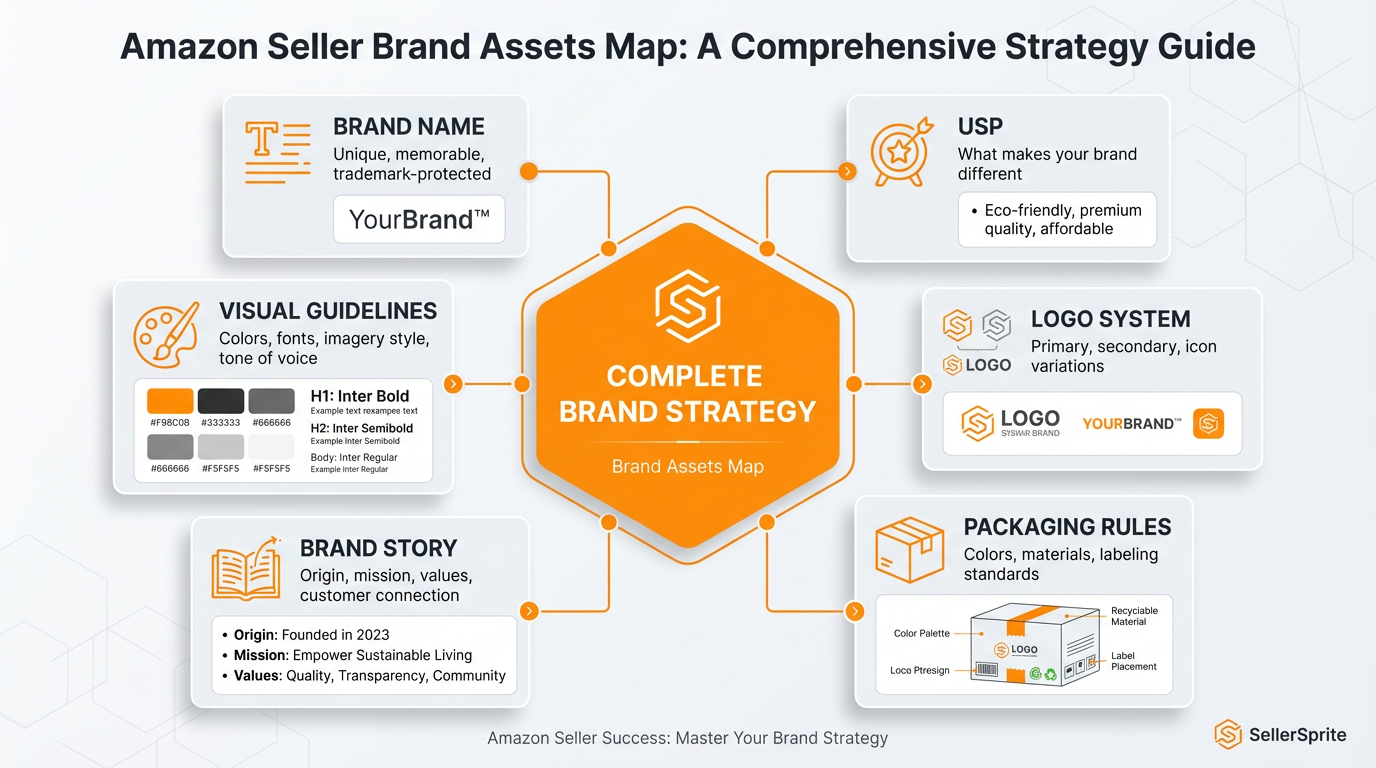
Choosing Your Business And Brand Name

Many new sellers put enormous pressure on themselves to come up with the "perfect" name and get stuck for weeks. In reality, the market cares far more about the quality of your product, your reviews, and your customer service than about whether your brand name sounds like it came from a global agency.
Your goal is not perfection. Your goal is a good, protectable, distinctive name that you can build on.
Brand Name & Logo - Idea, Name (YourBrandName), Logo, Identity infographic on a blue gradient background, with a lightbulb, text editor, paintbrush, and shield.

Business Name, Brand Name, And DBA

It helps to start by understanding three different "names" that often get mixed up.
Your business name is the legal name of your company. It is what appears on government documents and on your business bank account. For example:
  • "Smith Holdings LLC"
  • "Greenline Ventures LLC"
Your brand name is the name customers see on Amazon, on your packaging, and eventually on your website and social media. For example:
  • "Pettico" for a pet products brand
  • "GlowNest" for a home decor brand
In many cases, you have only one legal entity but several brands. A holding company like "Smith Holdings LLC" might operate brands like "Pettico," "GlowNest," and "IronPeak."
When your brand name is different from your legal company name, you often register a DBA, which is "Doing Business As." This is a way to say:
The legal entity "Smith Holdings LLC" is doing business as "Pettico".
You can also choose to make your business name and brand name the same. For example, forming "Pettico LLC" and using "Pettico" everywhere. This keeps things simple and is very common among Amazon sellers.
If you are eager to get started and still unsure about your brand name, one practical approach is:
  • Register a clean, flexible business name such as "YourLastName Holdings LLC"or "YourLastName Brands LLC".
  • Start your Amazon account under that business.
  • Finalize and register your brand name slightly later, adding it as a DBA if necessary.
The key thing to remember is that your brand name and your company name do not have to be identical, and you have options.

Why A Fictitious Name Usually Works Best

For Amazon private label brands, a made-up or fictitious name is usually your best friend.
Think of many modern brand names you know: when they first appeared, they sounded strange, even meaningless. Over time, the brand gave the word meaning, not the other way around. The same can be true for your brand.
Invented names are powerful because:
  • They are more likely to be available for trademark registration.
  • They are less likely to be confused with existing brands.
  • They can grow with you if you expand into new product categories.
Contrast that with generic names like "Best Pet Products"or "Premium Dog Gear." Those are difficult to protect legally, easy to confuse, and not very distinctive.
When you create a fictitious name, you often combine fragments of words related to your niche. In a pet niche, you might play with parts of words like "pet," "paw," "tail," "fur," "nest," "buddy," or "pal" and twist them into something unique.
SellerSprite can help at this stage. By looking at the keywords customers actually use in your niche, you gather a pool of genuine, meaningful word fragments to remix into something new.

A Practical Naming Workflow

A structured process will save you a lot of frustration. Here is a simple workflow you can adapt.

Step 1: Extract root words from your niche

Start with what you know about your market. Use SellerSprite's keyword and product intelligence to identify the main concepts and search terms in your niche. For a pet brand, you might see patterns like:
  • Pet, dog, cat, paw, tail, fur, leash, crate, bowl, home, cozy
Write these words down. You are not going to use them directly as your brand, but you will use them as raw material.

Step 2: Remix and invent

Now start combining, shortening, and twisting those root words. There are no rules at this stage. You might invent names like:
  • Pettico, Pawvory, Furiva, Tailyo, CosyNest, Whisqo
Say them out loud. Type them quickly. Many will be bad. That is fine. Your goal is to generate a long list of candidates, not to find perfection in the first three drafts.

Step 3: Check pronunciation and memorability

For each candidate, ask yourself:
  • Can someone pronounce this the first time they see it?
  • If they hear it once in conversation, could they type it into Amazon without getting lost?
  • Does it sound too similar to a common word that might confuse?
You want something easy to say, easy to spell, and easy to remember. A customer should be able to hear your brand name from a friend and find your product on Amazon without thinking too hard about spelling.
If a name could reasonably be spelled in three or four different ways, it will cost you sales and frustrate customers.

Step 4: Check for conflicts and confusion

Once you have a shortlist of names that feel good, you need to do basic due diligence. Trademark law can be complex, and this is where you should eventually talk to a trademark attorney. But even before that conversation, do some simple checks.
Search for your brand candidate in:
  • Amazon itself
  • General search engines
Look for signs that:
  • There is already a brand in your product category using a very similar name.
  • Some names sound almost identical, even if the spelling is different.
Trademark law in many countries focuses on consumer confusion. If two names in the same product type sound nearly the same, that is risky, even if the spelling is slightly different.
For example, if there is already a honey brand called "Petak," launching another called "Petac" would likely be a problem. Even if you changed the spelling further, if the pronunciation is basically the same and the products are similar, confusion is likely.
If, however, a food brand uses a specific name and you are selling something very far from that category, the situation may be different. That is precisely the kind of nuance a legal professional should review for you.

Step 5: Look at domain availability

You do not have to build a complete website before you launch on Amazon. But owning a clean domain that matches your brand, or at least closely resembles it, is extremely useful for the future.
Search for an appropriate domain that is available at a reasonable price. If all normal-priced domains are taken and only expensive, speculative domains remain, that is a signal to consider another name.

Step 6: Decide and move forward

Eventually, you must stop searching and start building.
Once you have:
  • A fictitious name that feels right for your niche,
  • Reasonable confidence that it does not conflict with obvious existing brands,
  • A domain that is either available or acceptable in a close variation,
commit to the name, discuss it with a professional for trademark registration, and move forward. Do not let the pursuit of the perfect name delay your first sale by months.
Your brand will become strong because of your product quality, your reviews, your customer service, and your consistency, not just because of the word printed on the box.

Maximize your Amazon workflow

Discover SellerSprite to research products keywords and competitors. Explore features and success stories on our homepage.

Visit Homepage

Building Your Legal And Financial Foundation

A brand name is the personality of your business. Your legal and financial structure is its skeleton. Both matter if you want a business that can last, scale, and eventually be sold.
The focus in this section is primarily on selling in the United States, but the principles apply broadly.

Check Whether Your Country Is Approved

Before you open a Seller Central account for the US marketplace, make sure Amazon allows sellers from your country.
Amazon maintains an official list of countries approved to sell on its marketplaces. If your country appears on that list for the US, you can proceed. If it does not, do not panic and we will discuss options in next section.
Always check Amazon's current documentation, because the list of approved countries expands over time.

Understanding The LLC For US Based Sellers

If you live in the US, one of the most common structures for an Amazon seller is an LLC (Limited Liability Company).
In simple terms, an LLC:
  • Creates a legal separation between your business assets and your personal assets.
  • Makes it less likely that a business problem will directly threaten your personal savings, your house, or your car.
Forming an LLC is usually straightforward. Most US states allow you to submit everything online in a short process. Some sellers choose to form their LLC in their home state, while others research alternative states where company law or tax rules may be more favorable. Each option has tradeoffs and must be evaluated with a professional.
The key idea is that by operating as an LLC, you are treating your Amazon business as a real, separate entity, not just a side project.

Do You Need An LLC To Start Selling?

Legally, in many situations, you do not need a formal business entity to open an Amazon seller account in the United States.
Many sellers begin as individuals, using:
  • Their personal Social Security Number, and
  • A personal bank account.
This approach can be attractive if:
  • You want to test whether Amazon is right for you,
  • You do not yet want the responsibility of company paperwork.
Later, if your business begins to grow, you can form an LLC and reorganize your seller account and bank accounts accordingly.
Other sellers prefer to start with an LLC from day one. Their reasoning is:
  • They are committed to building a serious, long-term business,
  • They want to separate business and personal finances immediately,
  • They want the liability protection and professional appearance from the start.
Both approaches appear in the real world. There is no universal rule; your decision should be made with a legal or tax advisor who understands your goals.

Business Bank Accounts And Clean Bookkeeping

Once you have a legal entity, one of the best habits you can build is to keep business and personal money completely separate.
Typically, this means:
  • Opening a business checking account in the name of your company.
  • Getting a business credit card linked to that account.
  • Ensuring that all Amazon related expenses and revenues go through the business accounts.
There are several benefits to this discipline:
  • Your bookkeeping becomes much simpler.
  • Tax time becomes less stressful and less expensive.
  • You see clearly how your business is performing, without personal spending mixed in.
  • If you ever sell the business, buyers can review clean financial statements.
You can still pay yourself from your company. The difference is that money flows first into the business, then from the business to you, instead of everything flowing through personal accounts without separation.

EIN Basics For US Sellers

In addition to your LLC and bank account, you will usually need an EIN (Employer Identification Number).
An EIN is like a Social Security Number for your business. The tax authority issues it and identifies your business in official tax and financial systems.
For US residents, obtaining an EIN is generally a straightforward process done through official government channels once your entity is formed. You typically use it to:
  • Open your business bank account.
  • Register your Amazon account as a business.
  • File the required tax returns for your company.
Details such as forms, phone numbers, and working hours can change, so always rely on the latest instructions from the official website rather than on old screenshots or hearsay.

International Sellers: Local Entities And Cross Border Banking

If you live outside the United States but plan to sell mainly on Amazon US, the principles are similar but the details differ.
You will need to understand:
  • What type of business entity in your country plays a similar role to a US LLC?
  • How is that entity registered and taxed in your home system?
  • How to receive dollars from Amazon and convert them into your local currency?
Many international sellers:
  • Form a basic business structure in their own country.
  • Open a local business bank account.
  • Use cross border payment services that connect their Amazon payouts to their local account.
Again, because each country has its own rules, this is an area where professional guidance is essential. Your goal is to find the simplest structure that protects you reasonably and allows you to receive your Amazon income smoothly.

When Your Country Is Not Approved To Sell

Sometimes you check Amazon’s approved country list and discover that your home country simply is not there for the marketplace you want. It is a discouraging feeling, but it is not always the end of the story.
One option that some sellers have used successfully is e‑residency.
E‑residency is a program offered by a small number of countries that allows non‑residents to establish a kind of online residence and form a company there without physically living in the country. Estonia is a well known example.
The general pattern is:
  • You apply for e‑residency through the official government website.
  • After approval, you can form a company under that jurisdiction.
  • You use that company to open accounts and operate your Amazon business, provided Amazon accepts entities from that country.
It is important to understand that this path crosses multiple legal systems:
  • The laws of your home country,
  • The laws of the e‑residency country,
  • The rules and policies of Amazon.
For that reason, treat this as a strategy to investigate with legal and tax professionals rather than as a simple hack. At the same time, remember that Amazon regularly expands its list of approved countries, so check back periodically. What is not possible today may become straightforward tomorrow.

Creating A Beautiful, Affordable Logo

Your logo is one of the most visible parts of your brand. It will appear on your product packaging, on your Amazon listing images, in your brand story, on your website, and in any social media presence you build.
A strong logo does not have to be complicated or expensive. But it should be intentional.

Why Your Logo Matters On Amazon

On Amazon, customers often scroll quickly. The small logo in your main image, the consistent branding in your lifestyle photos, and the mark on your packaging all send subtle messages:
  • "This is a real brand."
  • "This product is professionally made."
  • "If something goes wrong, these people will be here."
A well-designed logo, paired with clean packaging and reliable products, increases the perceived value of everything you sell. It also increases your brand's resale value if you decide to sell the business as a whole one day.
Because your logo will ripple through so many assets, it is smart to create it early, before you finalize packaging or order physical branding like embossing, labels, or printing on the product itself.

Gathering Inspiration And Defining Your Style

Before you hire anyone or try to create a logo yourself, you need to know what you like.
A simple way to start is to search for "logo inspiration" in an image search engine and scroll through collections of logos. Pay attention to:
  • Whether you are drawn to minimalist, clean designs or more playful, detailed ones.
  • Whether you prefer purely text-based logos or icons, mascots, and badges.
  • How different logos use animals, shapes, or letters to convey personality.
When an image or a set of logos speaks to you, save it. Aim to collect five to ten examples that feel like they could belong to your brand universe.
As you look at your saved examples together, patterns will appear. Perhaps you realize you love simple wordmarks with slightly rounded fonts and a small icon above the name. Maybe you notice you like circular badges with bold, confident lines. These patterns become your brief for a designer.
You do not need to know design terminology. You need to be able to say "I like logos that look like these" and show a few concrete examples.

Working With Designers Without Overspending

You have several options for actually creating your logo, even if you are not a designer yourself.
One approach is to hire a freelance designer through an online marketplace. There are many such platforms globally. The practical steps are similar on most of them:
  • Browse designers and look carefully at their portfolios.
  • Shortlist those whose previous work looks similar in style and quality to the logos you saved.
  • Contact them with a clear message that explains:
    • What your brand will sell.
    • What kind of style you like, attached with your inspiration images.
    • Your approximate budget.
    • Any special ideas, such as wanting an animal incorporated or preferring a purely text based logo.
You are not trying to micromanage the design. You are giving the designer constraints and ingredients, then relying on their skill.
Another option is to purchase a pre‑made logo from a marketplace where designers upload ready-to-customize concepts. In that case, you browse by industry or style, purchase one that fits your brand, and then work with the designer to change the brand name and adjust details.
Whichever route you choose, pay attention to three things:
  • Revisions How many rounds of changes are included? 
    A typical arrangement might be one initial concept with two or three rounds of revisions.
  • Deliverables Make sure you will receive the logo in multiple formats, including vector files,which is
    commonly used by printers and packaging manufacturers and high resolution images for web.
  • Rights Confirm that you will own full rights to use the logo as the core of your brand.
In terms of budget, many successful Amazon brands spend somewhere between 75 and 200 US dollars on their first serious logo. Some pay less, especially if they work with students or newer designers, while others pay much more. The key is not the dollar amount but the clarity of the brief and the fit between the designer's style and your brand.

Treating The Logo As An Asset

Your logo is part of the long‑term value of your business. This is especially true if you plan to sell your brand one day.
A buyer is not just purchasing inventory and listings. They are purchasing:
  • A name with growing recognition and positive reviews.
  • A visual identity that customers recognize.
  • A package of intellectual property, including trademarks and a logo.
Doing this work thoughtfully now makes your future stronger. You are not "wasting money on design"; you are investing in an asset.

Sales Tax And VAT Basics For Marketplace Sellers

Taxes are one of the most intimidating parts of e‑commerce for many new sellers. The good news is that in recent years, selling on Amazon has become significantly simpler from a sales tax perspective in many countries.
Again, this section is a high-level overview. Tax is a complex and sensitive area, so you must ultimately follow the guidance of professionals and the official regulations in each jurisdiction where you operate.

Marketplace Facilitator Rules

In the United States and in several other large markets, Amazon is classified as a Marketplace Facilitator.
Under these rules, Amazon itself is responsible for:
  • Calculating the correct sales tax on customer orders in certain regions.
  • Collecting that tax from the buyer at checkout.
  • Remitting the tax to the appropriate tax authority.
In practice, this means that for many transactions in the United States and in other major marketplaces such as Canada, the United Kingdom, Germany, France, Italy, Spain, and Japan, Amazon handles the mechanics of sales tax collection and payment.
This does not remove every possible tax obligation from you as a seller, but it significantly reduces the operational burden of dealing with sales tax on individual orders.

VAT Nuances And Ongoing Obligations

If you sell into the European Union, the picture is slightly different and includes Value Added Tax (VAT).
In some instances, especially for non‑EU entities, Amazon may collect and remit VAT on your behalf for orders shipped to EU customers. However, you may still be required to:
  • Register for VAT in one or more EU countries.
  • File VAT returns at regular intervals.
  • Maintain proper invoices and records to support those filings.
In other words, Amazon may handle money flows for VAT on each transaction, but you are still responsible for staying compliant overall.
Tax rules change, and they vary widely by country and by your specific situation, such as where you store inventory and where your business is legally established. For that reason, the safest approach is:
  • Learn the basics so that you can ask informed questions.
  • Work with a tax advisor who specializes in e‑commerce in the regions where you sell.
  • Revisit your setup when you add new marketplaces or when your sales volume grows significantly.

EIN Considerations For International Sellers Shipping To The US

If you are an international seller shipping inventory into the United States, you will eventually hear about the EIN – Employer Identification Number – even if you do not live in the US.
An EIN is often useful, and sometimes necessary, for customs and logistics purposes.

When An International Seller Needs An EIN

A simplified way to think about it is:
  • If you ship goods into the US by air and the total value of a shipment is relatively low, under a certain threshold, you may not need an EIN purely for customs on that shipment.
  • If your shipment value exceeds that threshold, or if you are shipping by sea freight or air cargo, carriers and customs brokers will often ask for an EIN.
Details such as the exact dollar threshold can change, and there may be additional reasons to obtain an EIN for tax or banking reasons. This is another area where your freight forwarder and your tax advisor can give specific, current guidance.

Steps To Obtain An EIN As A Non‑US Seller

The core steps for an international seller generally include:
  • Obtaining a US mailing address 
    This is often required on the EIN application. 
    Some sellers use a trusted contact in the US; others use professional address services. 
    The important thing is that whatever solution you use is legitimate and acceptable under the rules.
  • Completing the official EIN application form 
    The relevant form is typically an application form provided by the US tax authority. 
    You can download it from the official website, fill it in with your business details, and keep it handy for reference.
  • Contacting the tax authority directly 
    International applicants often complete the process by calling a dedicated phone line for EIN applications, 
    where an agent reviews the information from your form and asks you questions. 
    If everything is in order, they issue the EIN to you during the call.
Since phone numbers, opening hours, and procedures can change, always take these details from the current official website, not from old forum posts. When you receive your EIN, write it down, store the official confirmation document carefully, and keep a backup.
You may never have to quote your EIN in conversation, but you will almost certainly need it in paperwork.

Protecting Your Amazon Account While Traveling

One of the most significant lifestyle advantages of an Amazon business is that you can run it from almost anywhere with a laptop and an internet connection. Many sellers travel extensively while managing their products, campaigns, and customer messages.
However, you must remember that Amazon takes account security very seriously, and sudden changes in how and where you log in can look suspicious.

How Travel Can Trigger Security Checks

Think about how your bank reacts when your credit card is used in unexpected locations. If one transaction occurs in your hometown and the next several hours later in a different state or country, it may trigger a security alert. The bank may temporarily block the card to protect you.
Amazon behaves similarly with Seller Central:
  • If you normally log in from your home country and suddenly access your account from a different continent,
  • Or if you move from a secure home network to a random public Wi‑Fi network at a café,
the system may interpret that as a possible hacking attempt. In some cases, Amazon may temporarily lock the account or ask for additional verification.
These systems exist to protect you and your customers, but you do not want them triggering at the wrong moment while you are in the middle of managing your inventory or responding to customers.

Using Secure Networks And VPNs

To reduce the risk, treat your Seller Central login with the same seriousness as your online banking. Good habits include:
  • Avoid logging in from unsecured public Wi‑Fi networks if you can.
  • When you must use a public network, connect only through a secure, encrypted connection such as a reputable VPN service.
  • Use strong, unique passwords and enable additional authentication methods where available.
A VPN – a virtual private network – effectively gives you a secure tunnel through the internet. Instead of exposing your connection directly on a coffee shop network, your data is encrypted and routed through a server that you trust.
You pay a monthly subscription, install the provider’s app on your laptop, and connect to the VPN before you open Seller Central. From Amazon’s perspective, your logins become more consistent, and your data is less exposed to potential attackers.

Proactively Communicating With Amazon

If you plan to travel extensively or relocate, it can be helpful to let Amazon know in advance, especially if your business is large or if you are exceptionally cautious.
You can contact Seller Support and explain that you may be accessing your account from new locations in the coming months. This does not guarantee that no security checks will ever trigger, but it shows good faith and can sometimes reduce friction.
At the same time, remember that many sellers successfully log in from multiple countries and networks without any problems. Your goal is not to panic, but to adopt simple habits that dramatically improve your safety.

Bringing It All Together

In this chapter, you moved from product thinking to business thinking.
You learned how to:
  • Choose a fictitious, protectable brand name and understand how it relates to your legal business name and any DBA registrations.
  • Use SellerSprite’s market insights as raw material for creative naming, while still relying on legal professionals for trademark decisions.
  • Decide whether to start as an individual or form an LLC or equivalent entity, and how to separate your business finances from your personal ones.
  • Explore options such as e‑residency if your country is not yet approved to sell on Amazon.
  • Commission a professional logo that feels right for your brand without overspending, treating it as a long-term asset rather than a decoration.
  • Understand, at a high level, how Amazon’s role as a marketplace facilitator simplifies parts of sales tax and VAT, while still leaving you with significant responsibilities.
  • Obtain an EIN as an international seller when needed, and understand its role in customs and administration.
  • Protect your Seller Central account when you travel by using secure networks, VPNs, and proactive communication.
You are no longer just listing a product. You are building a brand with a name, visual identity, legal structure, and professional mindset.

Continue your learning journey

Visit the Course Directory to view every chapter of the SellerSprite Amazon Seller Beginner to Master Course and jump to the section you need.

Open Course Directory
User Comments
Avatar
  • Add photo
log-in
All Comments(0) / My Comments
Hottest / Latest

Content is loading. Please wait

Latest Article
Tags