TL;DR: Amazon fake reviews detection is about identifying suspicious review activity and determining whether the available evidence warrants further investigation. Sudden review bursts, repeated wording, unusual rating patterns, and product mismatches can raise questions, but none independently proves fraud. Sellers should preserve observable facts, check legitimate explanations such as promotions or variation changes, and report credible concerns through Amazon's official channels. Third-party review-analysis tools can help organise public information; they cannot establish reviewer identity, hidden relationships, or policy violations.
Key Takeaways
- Suspicious does not mean fake. Review patterns are signals for investigation, not proof that a buyer or competitor manipulated feedback.
- Check ordinary explanations first. Promotions, product defects, review-publication delays, and catalog changes can produce patterns that resemble coordinated activity.
- Amazon has access to evidence sellers do not. Its review-integrity systems use nonpublic signals, including account relationships and activity patterns.
- Reporting channels serve different purposes. An individual review that appears to violate content guidelines is not the same as suspected coordinated competitor abuse.
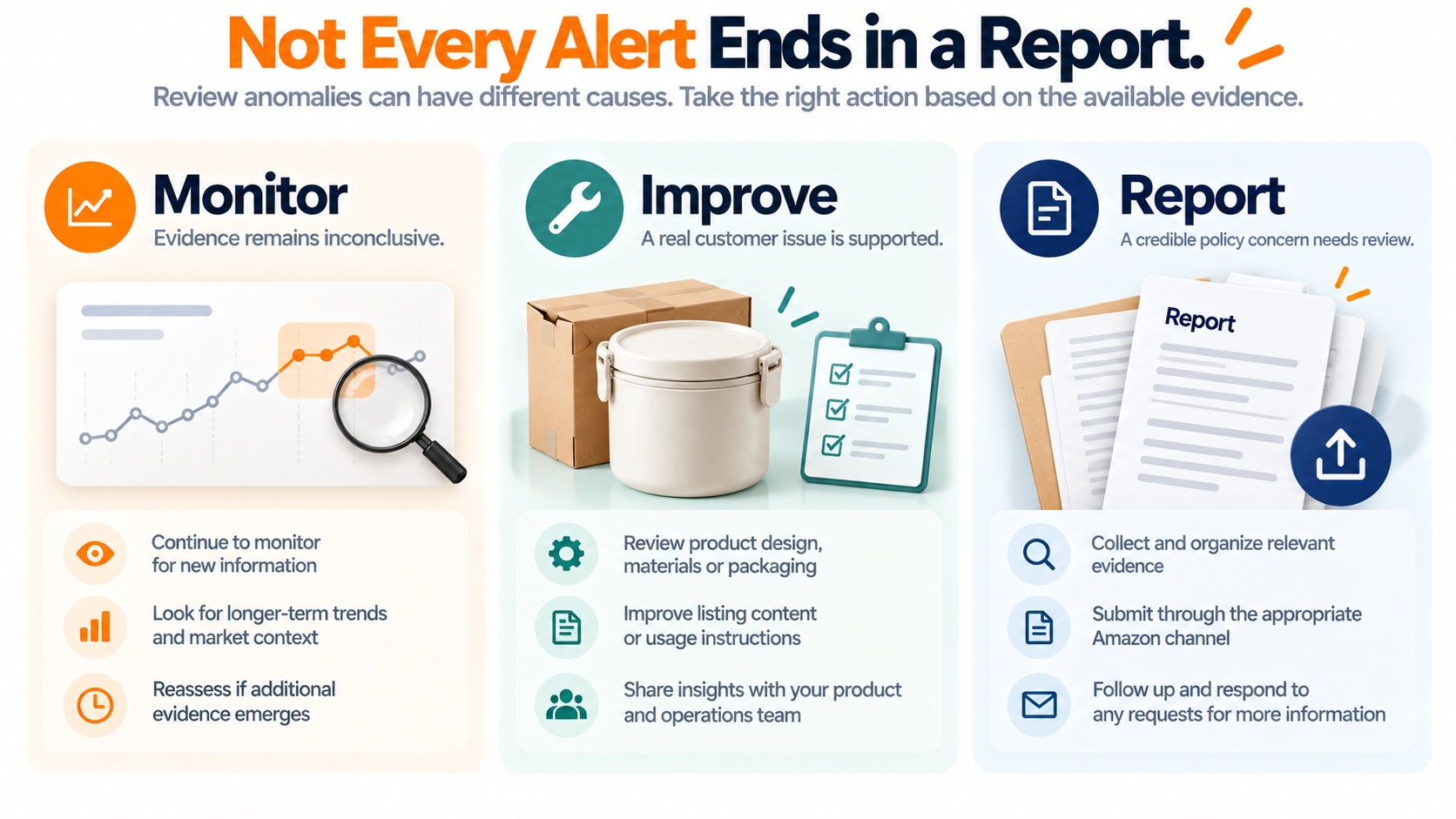
- Detection should lead to a defensible decision. Sometimes that means reporting a possible violation. Sometimes it means correcting a listing, examining a faulty batch, or continuing to monitor.
Table of Contents
- What Amazon Fake Reviews Detection Can Actually Establish
- Five Suspicious Patterns and Their Innocent Explanations
- What Amazon Can See That a Review Checker Cannot
- A Sudden Wave of One-Star Reviews: What Would You Check?
- Build an Evidence File Before Opening a Case
- Report the Right Problem Through the Right Channel
- Fake Reviews Are Also a Legal and Business-Partner Risk
- Where SellerSprite Review Analysis Helps, and Where It Stops
- Make Review Monitoring an Evidence-Based Routine
- The Most Useful Finding May Not Be Fraud
- FAQs
- References
Scope: This guide covers public review analysis and seller reporting procedures for Amazon.com in the United States. A review anomaly is not a legal finding or an Amazon enforcement decision. Amazon's account-specific tools and reporting options can vary. The discussion of US law is informational and does not constitute legal advice.
What Amazon Fake Reviews Detection Can Actually Establish
Imagine checking a competitor's listing on Monday and finding an unusually large number of new five-star reviews. The language is enthusiastic, several comments sound alike, and the average rating has increased.
You may have found something worth investigating. You have not yet established that anyone bought reviews.
That distinction defines responsible Amazon fake reviews detection. The seller's immediate task is to identify observable inconsistencies and determine what additional information would explain them. Amazon, not the seller or a third-party checker, makes the platform's review-moderation and enforcement decisions.
What Makes a Review Fake or Manipulated?
Review abuse can take several forms. Examples include a fabricated customer experience, a person pretending to have used a product, a seller arranging reviews of its own or a competitor's products, or a campaign that rewards customers for leaving reviews with a specified positive or negative sentiment.
Amazon's Customer Product Reviews policy also prohibits certain employee and family reviews, review clubs, review-related compensation, attempts to pressure buyers into changing reviews, and variation relationships created to manipulate ratings.
What Does Not Establish Fraud?
A negative opinion is not automatically malicious. Generic praise is not automatically purchased. A customer can write a short review without describing every feature they used. Likewise, an unusually enthusiastic review may reflect a genuinely good experience.
A review can also contain inaccurate information without being deliberately fabricated. Customers may misunderstand instructions, choose the wrong variation, or describe an earlier version of a product.
OBSERVATION
"Several reviews appeared within a short period and contained similar phrases."
UNSUPPORTED CONCLUSION
"The competitor paid customers to post fake reviews."
The first statement is a description of visible data. The second claims to know the cause, the parties involved, and their intent. Those facts require evidence that is rarely available from a public product page.
Five Suspicious Patterns and Their Innocent Explanations
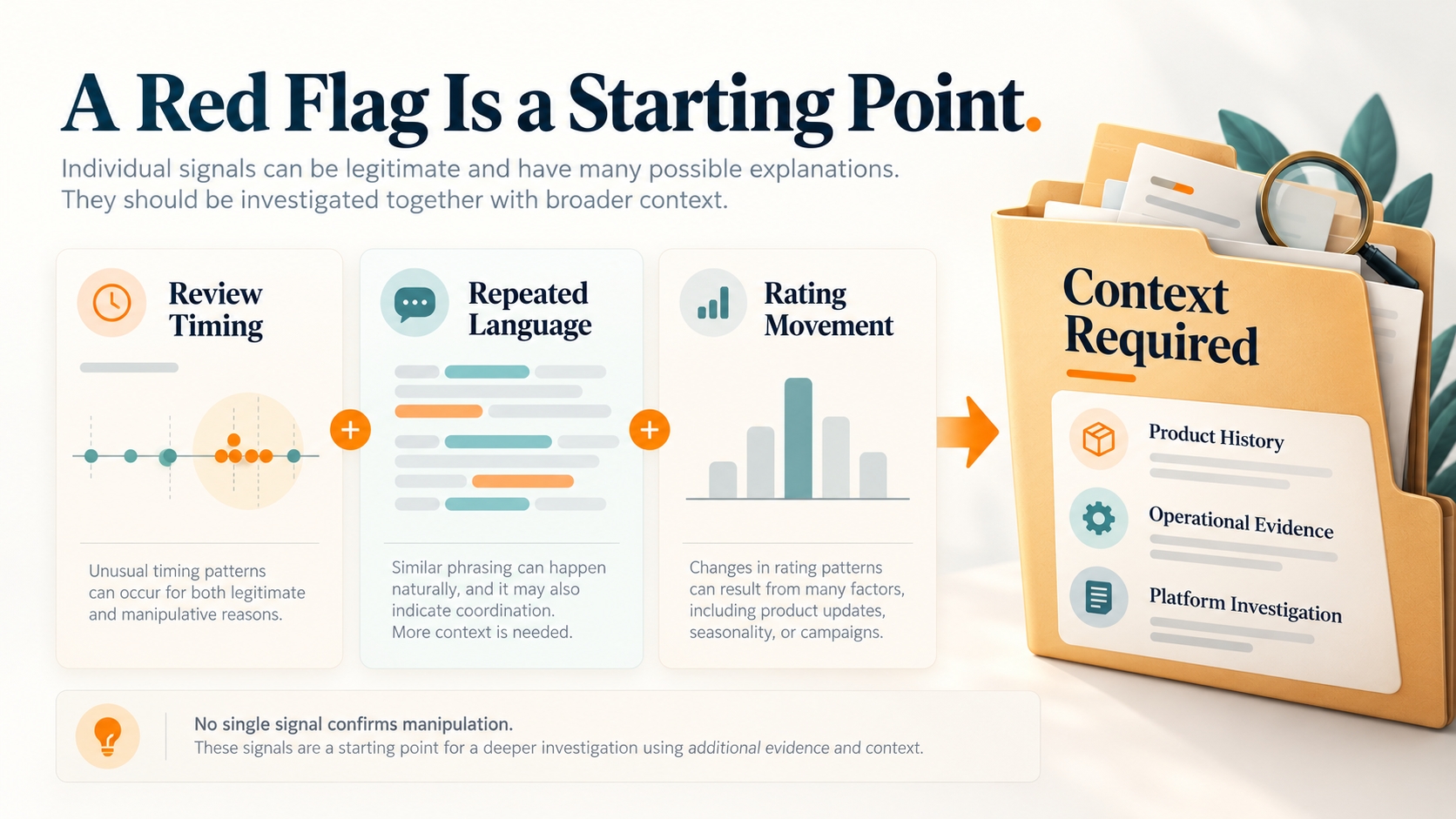
Review irregularities become more useful when you investigate them alongside the events affecting the product. A pattern that looks alarming in isolation may become understandable after checking promotions, inventory, product revisions, and the listing's variation structure.
The table below treats each signal as a question to investigate rather than a verdict.
| Visible signal | Possible ordinary explanation | What to check next |
|---|---|---|
| Sudden review burst | A launch, seasonal sales event, promotion, or delayed review publication. | Review dates, available sales context, promotional periods, and reasonable posting delays. |
| Repeated language | Customers describing the same prominent feature, problem, or product instructions. | Full review context, product-specific details, and whether the language is genuinely distinctive. |
| Spike in one-star reviews | A defective batch, packaging change, product revision, or new compatibility problem. | Returns, support contacts, batch records, and the affected variations. |
| Review describes another product | An older catalog relationship, variation change, or product-detail mismatch. | Model, size, packaging, parent-child structure, and listing history. |
| Review lacks Verified Purchase | A customer obtained the product through another legitimate route or did not meet the label criteria. | Review relevance and other visible evidence, without assuming a missing badge proves fraud. |
The Verified Purchase Badge Is Useful, but Limited
A Verified Purchase label indicates that Amazon has verified the purchase under its applicable criteria. It supplies useful purchasing context. It does not establish that every claim in the review is accurate, that a reviewer has no undisclosed relationship, or that the transaction could not be associated with manipulation.
The reverse is also true. A missing badge does not automatically mean the review is fraudulent. Public review data rarely provides the complete transaction history necessary to make that determination.
Why Review Count Changes Require Extra Care in 2026
Amazon changed review sharing across product variations beginning February 12, 2026, with a gradual rollout through May 31, 2026. Reviews are now shared more selectively between variations with minor differences that do not affect functionality.
That means a visible review-count or rating change can result from the way feedback is assigned to variations. Before interpreting a sudden decrease as Amazon removing fraudulent reviews, inspect the product's current parent-child structure and any recent variation changes.
The practical standard: A useful detection report should explain what changed, identify the observation period, and list plausible explanations. If the report contains only a percentage labelled "fake reviews," the seller still needs to know what the score actually measures.
What Amazon Can See That a Review Checker Cannot
A seller reviewing public comments sees only part of the evidence. Amazon operates the marketplace, processes transactions, and maintains systems designed to detect review abuse before suspicious content reaches shoppers.
Amazon states that its review-integrity systems use machine-learning models and specialist investigators to evaluate thousands of data points. Those signals can include account relationships, sign-in activity, review history, and other behavioural information that independent review tools do not possess.
In its 2026 Trustworthy Shopping Experience Report, Amazon said it proactively blocked hundreds of millions of suspected fake reviews in 2025. That figure describes Amazon's reported enforcement activity. It is not a measure of how many published reviews on any particular ASIN are fake.
PUBLICLY OBSERVABLE INFORMATION
- Published review dates and ratings.
- Review text and available images.
- Product and variation context.
- Publicly visible review and rating changes.
ADDITIONAL PLATFORM-LEVEL SIGNALS
- Nonpublic account relationships.
- Internal activity and sign-in patterns.
- Transaction and enforcement context.
- Other information available through Amazon's investigations.
This information gap is why a public-data tool cannot reliably establish who coordinated a review campaign, whether accounts are related, or what compensation, if any, was exchanged.
It also explains why sellers should avoid trying to identify reviewers through private information or external investigation methods. The appropriate role of a seller is to document an observable concern and submit relevant evidence through authorised channels, not to expose individuals or conduct an independent identity investigation.
A Sudden Wave of One-Star Reviews: What Would You Check?
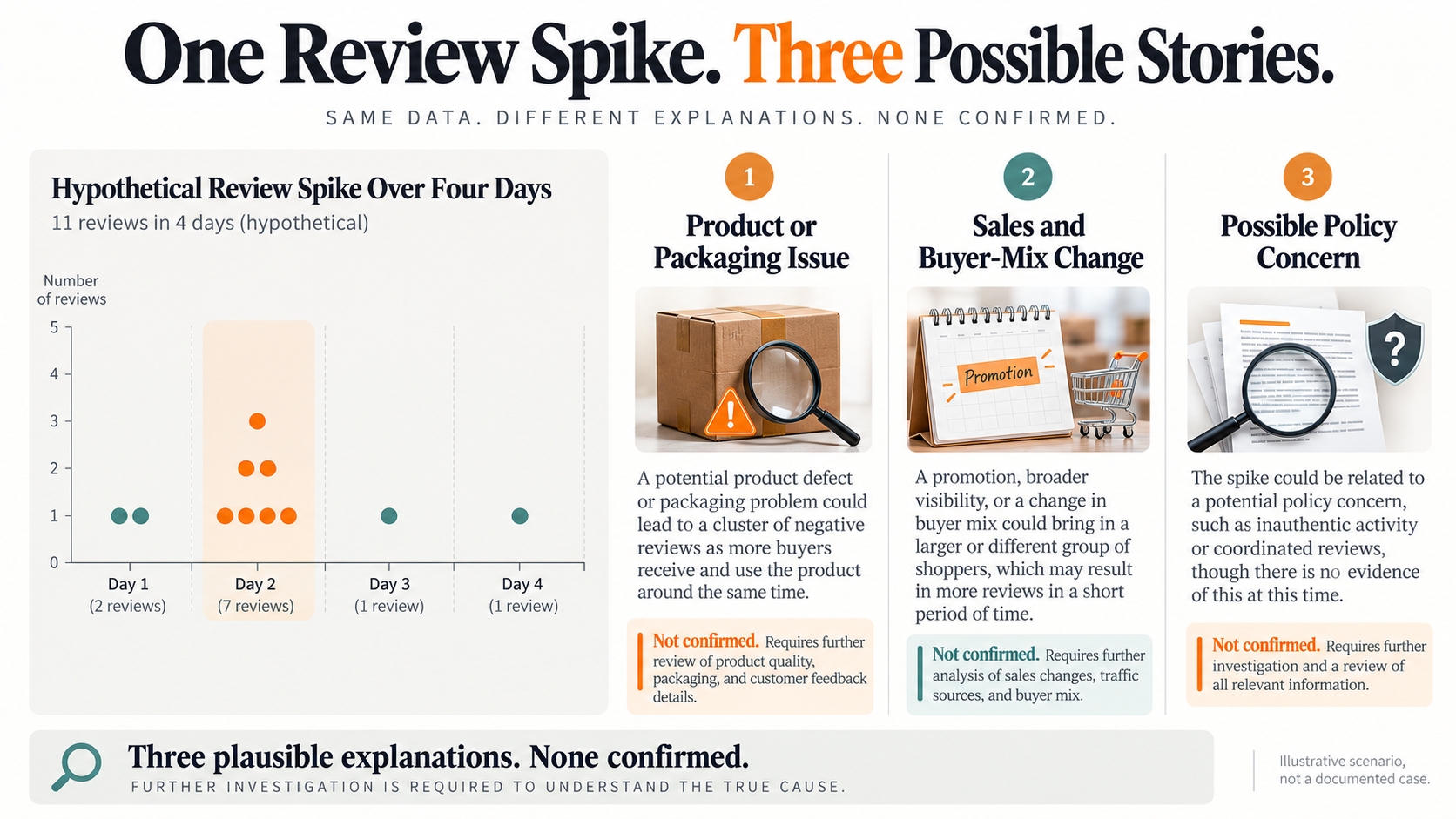
Consider a hypothetical brand selling insulated travel mugs on Amazon.com. The listing receives 11 one-star reviews over four days after a relatively quiet period. Several customers mention leaking lids and damaged packaging.
The customer experience team suspects a coordinated negative-review campaign. That concern may deserve attention, but the current evidence also supports several other explanations.
Explanation A: A Product or Packaging Failure
A supplier may have changed a component or packaging material. A defective batch could have reached customers around the same time, making the cluster of reviews a genuine reflection of recently purchased units.
The team should examine returns, packaging inspection records, supplier changes, and any available order-level quality information before attributing the reviews to manipulation.
Explanation B: A Change in Sales or Buyer Mix
The product may have been promoted recently, attracting more buyers or a different audience. Reviews do not necessarily appear on the same day as the underlying purchase, so an increase in published reviews may lag an earlier increase in orders.
A promotion is not proof that the reviews are genuine, but failing to account for it can make ordinary review activity look artificially concentrated.
Explanation C: Suspicious Activity That Needs Platform Review
If the reviews contain apparent policy violations, misleading product references, or a pattern that remains unexplained after checking available evidence, the seller may have grounds to report a concern.
The report should describe what was observed rather than assert that a competitor orchestrated the activity. Seller-side analysis alone cannot establish the identity or motivation of the reviewers.
What this example teaches: A concentrated wave of negative reviews can be a business-critical signal even when no manipulation occurred. Investigating only the possibility of fraud could leave an actual product or packaging defect unresolved.
The same principle applies to sudden positive-review growth. Before calling the activity artificial, examine legitimate demand events, product launches, and the review-publication period. A well-supported explanation is more useful than a dramatic interpretation.
Build an Evidence File Before Opening a Case
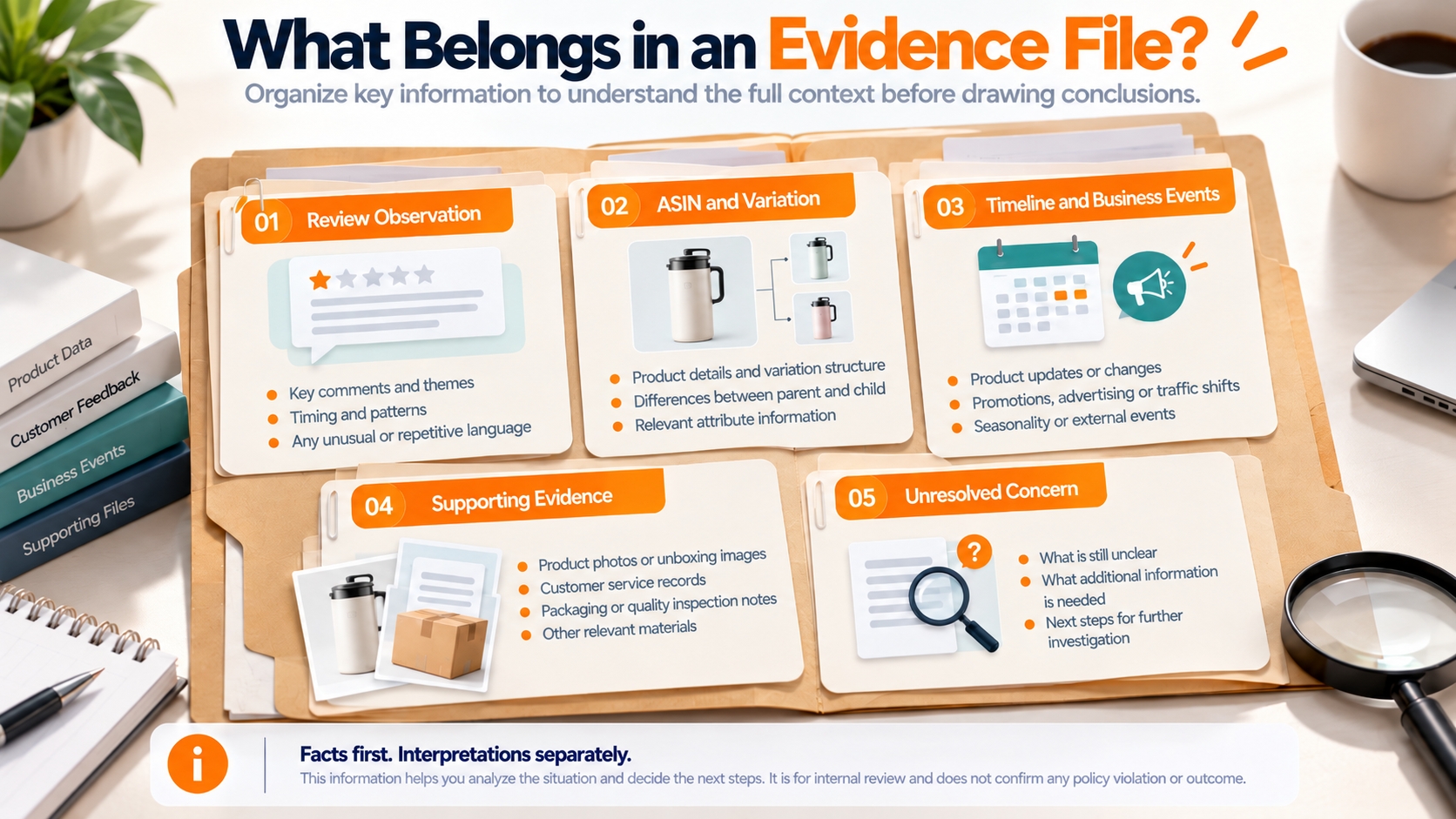
Reporting a suspected violation becomes difficult when the team has screenshots but cannot explain what those screenshots demonstrate. A stronger process begins with a short, structured record.
The purpose is not to produce a legal accusation. It is to preserve observations, identify missing context, and give Amazon a clear account of the possible issue when reporting is justified.
Step 1: Preserve the Original Observation
Record the affected marketplace, ASIN, relevant child variation, visible review link, rating, publication date, and date of observation. Save the relevant screenshot and note the exact feature that raised concern.
If software generated the alert, record the tool name, report date, date range, filters and metric definition. A conclusion that cannot be traced to its underlying observations is difficult to verify.
Step 2: Establish the Product and Catalog Context
Check whether the review accurately refers to the product currently displayed. Verify model, size, pack quantity and the relevant variation relationship.
A complaint about an accessory missing from an earlier configuration may look inconsistent with the present listing. That discrepancy could arise from catalog history or a product change, not necessarily a fabricated review.
Step 3: Compare the Timing with Business Events
Document known promotions, price changes, advertising activity, stockouts, restocks, fulfilment changes, and product revisions during the relevant period. Allow for the delay between a purchase and the customer's published review.
Use dates consistently. Comparing one calendar week's published reviews with that week's unit sales does not necessarily describe a single group of customers.
Step 4: Check Your Own Operational Evidence
If the affected product is yours, compare the review theme with aggregate return reasons, approved customer-support records, supplier batches, quality-control findings, and documented packaging changes.
Keep the review investigation within authorised access and privacy boundaries. Do not attempt to reconstruct a reviewer's private identity or infer an undisclosed relationship by matching public profiles to personal customer information.
Step 5: State What Remains Unexplained
Write a concise summary distinguishing confirmed observations from possible explanations. If a product-quality problem is supported by evidence, assign it to the operational team. If a policy concern remains credible, prepare the relevant Amazon report.
Suggested Internal Evidence Record
Product: Marketplace, ASIN and affected variation.
Observation: Specific review links, publication dates, ratings and the visible irregularity.
Evidence source: Screenshots, report settings, date range and available operational records.
Alternative explanations checked: Promotions, catalog changes, product revisions and relevant quality issues.
Unresolved concern: A factual description of the pattern and the policy potentially implicated.
Next action: Continue monitoring, investigate product quality, request catalog clarification, or submit an appropriate Amazon report.
Store this record securely and limit it to people who need the information. Do not distribute reviewer profiles, speculative fraud labels or unnecessary customer data among external partners.
Report the Right Problem Through the Right Channel
A seller who discovers suspicious reviews has several possible reporting routes. Choosing the appropriate one depends on whether the concern involves an individual piece of review content, broader marketplace abuse, or a brand-related policy violation.
Amazon reviews reports against its applicable rules. Filing a report does not automatically establish that the review is fake, nor does it guarantee removal or disclosure of Amazon's findings.
Route 1: An Individual Review Appears to Violate Content Guidelines
If a particular review appears to violate Amazon's Community Guidelines, use the available Report or Report abuse option associated with that review on the product detail page.
Identify the specific concern rather than stating that the review is unfair or harmful to sales. Amazon's Inappropriate Product Reviews guidance distinguishes potential policy violations from authentic negative customer opinions.
Route 2: Suspected Coordinated Seller or Competitor Abuse
For suspected wider seller-policy abuse, Seller Central provides a reporting process through the Account Health and Report Abuse tools. Select the violation category that accurately describes the concern and provide the applicable ASIN, order information when relevant, a concise explanation, and supporting documentation.
Amazon's guidance for reporting seller-policy violations describes the information that can help investigators evaluate a report.
An Amazon moderator's seller-forum guidance also advises sellers concerned about competitor abuse to use the appropriate Report Abuse category and document the ASIN, incident timeline and supporting records.
Route 3: Brand Registry's Report a Violation Tool
Amazon expanded the Report a Violation experience in Brand Registry in July 2026. The updated interface combines reporting for eligible intellectual-property infringement, store-policy violations, and regulatory compliance concerns within a guided system.
Access is limited to users associated with enrolled brands. Amazon states that an associated Brand Registry user can report store-policy violations without necessarily holding the Rights Owner role.
Use the tool only for violation types it supports. A suspicious review is not automatically an intellectual-property infringement, and a review-content complaint should not be misclassified to force it through a different reporting form.
A Useful Report Is Specific About the Concern
Identify: The affected ASIN, marketplace and specific review or activity pattern.
Describe: The observable facts and the relevant Amazon policy category.
Support: The review links, screenshots, timestamps and records relevant to the concern.
Limit: The report to what is actually known. Do not fabricate an order ID, assert an unverified connection to a competitor, or promise the reviewer will be identified.
Keep the submitted case reference and any permitted follow-up record. For privacy and investigation-integrity reasons, Amazon may not disclose the details of enforcement decisions.
Fake Reviews Are Also a Legal and Business-Partner Risk
Sellers should distinguish Amazon's platform policies from US consumer-protection law. The rules overlap in important ways, but they are not word-for-word equivalents.
The FTC's Rule on the Use of Consumer Reviews and Testimonials became effective on October 21, 2024. It addresses specified deceptive review and testimonial practices, including fake or false reviews, certain undisclosed insider reviews, incentives conditioned on positive or negative sentiment, and particular review-suppression practices.
An Important Difference: Incentivised Reviews
The FTC rule specifically addresses incentives tied to a review expressing a particular sentiment. Its Q&A also explains that the rule is not a universal ban on every incentivised review in every setting.
Amazon's own review policies impose additional restrictions on sellers. Outside authorised Amazon programmes, offering financial rewards, discounts, free products, or other compensation in exchange for reviews can violate platform policy even where the promised sentiment is not expressly specified.
Therefore, a tactic should not be treated as permitted on Amazon simply because a seller believes it falls outside one particular part of the FTC rule.
Agencies, Employees, and Contractors Can Create Risk for the Seller
Amazon's policy makes clear that employees and third-party partners acting for the seller are included in its review-related restrictions. Hiring an agency that promises a specific number of five-star reviews does not make the resulting tactics compliant.
Before approving a review-related service, ask how the provider obtains reviews, whether compensation is involved, how customers are selected, and what evidence supports its claims. Promises of guaranteed positive ratings or review removal should be treated as serious warning signs.
Do Not Turn an Internal Suspicion into a Public Accusation
An allegation that a specific competitor purchased fraudulent reviews is materially different from an internal observation that a review pattern has unusual timing. Public accusations may create reputational and legal exposure when the underlying evidence remains incomplete.
The FTC's Consumer Review Rule questions and answers explains the scope of several legal prohibitions and distinguishes fake or false reviews from other review-related conduct.
Compliance checkpoint: Keep separate records for an Amazon policy concern, a confirmed internal business practice, and a possible legal violation. They are not interchangeable findings. Obtain qualified advice before making a legal conclusion or a public allegation involving a named business or individual.
Where SellerSprite Review Analysis Helps, and Where It Stops
Reviewing hundreds of customer comments manually is slow, especially when a listing contains multiple variations or the seller is comparing several competing ASINs. Review-analysis software can make the information easier to organise.
SellerSprite's AI Review Analysis is relevant to this work because it can help examine review distributions, variation-level feedback, recurring customer complaints, product strengths and weaknesses, and changes in review sentiment.
These capabilities can support an investigation into whether a review cluster is associated with a real product concern. For example, a concentration of comments about an accessory failing may justify examining product variations and inspection records.
A Narrow Review-Analysis Workflow
- Select the relevant ASIN and variation. Avoid combining distinct products or model generations into a single review sample.
- Define the observation period. Compare the suspicious interval with an earlier period and note any sampling limitations.
- Examine ratings and review themes. Look for product-specific details, recurring complaints, and changes in the available review sample.
- Compare related business events. Check product revisions, stock availability, promotions, and other historical context.
- Verify outside the tool. Use original visible reviews and appropriate business records before deciding whether the concern is about product quality or a possible policy violation.
The SellerSprite Review Analysis guide explains how to examine product reviews, compare variations, generate AI-assisted insights, and export or share analysis results.
What the Tool Should Not Be Asked to Decide
SellerSprite Review Analysis is not a dedicated Amazon fraud-enforcement service. It does not establish that a specific buyer is fraudulent, identify a hidden review network, determine who paid for a review, or guarantee that Amazon will remove particular content.
Historical product tracking can provide supplementary context around review-count movement, price, inventory and BSR. Those signals may help explain changes in marketplace activity, but a correlation between ratings and BSR does not prove manipulation or causation.
The distinction is simple: use analysis tools to make the review evidence easier to examine, and use Amazon's official process for possible review-policy enforcement.
Make Review Monitoring an Evidence-Based Routine
Not every catalog needs a daily fraud investigation. The right frequency depends on sales volume, product maturity, recent changes, customer-risk severity and whether unusual review activity is already under examination.
For a stable product range, a monthly review of rating movement, recurring themes and catalog changes may be sufficient. Recently launched products, new supplier batches and high-volume campaigns may justify more frequent checks.
ROUTINE MONITORING
Check What Changed
Record new reviews, visible rating movement, affected variations, and repeated product concerns. Keep a consistent time window and review only the level of detail needed to determine whether the pattern deserves further attention.
TRIGGERED INVESTIGATION
Check What Might Explain It
Investigate a material review anomaly, credible safety complaint, product mismatch, or recurring quality concern. Preserve the relevant evidence and compare it with catalog changes and operational records.
CASE REVIEW
Record the Decision and Its Limits
Document whether the concern was reported, assigned to a product team, resolved through catalog clarification, or retained for monitoring. Keep any Amazon case reference and avoid describing an unresolved report as confirmed fraud.
What Deserves Immediate Attention?
Some findings should bypass routine monitoring. A credible safety complaint, a confirmed internal review-incentive practice, or a serious policy notice may require prompt action independent of how many reviews have appeared.
A high-confidence operational problem should not remain in the queue merely because the suspected fraud explanation is still unresolved. Protecting customers and correcting a documented product issue are worthwhile even when the reviews themselves are authentic.
The Most Useful Finding May Not Be Fraud
Amazon fake reviews detection is most useful when it improves the quality of the next decision. That may mean documenting a pattern that Amazon should examine. It may also mean discovering a packaging problem, a variation mismatch, or a customer-experience issue that deserves more attention than the suspected manipulation itself.
Preserve the facts, check plausible explanations, and choose the correct response. Do not turn a suspicious pattern into a public accusation, or a proprietary score into a statement of certainty.
The strongest investigation is not the one that labels the most reviews as fake. It is the one that makes clear what is known, what remains uncertain, and what the seller can responsibly do next.
FAQs
What is Amazon fake reviews detection?
Amazon fake reviews detection involves identifying unusual review activity, examining whether legitimate events could explain it, and documenting credible concerns for further review. Public analysis can flag suspicious patterns but generally cannot conclusively establish the identity, intent, or policy status of a reviewer.
How can I spot suspicious Amazon reviews?
Look for unusual review timing, repeated distinctive language, abrupt rating-pattern changes, and reviews that appear unrelated to the current product. Check promotions, product revisions, variation relationships and other plausible explanations before treating these signals as evidence of manipulation.
Can an AI review checker prove an Amazon review is fake?
No. A checker may classify review text or highlight suspicious patterns, but it generally lacks Amazon's private transaction, account-relationship, and enforcement information. A tool-generated probability or label is not proof of fraud and does not determine whether Amazon will remove the review.
Are Verified Purchase reviews always genuine?
A Verified Purchase badge is useful purchasing context, not an absolute authenticity guarantee. It does not prove the accuracy of every claim or rule out undisclosed manipulation. Similarly, reviews without the badge are not automatically fake.
What should I do if my product suddenly receives many negative reviews?
Preserve the review dates and relevant content, identify the affected ASIN or variation, and compare the pattern with product changes, returns, support issues, inventory and promotions. If a credible policy concern remains, report it through Amazon. Do not assume that the spike proves a competitor attack.
How do I report suspected fake Amazon reviews?
Use the available review-level reporting option for specific content that appears to violate Amazon's guidelines. Broader seller-policy or competitor-abuse concerns can be submitted through Seller Central's appropriate Report Abuse process. Eligible Brand Registry users may also have access to Report a Violation for supported violation types. Provide factual evidence rather than unsupported allegations.
Will Amazon remove a review after I report it?
Not necessarily. Amazon evaluates reported content against its policies and may take action when a violation is established. A negative review is not removable solely because a seller disagrees with it, and filing a report does not guarantee removal or disclosure of the investigation outcome.
Does the FTC ban all reviews written after customers receive an incentive?
The FTC's Consumer Review Rule targets specified deceptive practices, including incentives conditioned on particular review sentiment. It is not a universal prohibition on every incentivised review in every setting. Amazon's platform policy imposes its own restrictions on compensation in exchange for reviews, so sellers must comply with both applicable requirements.
Are Amazon Vine reviews considered fake reviews?
No. Amazon Vine is an Amazon-operated programme through which eligible products are made available to invited reviewers who provide independent opinions. Participation does not guarantee a positive rating or review. A Vine review should not be labelled fraudulent merely because the reviewer received the product through that programme.
Why did a product lose reviews after a variation change?
Amazon updated review sharing across product variations in 2026. Reviews are shared more selectively when variation differences affect functionality. A review-count change may therefore result from catalog or variation eligibility rather than a review-abuse enforcement action.
Can SellerSprite detect or remove fake Amazon reviews?
SellerSprite Review Analysis helps organise review content, examine customer sentiment, compare variations, and identify recurring product themes. It is not an Amazon review-enforcement tool and cannot conclusively identify fraudulent reviewers or remove reviews. Suspected policy violations should be handled through Amazon's reporting process.
References
- Amazon Seller Central: Customer Product Reviews Policies View
- Amazon Seller Central: Inappropriate Product Reviews View
- Amazon: 2026 Trustworthy Shopping Experience Report View
- Amazon Seller Central: Report a Violation View
- Amazon Seller Forums: Recognising and Reporting Competitor Abuse View
- Amazon: Report Brand Violations Faster with One Guided Experience View
- Federal Trade Commission: Final Rule on Fake Reviews and Testimonials View
- Federal Trade Commission: Consumer Reviews and Testimonials Rule, Questions and Answers View
- Amazon Seller Forums: Changes to Review Sharing Across Product Variations in 2026 View
- SellerSprite: Review Analysis Guide View
- SellerSprite: Product & Keyword Tracker Guide View
- Amazon: Amazon Vine Programme View
By SellerSprite Content Team
The SellerSprite Content Team brings together Amazon marketplace researchers, ecommerce data analysts, and content specialists who study how marketplace information influences seller decisions. The team's work in customer-review research focuses on review-pattern interpretation, competitor analysis, product-quality signals, and the limits of public marketplace data.
Last reviewed: October 21, 2026