TL;DR: Amazon Associates is the affiliate program; the Amazon Influencer Program adds a creator storefront and other opportunities for qualifying social creators. Start with a buyer problem, choose products you can recommend credibly, and distinguish external referrals from onsite earnings and brand-funded campaigns. A useful recommendation needs accurate content, visible disclosures, working links, and a measurement plan that goes beyond clicks.
Key Takeaways
- Influencer is an extension of Associates, not a competing affiliate system. Choose the features that fit how you reach an audience.
- A storefront is not a promise of onsite distribution. Content selection, qualifying activity, and onsite rates have their own rules.
- Recommendation quality starts before filming. Match audience needs with product fit, buyer intent, and a dependable offer.
- Creator income and seller revenue are different outcomes. Track the correct program, costs, and reporting window before deciding a campaign worked.
Table of Contents
- Amazon Influencer and Affiliate Program: How the Two Fit Together
- Apply With Evidence of a Real Audience
- Choose the Buyer Problem Before the Product
- Build a Recommendation That Helps Someone Decide
- For Brands: Commission, Sponsorship, or Both?
- Put the Disclosure Where the Recommendation Happens
- Understand Which Purchases Can Earn
- Measure Commission, Not Just Traffic
- Keep Your Best Recommendations Accurate
- Start With One Buying Question
- FAQs
- References
Scope: US creators, publishers, brands, and Amazon marketplace teams. Check the current terms for the relevant account, country, and earning route. Examples below illustrate decisions, not promised earnings or product endorsements.
Amazon Influencer and Affiliate Program: How the Two Fit Together
Amazon Associates lets eligible publishers and creators use tracked links to earn from qualifying activity. The Amazon Influencer Program extends that arrangement for qualifying social creators with an Amazon-hosted storefront. An influencer can share individual affiliate links as well as the storefront; these are not mutually exclusive choices.
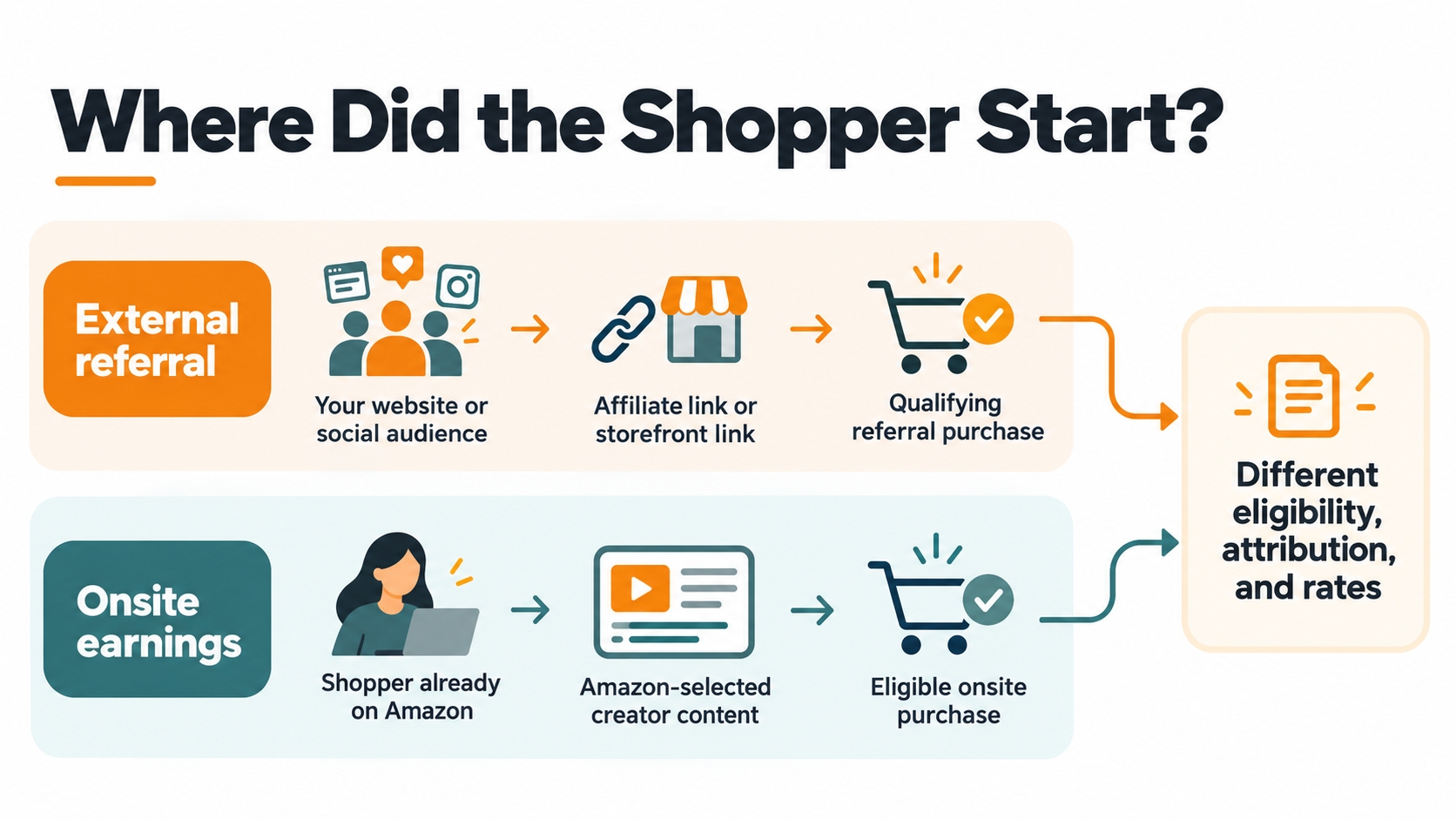
The more important distinction is where the shopper comes from. A follower you send to Amazon and a shopper who encounters your content while already on Amazon do not necessarily generate the same type of commission.
Your audience follows your link
Use the standard Associates route to refer visitors from your eligible website or social presence. An Influencer storefront offers another destination for those referrals, especially when you want to organize recommendations around a topic rather than share one isolated product.
Amazon shoppers encounter your content onsite
Eligible storefront content may be selected for placement elsewhere on Amazon. Amazon records those onsite earnings under a separate Onsite Store ID; sending your own followers to the storefront remains external referral traffic. Neither uploading a video nor receiving a storefront guarantees placement or earnings.
Onsite commissions use separate rates and Direct Qualifying Purchase rules. For video, qualifying activity can depend on Amazon-defined viewing requirements and the featured product. Do not assume onsite content earns on every item a viewer later buys.
For sellers and brands: An Influencer storefront belongs to a creator recommending products. It is not your seller account, your product listing, or a guarantee that a creator will promote your brand. Plan the partnership separately from the creator's Amazon enrollment.
Apply With Evidence of a Real Audience
Prepare a channel that demonstrates useful original content before treating approval as the first growth tactic. Amazon evaluates the properties and audience you submit, so an empty profile or a collection of copied product listings is not a strong foundation.
Associates: submit the actual publishing properties
Amazon reviews an Associates application after at least three qualifying sales within the first 180 days; personal purchases do not count. Its review covers the websites, apps, and supported social pages you identify. Keep those properties public, substantive, and accurately listed rather than submitting only a social network's homepage.
Influencer: apply with the social presence you use
The US signup page currently accepts YouTube, Instagram, Facebook, or TikTok accounts and requires a business account when applying with Instagram or Facebook. Amazon considers follower numbers and engagement, but the page does not promise approval at a universal numerical follower threshold.
Complete the applicable tax and payment setup, check your account status, and use Amazon's provided link tools. Choose the account route your real content supports; do not buy followers or arrange artificial purchases to manufacture qualification.
Choose the Buyer Problem Before the Product
The outline of a good recommendation starts with a constraint the audience recognizes. "A laptop stand for a shallow desk" gives you a more useful research question than "popular electronics to link."
Confirm intent without confusing search demand with your reach
Research the product category, use case, and buying criteria separately. A broad search term can reveal interest, while a phrase mentioning size, compatibility, or a specific use may reveal what needs explaining. Amazon search demand is not a forecast of views on your social account.
SellerSprite's guide to Amazon keyword research and buyer intent provides a starting point for matching product language to shopper needs. In Keyword Research, select the marketplace and period, then examine relevant search-volume and trend signals. Use the findings to choose questions worth answering, not to claim a particular video will sell.
Shortlist products that can sustain a recommendation
- Audience fit: Does the product address the problem your viewers actually have, at a price they would consider?
- Evidence: Can you verify the important specifications and demonstrate meaningful differences? Inspect recent review themes for unanswered questions, not just the average rating.
- Offer stability: Check the exact model, variation, seller, availability, and delivery conditions. Record when you last checked them.
- Commission fit: Consider the applicable rate and content-production effort after the product passes the usefulness test, not before.
Compare historical demand with the present trend. A short-lived social spike can justify a timely test, but an evergreen recommendation needs a product and use case likely to remain relevant. Stop the selection process when a serious quality concern or a mismatched listing undermines the recommendation.
Build a Recommendation That Helps Someone Decide
A comparison becomes valuable when it resolves a choice, not when it lists the same specifications in a new order. Decide what evidence the viewer needs and what would make the product a poor fit.
Example content brief: a laptop stand for a shallow desk
- Buyer question: Will the stand fit without taking away the workspace needed for a keyboard?
- Demonstration: Show the base footprint, supported laptop size, adjustment process, and cable access using the actual product.
- Comparison: Explain a relevant trade-off, such as folding portability versus adjustment range, rather than declaring one design best for everyone.
- Boundary: Identify configurations you did not test and separate manufacturer specifications from your observations.
- Next step: Link the exact version discussed and include the applicable affiliate or sponsorship disclosure.
This is an illustrative brief, not a tested product recommendation or a measured search opportunity. The same approach works for a written comparison, a short demonstration, or a themed storefront collection.
Do not present research-only content as hands-on testing or claim an experience you did not have. The FTC expects endorsements to reflect truthful opinions and experience, and claims still need support. A brand-approved script does not make an unverified result true.
Organize storefront collections around a recognizable shopping task, such as a compact home-office setup, instead of one undifferentiated catalog. A product-specific demonstration should point to the product actually shown; a wider comparison can justify a curated collection with clear selection criteria.

For Brands: Commission, Sponsorship, or Both?
A brand partnership adds another commercial relationship to the creator's Amazon account. Define who pays, which content is expected, and what counts as a result before discussing a commission percentage.
Keep direct sponsorship separate from standard Amazon commission
A direct arrangement may pay for a video, a product sample, licensed content, or a defined campaign. Specify deliverables, publication timing, usage rights, revision limits, disclosures, and reporting access. Do not promise that a creator's standard Amazon commission will cover work you have separately requested.
Creator Connections adds a brand-funded performance route
Amazon Creator Connections lets eligible brands offer bonus commissions on qualifying sales through creator campaigns. Brands select eligible products and set campaign terms such as rate, duration, and budget. Access depends on Amazon's advertiser, Brand Registry, and creator eligibility requirements; it is not automatic for every seller or new affiliate.
Use the campaign reporting portal and current terms to evaluate results. Amazon notes that Creator Connections orders are not linked to the normal order-management center, so do not expect a creator's activity to match a simple list of individual Seller Central order IDs.
A product sample is not a customer-review purchase. Separate a disclosed creator demonstration from Amazon customer star ratings. Amazon prohibits compensation or free products in exchange for customer reviews. Do not make a positive rating, review edit, or review deletion part of the creator brief.
For the seller, check that the featured variation is in stock and the detail page matches the demonstration before publication. If content will later be reused in advertising, agree on that usage separately and confirm the relevant ad-format rules. A successful organic post is not permission to reuse the creator's work indefinitely.
Put the Disclosure Where the Recommendation Happens
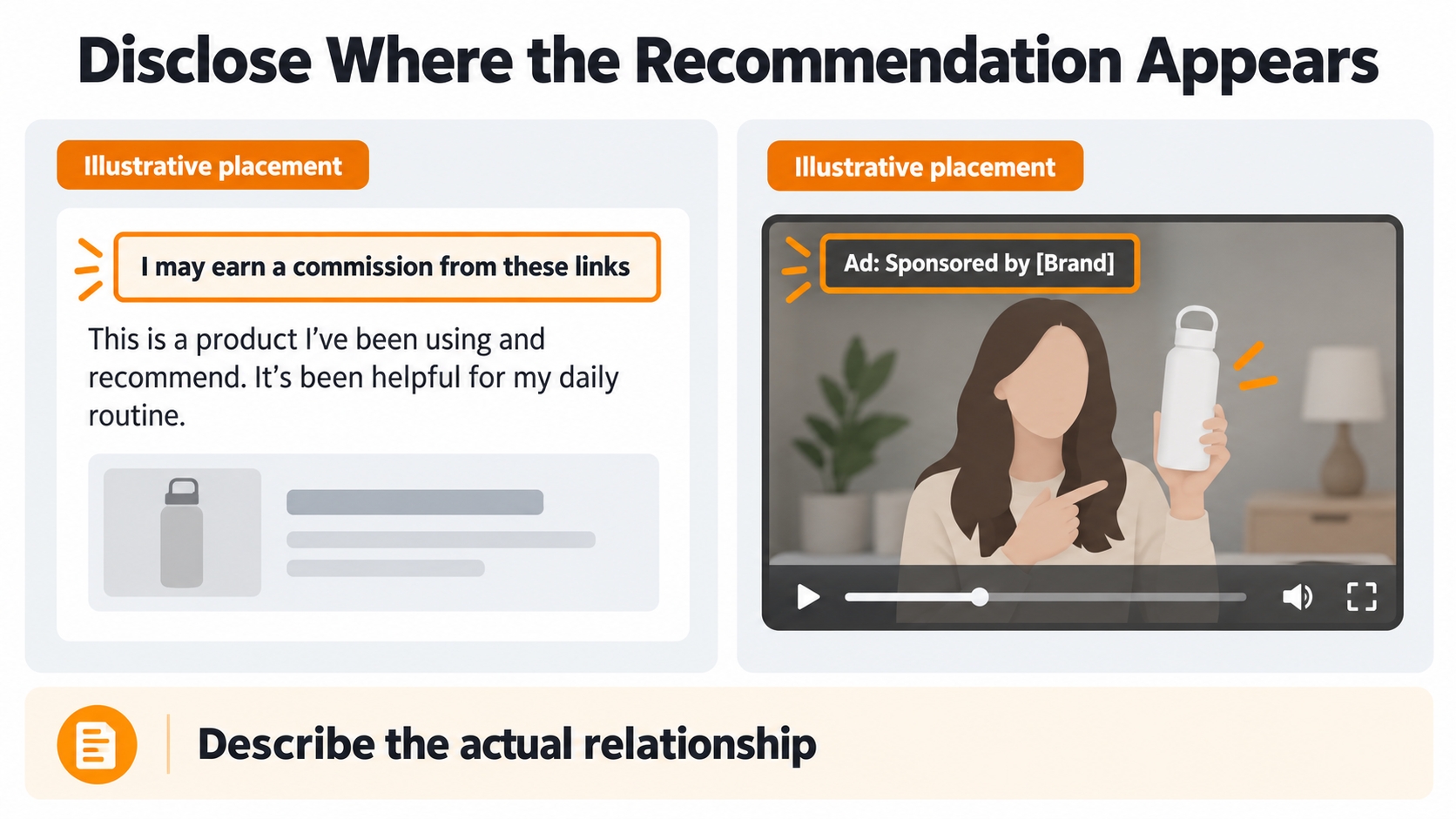
Disclosures need to explain the relationship when the audience encounters the endorsement. A general profile statement and the disclosure beside a specific recommendation perform different jobs.
Amazon requires a clear disclosure with affiliate links and the following identification on the site, or associated with the social account:
Required Amazon identification:
“As an Amazon Associate I earn from qualifying purchases.”
For placement, follow the FTC's disclosure guidance for influencers. Put clear wording with the endorsement, not behind a More button or among unrelated hashtags. For video, include the disclosure in the video; for a livestream, repeat it so viewers joining later can see or hear it. A platform label can supplement your disclosure rather than replace the assessment of whether viewers understand it.
Example wording, only when it describes the actual relationship
- Affiliate recommendation: "I may earn a commission if you buy through these links."
- Gifted product plus affiliate link: "The brand provided this product free. I may also earn a commission from purchases through my links."
- Paid collaboration: "Ad: This video is sponsored by [Brand]." Add the affiliate relationship when it also applies.
Free products, discounts, or other material benefits can require disclosure even without a cash sponsorship. Keep the wording understandable in the same language as the recommendation. Disclosure explains a relationship; it does not excuse inaccurate product claims.
Understand Which Purchases Can Earn
An outbound click starts a possible earning path, not a guaranteed payment. Match the rate schedule and qualification rules to the route that generated the purchase.
Use the correct rate, not the largest advertised percentage
Amazon's standard commission schedule assigns different rates to different categories and qualifying actions. Onsite rates are listed separately. A sponsorship fee or Creator Connections bonus is another arrangement, not a universal increase to every Associates link.
Understand the referral session
The standard referral session generally lasts up to 24 hours, but an order or another Associate's link can end it sooner. A qualifying item added to the cart during the session may remain eligible under the later-checkout rules. This is not a blanket 90-day cookie for every subsequent purchase.
The formal policy also applies shipment, payment, and disqualification conditions, including canceled or returned purchases. Incorrectly formatted links can prevent attribution. Treat reported orders as distinct from commission that remains payable after the applicable adjustments.
Do not place affiliate links in Amazon customer reviews or offer rewards for using your links. Those shortcuts conflict with the participation rules rather than creating legitimate demand.
Do not combine tracking systems to manufacture credit
Amazon prohibits manipulating or combining attribution links to claim commissions from multiple programs on the same traffic. Use the approved linking method; do not append another program's tags as a shortcut. A program-authorized bonus is different from altering tracking URLs yourself.
Measure Commission, Not Just Traffic
Measure the sequence you can observe: relevant exposure, useful visits, qualifying purchases, and retained commission. Content costs and the quality of the recommendation determine whether that income is worth repeating.
Associates reports distinguish clicks, ordered items, shipped items, and earnings, and support analysis by Tracking ID. Use permitted tracking IDs to separate major content groups and keep onsite reporting separate. Different reporting periods and update schedules can produce clicks without same-day earnings.
Two useful calculations:
Earnings per click = attributable commission after adjustments ÷ the corresponding recorded clicks
Content contribution = creator revenue − the content's production, distribution, and maintenance costs
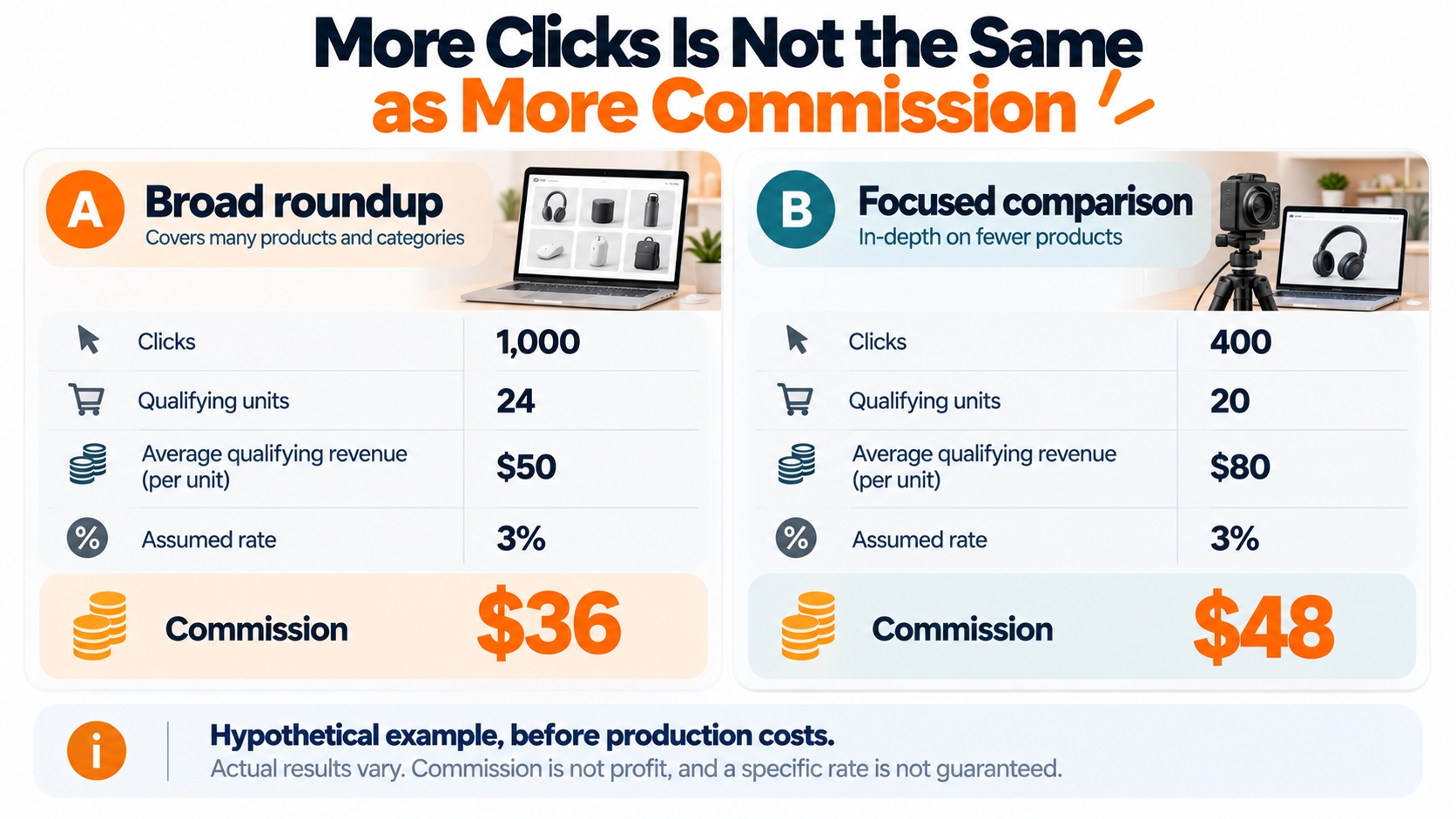
Hypothetical comparison: both examples below use an assumed 3% commission rate and treat the listed units as qualifying after relevant adjustments. The clicks and purchases are assumed to be matched to the same content cohort. They are not industry benchmarks or evidence that one format always performs better.
| Assumed measure | Broad product roundup | Focused buying comparison |
|---|---|---|
| Recorded outbound clicks | 1,000 | 400 |
| Qualifying units purchased | 24 | 20 |
| Average qualifying revenue per unit | $50.00 | $80.00 |
| Commission calculation | 24 × $50 × 3% | 20 × $80 × 3% |
| Total commission | $36.00 | $48.00 |
| Earnings per click | $0.036 | $0.12 |
The second example earns more commission with fewer clicks, but a higher production cost could reverse the business result. Do not extrapolate a small sample into a salary forecast. Compare similar periods, allow adjustments to settle, and record the content effort needed to achieve the result.
Brands need a different scorecard
A seller should measure the featured products' results and campaign costs, not substitute the creator's total commission for incremental brand revenue. Include samples, creator payments, bonuses, content rights, and expected post-sale costs. Treat repeat sales as evidence to observe, not a benefit to assume.
Amazon Attribution uses a 14-day, last-touch model, while Associates uses its own referral-session rules. They measure different things, so identical totals are not a reasonable default expectation. Keep program reports separate, do not add overlapping attributed sales as though they were unique orders, and remember that attribution alone does not prove a sale would not have happened otherwise.
Keep Your Best Recommendations Accurate
The recommendation does not stop being your responsibility when the post is published. Keep a record of the product version, destination link, evidence used, and date of the latest check.
- Before publishing: Open the destination on mobile, confirm the product variation, verify the disclosure, and check the campaign terms.
- During the campaign: Review availability, seller or listing changes, audience questions, and any new issue that could undermine the recommendation.
- After a material change: Update editable content, add a clear correction where needed, or retire a recommendation you can no longer support.
- When a bonus ends: Reassess the economics without silently changing the recommendation to whatever now pays most.
Amazon restricts how affiliates reproduce price, availability, reviews, and other Program Content. Use its permitted tools and data methods rather than manually copying live prices, ratings, or product images into permanent content. Product research access is not a license to republish Amazon assets.
Schedule checks according to exposure and risk: frequently shared recommendations and time-sensitive offers deserve closer attention than an inactive archive. A link that still opens can still be a bad recommendation if it now leads to a different model or no longer solves the buyer's problem.
Start With One Buying Question
Choose one audience problem, a small set of defensible products, and one content format you can execute well. Write down the evidence to show, the earning route, the disclosure, and the measure that will tell you whether to continue.
For creators, the result should be a recommendation worth maintaining, not merely a link that produced clicks. For brands, it should be a partnership whose audience fit, costs, and product experience hold up after the first burst of attention.
FAQs
Is the Amazon Influencer Program different from Amazon Associates?
It is an extension of Associates for qualifying social creators. It adds an Amazon storefront and related creator features, while affiliate links remain available. Onsite opportunities are subject to separate eligibility and selection.
Do I need a website to apply?
Not necessarily. Associates reviews eligible websites, apps, and supported social pages. The Influencer application uses a supported social account. Check the requirements for the route you choose rather than assuming a website is mandatory for every creator.
How many followers are required for the Influencer Program?
The US signup page considers follower numbers and engagement but does not publish a universal acceptance threshold. Do not confuse that with Associates' separate social-site review guidance or third-party anecdotes about approvals.
Does an Influencer storefront guarantee onsite video earnings?
No. Amazon may select eligible content for onsite placements, and earnings depend on the applicable interaction and purchase requirements. External traffic you send to your storefront is not automatically onsite traffic.
Can I use my own purchases to qualify for Associates?
No. Personal orders do not count toward the three qualifying sales required within the initial 180-day Associates application-review period. Build genuine audience referrals instead.
Does every purchase after my link click earn a commission?
No. Session timing, product eligibility, correct tracking, and the applicable commission rules all matter. Later cart checkout has conditions and does not give you credit for every purchase over the following months.
Can a brand pay me and also provide a product sample?
A sponsorship and a gifted product create relationships that must be disclosed appropriately. Keep those arrangements separate from customer-review requests, and do not agree to give an Amazon star rating in exchange for compensation.
Which result should a new creator monitor first?
Start with whether the content reaches the intended audience and sends relevant visitors. Then review qualifying activity, earnings after adjustments, and production cost. Keep ordered items, shipped items, and commission separate when using Associates reports.
References
- Amazon Associates: How the Influencer Program Differs from Online Associates View
- Amazon Influencer Program: Eligibility and Storefront Features View
- Amazon Associates: Application Review Process View
- Amazon Influencer Program: Earning Onsite Commissions View
- Amazon: Onsite Associates Program Commission Income Statement View
- Amazon: Standard Commission Income Statement View
- Amazon Associates: Referral Sessions and Shopping-Cart Timing View
- Amazon Associates: Program Policies View
- SellerSprite: Keyword Research Tool Guide View
- FTC: The Endorsement Guides, What People Are Asking View
- Amazon Ads: Understand Creator Connections View
- FTC: Disclosures 101 for Social Media Influencers View
- Amazon Associates: Identifying Yourself and Disclosing Links View
- Amazon Associates: Using Reports and Tracking IDs View
- Amazon Ads: Amazon Attribution Methodology View
- Amazon Ads: Create and Manage a Creator Connections Campaign View
By SellerSprite Content Team
The SellerSprite Content Team brings together Amazon marketplace researchers, data analysts, and e-commerce content specialists. The team studies search behavior, product competitiveness, and how shoppers move from content discovery to purchase. Its research spans keyword demand, product evaluation, and creator-led marketing, with an emphasis on audience relevance, reliable marketplace evidence, and measurable commercial outcomes.
Last reviewed: October 20, 2026