TL;DR: Amazon mystery boxes and surprises are a customer-trust topic before they are a growth opportunity. Amazon prohibits mystery or surprise boxes whose contents are not clearly described on the product detail page. Research the buyer need behind the curiosity, then evaluate a properly specified, eligible offer with clear contents, defensible value, reliable fulfillment, and realistic post-sale costs.
Key Takeaways
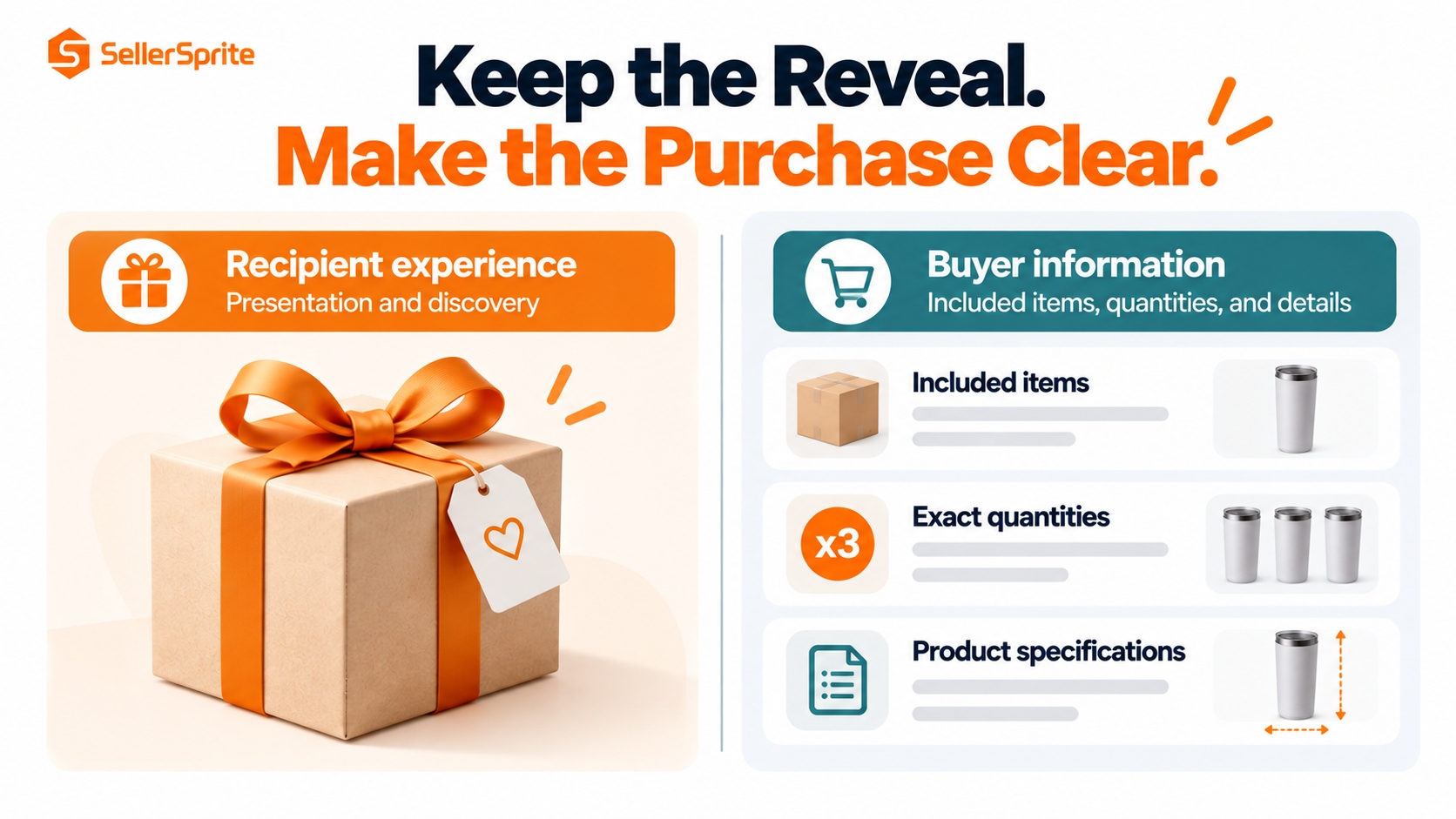
- Keep the experience surprising, not the purchase terms. A gift recipient can enjoy a reveal even when the purchaser knows exactly what the set contains.
- Classify the offer before sourcing. An itemized gift set, a manufacturer-sealed collectible, and a liquidation lot need different checks; one listing does not establish permission for another.
- Test demand beyond curiosity. Separate searches for entertainment or cheap return pallets from demand for the specific product and use case you can serve.
- Measure whether the promise was kept. Evaluate complaints, returns, availability, and contribution alongside conversion, rather than treating initial orders as proof of success.
Table of Contents
- Quick Answer: What Are Amazon Mystery Boxes and Surprises?
- Mystery Boxes, Gift Sets, and Return Pallets Are Different Offers
- Check the Listing Rules Before Buying Inventory
- Make the Offer Clear Without Losing the Unboxing Appeal
- Separate Novelty Spikes From Repeatable Demand
- A Practical Workflow for a Clearly Defined Offer
- Model the Cost of a Disappointed Customer
- Metrics and Decision Criteria
- Common Mistakes to Avoid
- The Bottom Line
- FAQs
- References
Scope: This guide is for Amazon US sellers evaluating novelty-led offers, gift sets, and related shopper concerns. It is not a source of unclaimed parcels or an Amazon customer-service channel. Product eligibility depends on the exact item, category, rights, condition, and applicable policy. The operational examples below are planning exercises, not product approvals.
Quick Answer: What Are Amazon Mystery Boxes and Surprises?
Amazon Mystery Boxes and Surprises is a broad search phrase covering several intentions: an entertaining unboxing, a gift, a collectible, or a supposed bargain from returned merchandise. For sellers, the useful question is which of those needs can be met with a clearly described product and a repeatable customer experience.
Start with Amazon's restriction on unspecified mystery boxes. It covers mystery boxes, surprise boxes, and similarly named products when their items are not clearly described. Renaming the offer a sampler or lucky bag does not resolve missing product information.
A better commercial question: Would the buyer still choose this offer if every included item were visible before checkout? If the value depends entirely on hiding disappointing contents, redesign the offer rather than improving the suspense.
Mystery Boxes, Gift Sets, and Return Pallets Are Different Offers
Do not put every box-shaped product into the same market analysis. Identify the transaction being proposed, then use the relevant rules and evidence to evaluate it.
Unspecified Mystery Boxes vs. Itemized Gift Sets
An unspecified box asks the purchaser to accept unknown merchandise. An itemized set lets the purchaser judge the components together, even if the packaging creates a reveal. The latter still needs to satisfy the applicable listing and bundling requirements; disclosure is necessary, not automatic approval.
Manufacturer-Sealed Collectibles Need a Product-Specific Check
A branded collectible sold in sealed packaging should be evaluated using its own manufacturer information, product identity, category requirements, and listing. Do not treat a familiar blind-box listing as a blanket exception for a seller-assembled random assortment. Where the permitted disclosure format is unclear, verify the exact product before ordering stock.
Liquidation Lots Are a Sourcing Transaction
Amazon's FBA Liquidations program helps sellers recover value from eligible excess or customer-returned inventory through liquidators. It is not evidence that a particular social-media advertisement is an official Amazon consumer offer. Amazon also states that its contracted liquidators are restricted from directly reselling that FBA-liquidated inventory on Amazon.
Before buying a lot, request the supplier identity, invoice, item manifest or documented lot description, condition grading, and contractual resale restrictions. A picture of an Amazon carton does not establish provenance, contents, or authorization. Amazon advises verifying suspicious claims through its website or app rather than following an unexpected payment request.
Check the Listing Rules Before Buying Inventory
Complete the policy check before the demand forecast. A profitable spreadsheet cannot make an ineligible configuration acceptable, and a competitor remaining live is not a substitute for your own review.
The Detail Page Must Describe What Is Being Sold
Amazon requires accurate product information and limits a detail page to the product it represents. For bundles, its policy calls for identifying the included products and showing the actual bundle contents in the main image. "Contents vary" is not a universal substitute for those requirements.
Treat an assortment change as a product-identity question, not just an inventory substitution. If you replace a component, check whether the existing listing still represents the same product or whether a new configuration and identifier are required. Do not silently ship different merchandise under an established ASIN.
Check Brand, Packaging, and Category Requirements
Review who assembled the set, whose brands appear inside it, and which permissions are required. Consumables and other regulated or restricted products need their own checks; a gift box does not remove component-level safety, condition, or category requirements.
Announced change to plan for: Amazon has announced broader product-bundle requirements effective January 11, 2027. Most bundles listed as one ASIN will need original manufacturer or brand packaging, subject to specified authorization, category, and virtual-bundle exceptions. Check both the rules applicable now and those covering your planned selling period. This transition does not suspend the existing restriction on undisclosed contents.
Returned Stock Is Not Automatically New Stock
Amazon requires sellers to assess condition accurately, with category-specific differences. Its condition guidelines also exclude some merchandise, including expired items and items designated unsellable. A low acquisition price, sealed shipping carton, or supplier description of "returns" does not establish that each item qualifies as New.
Keep condition and sourcing records for the actual merchandise. Separate items that need further inspection rather than using a mystery format to conceal damage, missing components, or uncertainty about whether they may be sold.
Make the Offer Clear Without Losing the Unboxing Appeal
Once the configuration is eligible, make the decision easier for the buyer. The goal is not to remove presentation or personality; it is to remove uncertainty about the product being purchased.
Answer the Questions That Determine Product Fit
- What is included? Identify each component, quantity, size, material, and other relevant specifications. Distinguish product components from decorative packaging.
- Who is it for? Explain the intended use and compatibility. Include required warnings or limitations in the appropriate product information.
- Does the image match the shipment? Show the actual configuration. Do not use premium props in a way that suggests they are included.
- What conditions apply? Use the proper offer and policy fields for price, condition, delivery, and returns. Do not place changing offer terms into product content where Amazon disallows them.
Replace the Vague Promise With an Itemized One
Illustrative copy exercise, not an approved listing
Vague: "Premium desk mystery box. Amazing surprises. Contents vary."
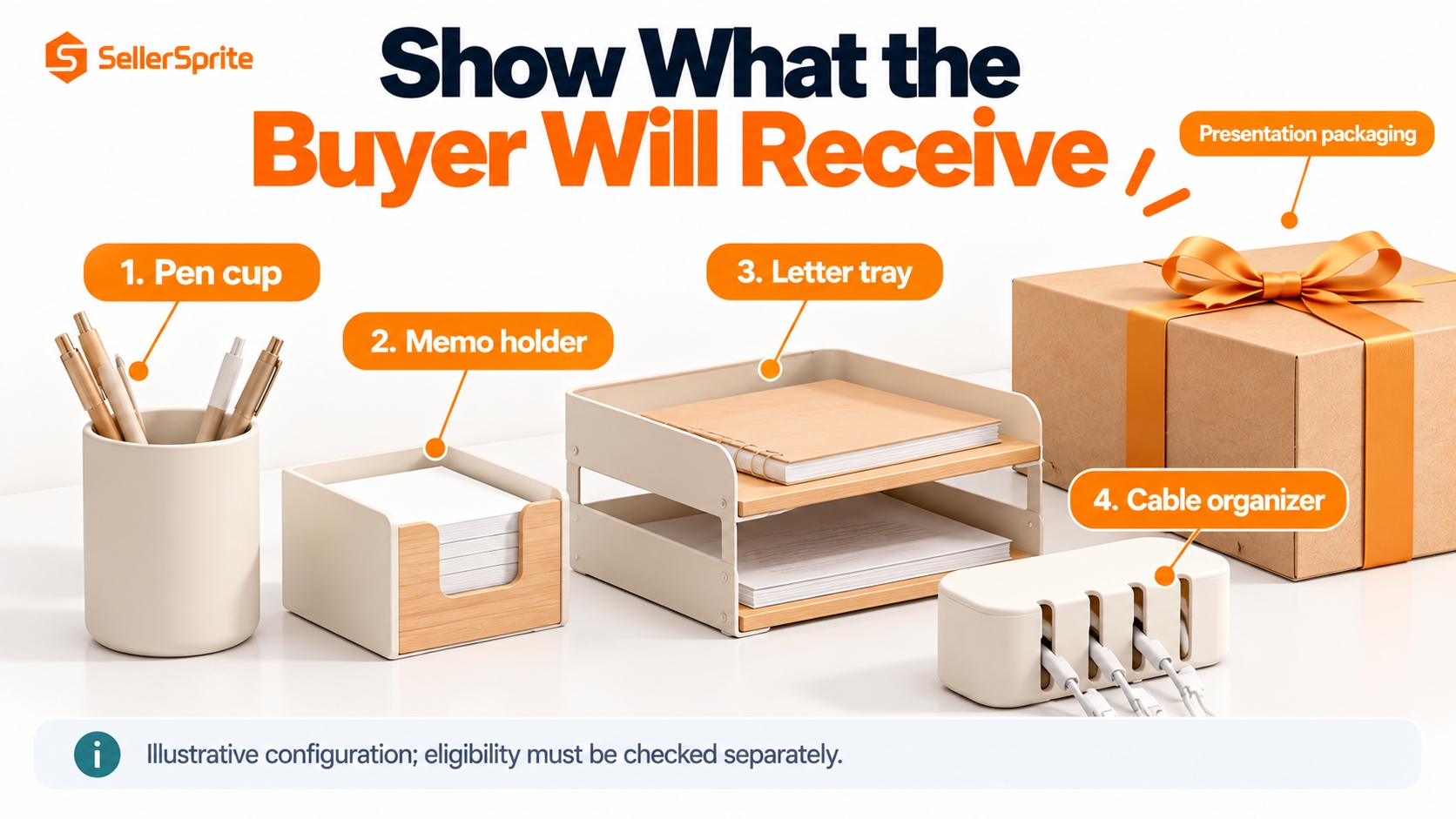
More specific: "Four-piece desk organization bundle: one pen cup, one memo holder, one letter tray, and one cable organizer, all in the same stated finish."
The second version explains the purchase. It still needs accurate specifications, matching images, and confirmation that the brand, packaging, and bundle configuration are permitted. Gift wrapping can create a reveal without concealing these details.
Substantiate Value Instead of Advertising an Imaginary Jackpot
The FTC's pricing guides say retail-price and comparable-value comparisons must have a factual, non-misleading basis. Keep support for a "retail value" claim, including which items, condition, quantities, market, and comparison prices it uses. An exceptional possible item is not the value of every box.
For an eligible listing, carry the same product promise into Sponsored Products and other campaign content. Do not attract buyers with expensive items that the offer does not actually include. If the proposition only works when customers overestimate the contents, the problem is the offer, not the click-through rate.
Separate Novelty Spikes From Repeatable Demand
Treat novelty-driven traffic as a hypothesis about shopper interest, not a forecast of profitable orders. The research question is whether people want the specific offer after its contents and terms are clear.
Separate Different Search Intentions
Build distinct research groups for unboxing entertainment, gifts for a defined recipient, specific collectible products, and liquidation sourcing. Illustrative phrases such as "desk organizer gift set" and "return pallet" describe very different transactions. Do not combine their search volumes and call the total demand for your product.
Compare Products, Time Periods, and Buyer Concerns
Choose genuinely comparable products by use case, condition, configuration, and price. Review more than one time period and annotate promotions or seasonal peaks. In customer feedback, distinguish "I disliked the selection" from "a listed component was missing"; those findings call for different changes.
SellerSprite Product Research can support this stage with historical product comparisons, including price, sales estimates, and BSR. Use those features to test market assumptions after the eligibility screen, not to authenticate a supplier or certify a mystery-box listing.
BSR is a category-relative sales rank, not a unit-sales count or proof that a novelty concept has durable demand. Compare it with the product's history and your own actual orders where available. An improved rank after a promotion does not isolate why sales changed.
A Practical Workflow for a Clearly Defined Offer
Translate the shopper concern into a defined operating plan before committing inventory. The sequence below follows the offer from sourcing to delivery rather than relying on a compelling unboxing video.
- Write the buyer concern and the fixed product promise. State the use case, included items, quantities, and intended condition. Remove unsupported expectations before sourcing.
- Verify eligibility, provenance, and permissions. Check the exact product and configuration, applicable brand rights, supplier documentation, and any resale restrictions. Resolve uncertainties before a live sales test.
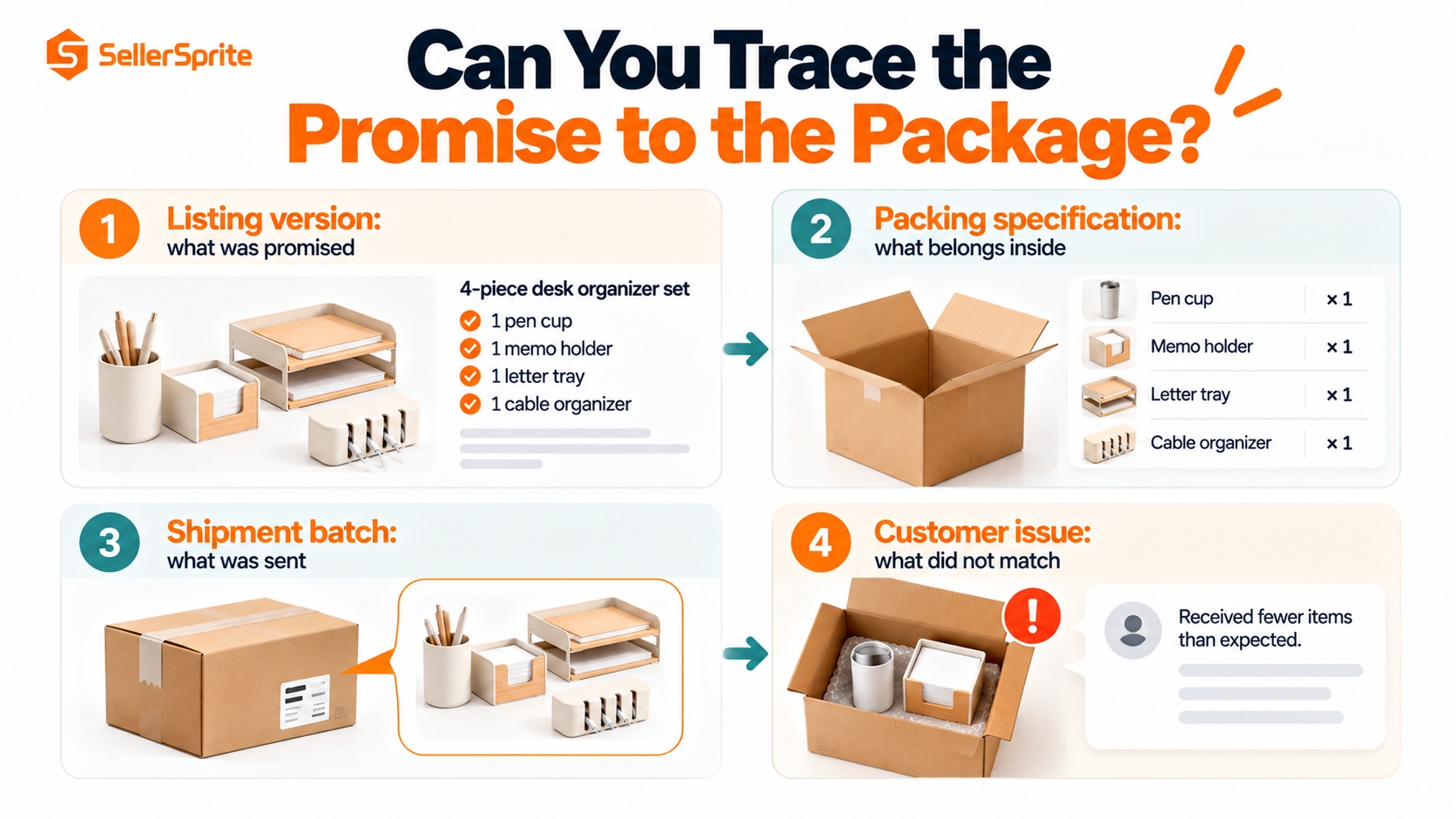
- Lock the packing specification. Give each component a clear internal reference and maintain a version-controlled packing list. Have a sample assembled and checked against the listing.
- Plan stock around the complete set. A shortage of one required component can stop the whole offer. Hold or replenish the set rather than swapping in unrelated leftovers.
- Check the listing-to-delivery match. Compare the contents, images, packaging, and support instructions with an actual packed unit. Assess the chosen fulfillment route and its requirements separately.
- Run a limited operational test only after the checks pass. Record the batch and listing version, customer questions, fulfillment problems, and net outcome. Correct repeat mismatches before increasing inventory or spend.
Keep Support and Review Requests Separate
Do not make a refund, free item, future discount, or other benefit conditional on posting, editing, or deleting an Amazon review. Requests for "honest" feedback do not make a compensation-for-review arrangement acceptable. Keep any insert or follow-up process within Amazon's review policies.
A "mystery" or "final sale" label does not replace the applicable Amazon returns process. Check the category and fulfillment arrangement, manage the actual request through the proper workflow, and investigate recurring reasons instead of treating disappointed customers as the cost of the concept.
Model the Cost of a Disappointed Customer
Model the product as something you must source, assemble, ship, and support. Cheap components can still produce an expensive offer when inspection, missing items, refunds, or additional customer-service work consume the apparent margin.
For purchased lots, divide acquisition and inspection costs by the units you can actually sell under the permitted conditions, not every item that arrived. For a fixed set, include component shortages, assembly labor, packaging, inbound costs, applicable Amazon fees, and advertising. Do not use a supplier's headline "retail value" as revenue you will recover.
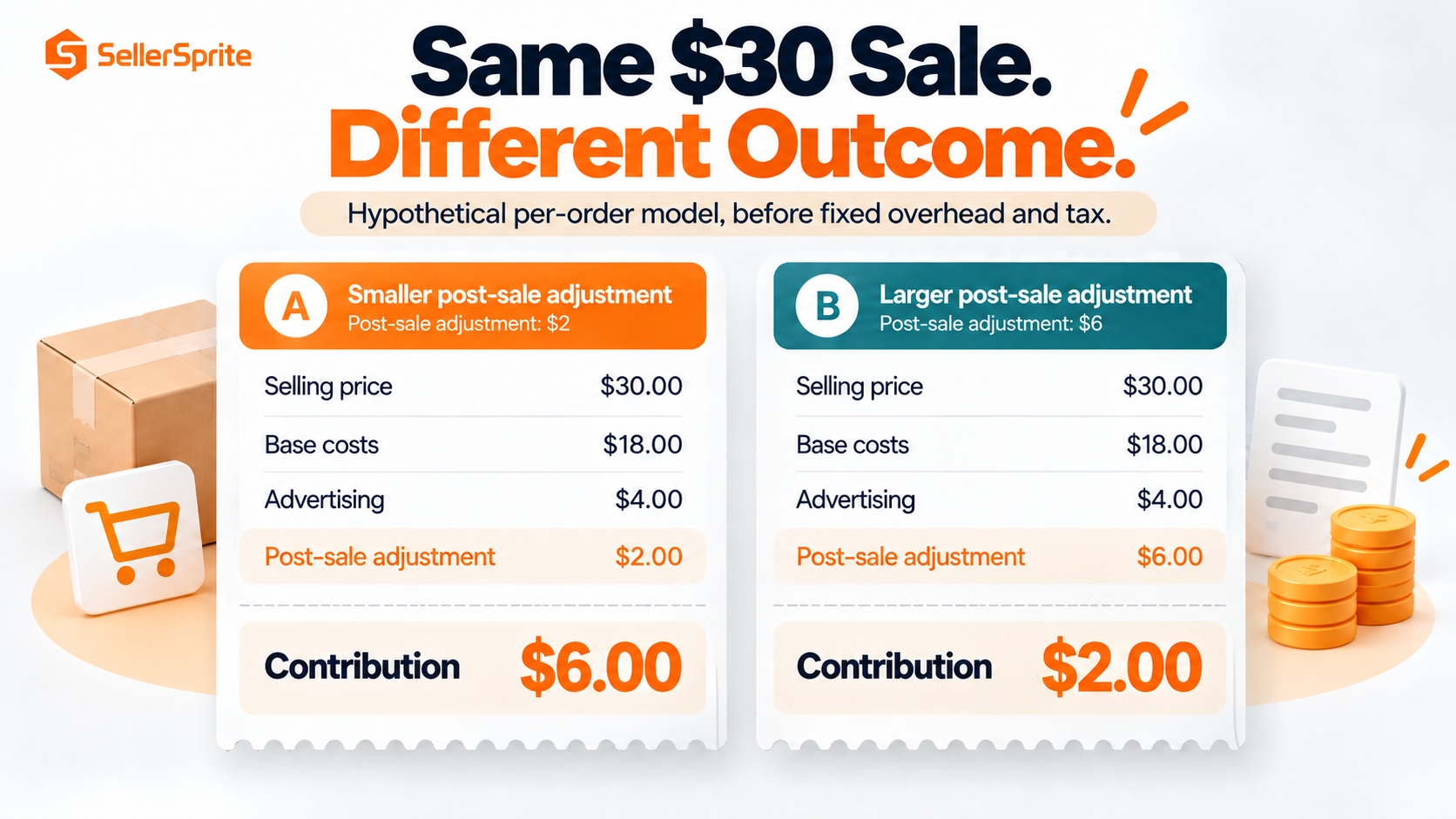
Simplified expected contribution per order = selling revenue before post-sale adjustments − base product and operating costs − advertising − expected net post-sale adjustment
Hypothetical example: Assume a $30 sale, $18 in base product, assembly, packaging, and selling/fulfillment costs, plus $4 in advertising. Compare a $2 expected post-sale adjustment with a $6 downside assumption. These are planning inputs, not Amazon fee rates or market benchmarks.
| Per-order input | Base case | Downside case |
|---|---|---|
| Selling revenue before post-sale adjustments | $30.00 | $30.00 |
| Base product and operating costs | $18.00 | $18.00 |
| Advertising cost | $4.00 | $4.00 |
| Expected net post-sale adjustment | $2.00 | $6.00 |
| Expected contribution before fixed overhead and tax | $6.00 | $2.00 |
The adjustment includes expected refunded revenue and incremental return or support costs, net of applicable recoveries or fee credits. Do not charge the original product cost again if it is already in base costs, and do not subtract refunds twice. Replace the assumptions with a reconciled view of your own order outcomes.
In this example, contribution falls by two-thirds even though the price and order count are unchanged. For the underlying distinction, see SellerSprite's guide to sales estimates versus profit calculations. Initial conversion cannot establish whether the offer survives its post-sale costs.
Metrics and Decision Criteria
Evaluate five practical questions: what shoppers ask, why they complain, whether you can deliver, how price affects the decision, and whether the presentation earns trust. Use consistent definitions so a dashboard does not turn different observations into one misleading success score.
| Measure | What to record | Decision it supports |
|---|---|---|
| Question frequency | Count recurring questions by topic and source, separating pre-purchase inquiries from order issues. | Clarify the missing information rather than adding more suspense. |
| Return and complaint themes | Group unique affected orders by missing item, condition, description mismatch, or personal preference. | Identify whether to fix packing, product quality, positioning, or support. |
| Availability and delivery | Track complete-set stock, dispatch performance, and the delivery expectations shown for the offer. | Avoid promoting a set you cannot reliably supply. |
| Price sensitivity and contribution | Compare similar traffic periods and evaluate post-sale contribution, not just discounted orders. | Decide whether the price funds the full customer experience. |
| Trust and clarity checks | Audit the match between listing claims, packed contents, condition records, and customer questions. | Resolve unsupported claims or repeat expectation gaps before scaling. |
For an internal mismatch rate, divide unique delivered orders with a confirmed description or contents mismatch by all delivered orders in the same defined group. Allow comparable follow-up time and count each affected order once. Do not divide a sample of negative reviews by estimated sales and call the result a verified defect rate.
Record the listing version, batch, date range, and concurrent promotions when evaluating a change. A cleaner complaint pattern alongside steadier BSR is useful context, but it does not prove the wording change caused more sales. Confirm the operational result with your own order and packing records.
The stop condition: Unresolved eligibility, unsafe or untraceable stock, or a persistent mismatch between the listing and shipment should stop the launch or scale-up decision. Higher conversion does not compensate for those failures.
Common Mistakes to Avoid
The recurring problem is not that customers dislike all surprises. It is that a seller confuses a creative experience with permission to leave the product undefined.
- Copying a live listing as policy evidence. Research the actual configuration and requirements instead of assuming another seller's visibility settles eligibility.
- Treating returned inventory as ready-to-sell inventory. Inspect, classify, and document it before forecasting recoverable value.
- Using a premium item to imply the value of every purchase. A spectacular unboxing example is not a representative offer specification.
- Substituting items to protect stock availability. Update the product configuration through the appropriate process rather than shipping a different promise.
- Bundling a freebie with a review condition. Resolve the buyer's issue without negotiating the rating.
- Optimizing only the first purchase. Measure whether the promised contents, delivery, and economics hold up after the order.
The Bottom Line
Amazon mystery boxes and surprises are best approached as a lesson in customer expectations. Identify the appeal, then build an eligible offer whose contents and value can stand on their own when fully explained.
The practical path is to verify the configuration, document the sourcing, make the product promise specific, and test fulfillment and contribution before scaling. Use novelty to improve presentation, not to transfer inventory uncertainty to the buyer.
FAQs
Can sellers list mystery boxes on Amazon?
Amazon prohibits mystery boxes, surprise boxes, and similar products whose included items are not clearly described on the detail page. Assess the precise product and disclosure requirements, not just the name of the offer.
Is a clearly described gift set automatically allowed?
No. It must also satisfy the applicable bundling, category, brand, condition, and product requirements. A complete item list is an essential part of evaluating the offer, not a blanket exemption.
Do manufacturer-sealed blind boxes prove my random assortment is acceptable?
No. A specific branded collectible and a seller-assembled assortment are different product configurations. Check the exact ASIN, manufacturer information, category, and permitted disclosures before treating one as a precedent for the other.
Are advertisements for unclaimed Amazon return boxes necessarily genuine?
No. Legitimate liquidation activity does not authenticate a particular advertisement. Verify the seller, inventory description, documentation, payment route, and resale terms; independently check any claimed Amazon involvement.
Can I put returned products in a box and list it as New?
Do not assign New condition based only on a supplier's description or the outer carton. Assess the items under Amazon's condition rules and the applicable category requirements, and do not use vague contents to hide condition problems.
Can I offer a free surprise item for an honest review?
Do not tie free products or other compensation to an Amazon review. Calling it an honest review does not remove the incentive. Keep customer assistance and review requests independent.
Which metrics matter most for a novelty-led offer?
Track repeated buyer questions, contents or condition mismatches, returns, complete-set availability, delivery performance, and contribution after post-sale costs. Compare those with conversion using matching periods and clear denominators.
What if a shopper receives a package they never ordered?
That is a different situation from buying a surprise product. It could be a gift, a mistake, or a brushing attempt; do not assume one explanation. The FTC warns that unexpected packages can contain QR codes leading to phishing sites. Verify independently with the marketplace rather than following an unsolicited code.
References
- Amazon Seller Central: Other Restricted Products View
- Amazon Seller Central: Product Detail Page Rules View
- Amazon Seller Central: Product Bundling Policy View
- Amazon News: Product Bundle Requirements Effective January 11, 2027 View
- Amazon Seller Central: Condition Guidelines View
- Amazon Seller Central: FBA Liquidations View
- About Amazon: How to Avoid Impersonation Scams View
- FTC Guides Against Deceptive Pricing: Retail and Comparable-Value Comparisons View
- Amazon Seller Central: Customer Product Reviews Policies View
- Amazon: Managing Customer Returns for Seller-Fulfilled Orders View
- SellerSprite: Product Research Quick Tips View
- Amazon Seller Central: Additional Restricted Products Guidance View
- FTC: Unexpected Packages and Brushing Scams View
By SellerSprite Content Team
SellerSprite publishes practical guidance on Amazon marketplace research and seller operations. This guide combines a customer-trust framework with official policy sources and clearly labeled planning examples.
Last reviewed: October 19, 2026