TL;DR: Amazon review analysis helps sellers identify customer pain points, improve product quality, and outperform competitors by leveraging AI-powered tools to extract actionable insights from thousands of reviews.
Key Takeaways
- Amazon review analysis uncovers real customer pain points and unmet needs that drive product improvements.
- Sentiment analysis helps categorize feedback into positive, negative, and neutral themes for strategic decision-making.
- AI-powered tools like SellerSprite streamline Amazon review mining, saving time and increasing accuracy.
- Competitor review analysis reveals gaps in the market and opportunities for product differentiation.
- Regular review monitoring supports long-term brand reputation and customer satisfaction.
Table of Contents
Note on marketplaces: This guide is specifically optimized for the US market.
Why Amazon Review Analysis Matters
Amazon review analysis is no longer optional for serious sellers. With over 300 million customer reviews on Amazon, each one contains valuable insights about what buyers love, hate, or wish was different about a product. For new and growing sellers, this data is a goldmine for product development, marketing messaging, and competitive positioning.
Customer sentiment analysis Amazon style allows brands to move beyond guesswork. Instead of relying on assumptions, you can use real voice-of-customer data to make informed decisions. Whether you're launching a new product or optimizing an existing one, analyzing Amazon customer feedback helps you stay ahead of the curve.
For example, a kitchen gadget seller noticed recurring complaints in competitor reviews about difficulty cleaning blender jars. By designing a model with removable blades and smoother edges, they addressed a top pain point and saw a 40% increase in conversion within three months. This kind of insight comes directly from structured Amazon product review analysis.
Step by Step Guide to Analyzing Amazon Reviews
Conducting effective Amazon review data analytics doesn't require a data science degree. Follow this proven five-step process to extract meaningful insights from customer feedback.
Step 1: Identify Top Competitors
Start by identifying 3 to 5 top-selling products in your niche. Use tools like Amazon sales estimators to confirm their performance. Focus on products with high review counts (500+) and solid ratings (4.0+ stars), as they represent validated demand.
Step 2: Extract Review Data
Collect reviews from your target ASINs. Manually reading hundreds of reviews is inefficient. Instead, use Amazon review mining tools that automatically scrape and organize feedback by keyword, rating, and date. This saves hours and ensures consistency.
Step 3: Perform Sentiment and Thematic Analysis
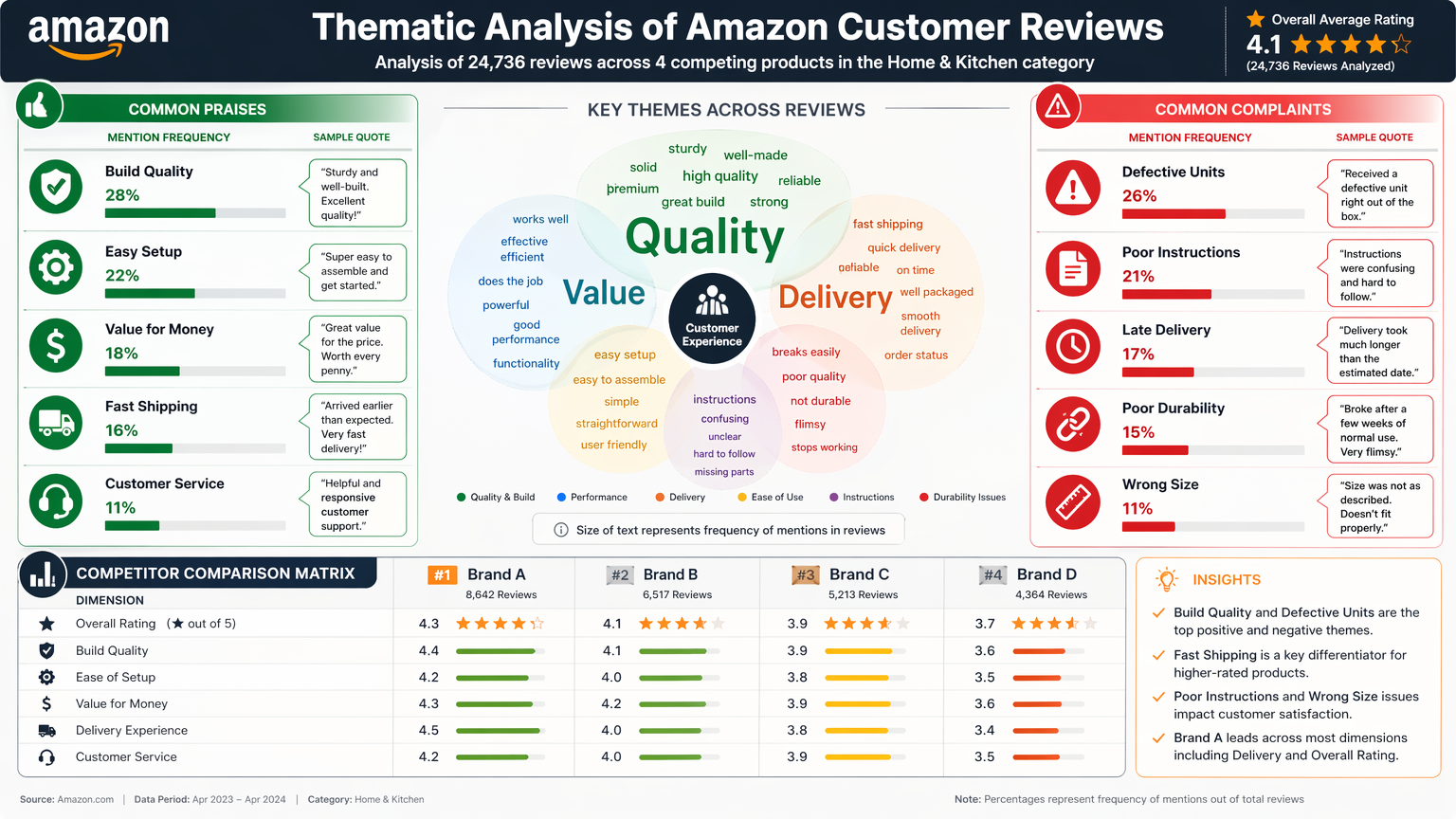
Classify feedback into positive, negative, and neutral sentiments. Then group comments into themes such as durability, ease of use, packaging, or customer service. For instance, if 30% of negative reviews mention "battery life," that's a clear area for improvement.
Step 4: Prioritize Actionable Insights
Not all feedback requires action. Focus on recurring issues mentioned across multiple products and reviews. High-frequency pain points with emotional language (e.g., "frustrating," "broken after one week") should be top priorities.
Step 5: Apply Findings to Your Product Strategy
Use insights to refine your product design, listing copy, or customer support. For example, if users complain about unclear instructions, include a QR code linking to a video tutorial. You can also highlight solved pain points in your bullet points to differentiate your listing.
Using Sentiment Analysis to Boost Sales
Sentiment analysis of Amazon reviews goes beyond counting stars. It helps you understand the emotional tone behind customer feedback, enabling smarter business decisions. Positive sentiment can inform your marketing messaging, while negative sentiment reveals risks to mitigate.
For example, if sentiment analysis shows strong positive reactions to "easy setup" but negative sentiment around "long charging time," you can emphasize quick installation in ads while working on battery improvements. This dual approach strengthens both short-term conversions and long-term product quality.
Advanced AI tools can even detect subtle shifts in sentiment over time. A gradual decline in positive comments might signal emerging quality issues before they impact your rating. Proactive monitoring allows you to address problems early, protecting your brand reputation and maintaining high seller ratings.
Best Tools for Amazon Review Mining
Manual review analysis is time-consuming and prone to bias. The best Amazon review mining tools use AI to process thousands of reviews instantly, delivering structured insights you can act on.
SellerSprite's AI-powered platform offers advanced Amazon product review analysis features, including:
- Automated sentiment classification (positive, negative, neutral)
- Keyword clustering to identify top pain points and delights
- Competitor benchmarking across multiple ASINs
- Trend detection over time to spot emerging issues
- Exportable reports for team collaboration
Compared to generic text analysis tools, SellerSprite is optimized for Amazon's unique review ecosystem. It understands e-commerce language patterns and filters out spam or irrelevant content, ensuring higher accuracy.
For sellers looking to scale, integrating review analysis into your product research workflow is essential. Learn more about how AI can transform your strategy in our complete AI for Amazon FBA guide.
FAQ
How can Amazon sellers use review analysis to improve product quality?
Sellers can identify recurring complaints in customer reviews, such as durability issues, missing features, or usability problems, and prioritize these in product redesigns. By addressing the most frequent pain points mentioned across competitor and their own reviews, sellers can create superior products that meet real customer needs and reduce negative feedback.
What are the best tools for analyzing Amazon customer reviews in 2026?
In 2026, the best tools for Amazon review analysis combine AI-powered sentiment detection, keyword clustering, and competitor benchmarking. SellerSprite is a leading solution tailored for Amazon sellers, offering accurate, fast, and actionable insights from thousands of reviews. It integrates seamlessly into product research and listing optimization workflows, making it ideal for both new and established brands.
How does sentiment analysis of Amazon reviews help in boosting sales?
Sentiment analysis helps sellers understand customer emotions behind reviews. By highlighting positive sentiments in product titles, bullet points, and ads, sellers can strengthen conversion rates. At the same time, addressing negative sentiments through product improvements or better instructions reduces returns and increases satisfaction, leading to higher ratings and better organic ranking on Amazon.
Next Steps
- Start analyzing top competitor reviews today using SellerSprite's free trial.
- Explore how review insights can drive product differentiation in our guide on analyzing reviews for product differentiation.
- Validate new product ideas with accurate demand data using our competition and demand evaluation framework.
References
- AI for Amazon FBA Guide View
- Analyze Amazon Reviews for Product Differentiation View
- Evaluating Competition and Demand for Your Product Ideas View
By SellerSprite Team
The SellerSprite Team combines deep expertise in Amazon FBA, AI-driven analytics, and e-commerce growth strategies. With years of hands-on experience helping thousands of sellers optimize product research, pricing, and customer feedback analysis, we deliver actionable insights grounded in real-world performance data.