TL;DR: Amazon review verification helps shoppers understand how certain reviews relate to real purchases, but no badge can guarantee that every opinion is accurate or useful. A Verified Purchase label means Amazon confirmed qualifying purchase conditions. Vine reviews are identified separately, and some genuine experiences may appear without a Verified Purchase label. For sellers, the responsible approach is to monitor review patterns, use Amazon-approved request channels, investigate recurring complaints, and report suspected policy violations with specific evidence. Reviews are most useful when they inform better products and clearer customer expectations, not when they are treated as a rating target to manipulate.
Key Takeaways
- Verified Purchase confirms qualifying transaction conditions, not review truth. The badge is useful context, but it is not a guarantee that every claim in the review is correct.
- No badge does not automatically mean fake. Genuine customers may describe products obtained outside Amazon or through other eligible circumstances.
- Vine is a distinct Amazon-managed program. Free products are supplied to invited reviewers for independent feedback, without seller control over the rating.
- Review requests must remain neutral. Avoid compensation for Amazon reviews, selective solicitation, review-linked refunds, or asking dissatisfied buyers to remove criticism.
- Use review patterns as investigation signals. Repeated fit or quality complaints can guide verification, listing corrections, and product development, but review counts are not automatically defect rates.
Table of Contents
- Amazon Reviews and Verification: What Is Actually Verified?
- Verified Purchase, Vine, and Reviews Without Badges
- Read Review Evidence Without Playing Detective
- How Sellers Can Request Reviews Without Influencing Them
- Resolve the Problem, Not the Star Rating
- Turn Review Themes into Product Decisions
- Monitor Ratings, Review Growth, and BSR Carefully
- A Hypothetical Review Investigation
- A Review-Health Routine That Does Not Chase Stars
- Trust Comes from What the Business Does Next
- FAQs
- References
Scope: This guide addresses Amazon.com product reviews for US sellers and shoppers. Product reviews are distinct from seller feedback and product ratings without written comments. Amazon's reviewer eligibility, moderation, messaging, and account access requirements can vary by marketplace and change over time. The compliance discussion is operational guidance, not individualized legal advice.
Amazon Reviews and Verification: What Is Actually Verified?
Two customers leave five-star reviews for the same kitchen scale. One review carries a Verified Purchase badge; the other does not. Both describe the display and weighing tray in detail.
Should the first automatically be trusted and the second dismissed? No. The badge communicates something specific about the purchase relationship, while the review itself still needs to be evaluated for relevance, accuracy, and useful detail.
Amazon reviews and verification are best understood as overlapping systems: eligibility to submit a review, transaction verification, disclosure of special review programs, and Amazon's efforts to detect review manipulation.
What Verified Purchase means
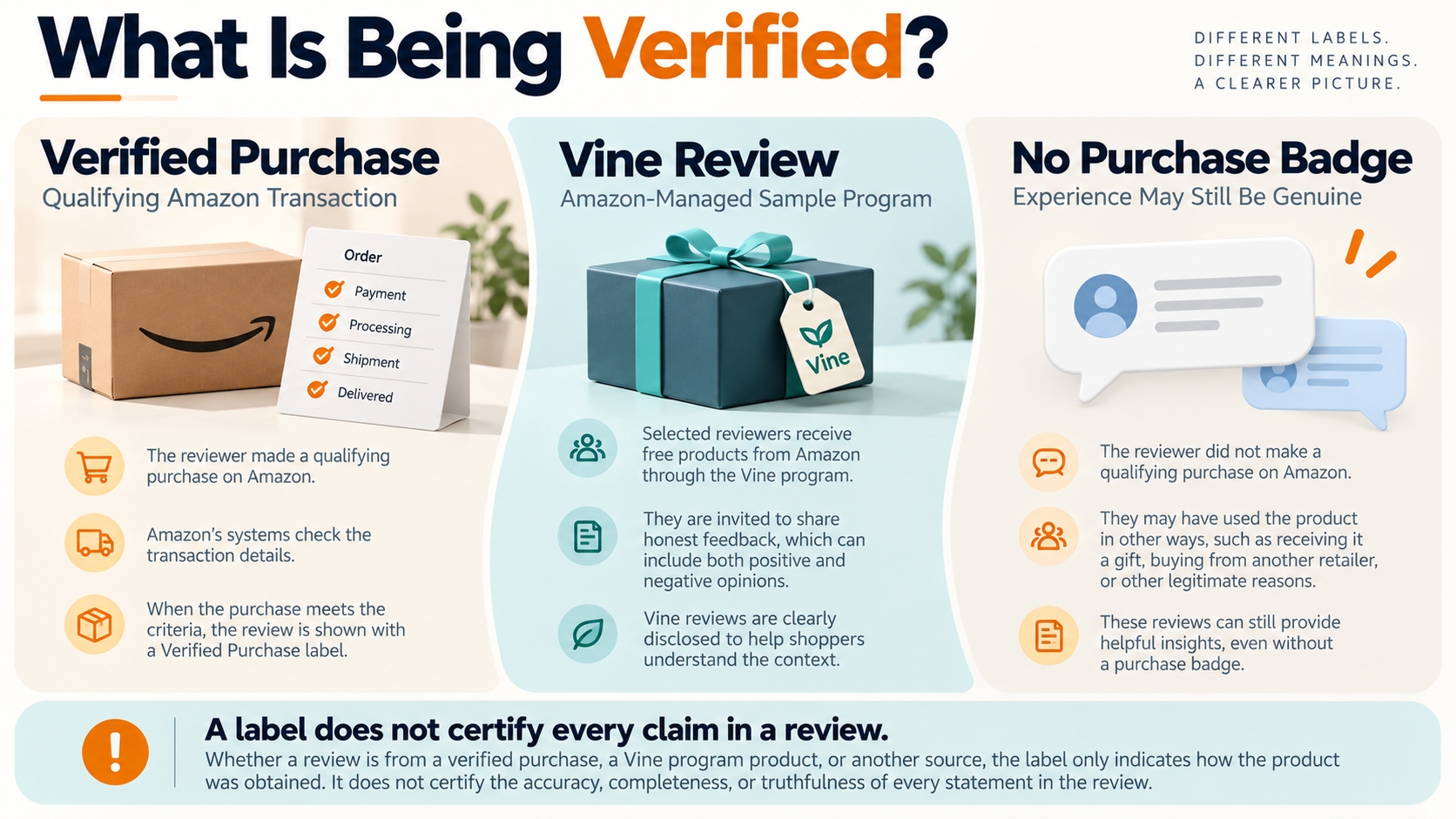
Amazon explains that it checks whether the reviewer bought the product through Amazon and paid a price available to most Amazon shoppers. When those conditions are confirmed, Amazon can label the review Verified Purchase.
This is a transaction-related signal. It does not certify the reviewer's technical expertise, make an opinion objective, or establish that every statement is factually correct.
What the badge does not establish
- That a product is free from defects or safety issues.
- That the reviewer's expectations match those of every other customer.
- That all review manipulation is impossible.
- That reviews without the badge are necessarily fabricated.
Amazon operates additional automated and human-led review-integrity systems. Those efforts are broader than the Verified Purchase label and involve detecting suspicious activity, abusive behavior, and policy violations.
The key distinction: Verification helps establish a qualifying purchase connection. Credibility still depends on the content, context, and consistency of the reviewer's experience. Neither a badge nor an unusually detailed review is conclusive proof of authenticity.
Verified Purchase, Vine, and Reviews Without Badges
Amazon's review system includes several different contexts. They should not be grouped into a single binary judgment of "real" or "fake".
| Review context | What it indicates | What to avoid assuming |
|---|---|---|
| Verified Purchase | Amazon confirmed its qualifying purchase and pricing conditions. | The opinion, product claim, or user experience was independently certified. |
| Vine Review | The feedback was submitted through Amazon's invitation-based Vine program. | The seller chose the reviewer's rating or the review is necessarily positive. |
| Review without Verified Purchase | The review does not carry Amazon's qualifying-purchase badge. | The reviewer has no genuine experience with the product. |
Why genuine reviews may lack the purchase badge
Someone may have received a product as a gift or purchased it through another retailer. Amazon permits certain eligible customers to share genuine experiences without a Verified Purchase designation, subject to its reviewer eligibility and community requirements.
Such a review may still contain valuable product information. Its missing badge should prompt appropriate context, not automatic dismissal.
Vine is not a private review-buying arrangement
Amazon Vine provides enrolled products to selected reviewers called Vine Voices. Amazon manages the program, and participants are expected to provide independent feedback. Sellers cannot control the opinion or contact Vine Voices directly to influence their reviews.
The Vine designation provides transparency about the program context. It should not be confused with a routine verified purchase or with a brand privately offering refunds in exchange for reviews.
Read Review Evidence Without Playing Detective
A suspicious-looking review is not automatically a fake review. Similar wording, a short comment, or a sudden increase in review activity can occur for reasons other than manipulation.
The useful approach is to distinguish observations that deserve investigation from conclusions that require evidence Amazon may have and sellers do not.
Look for context in individual reviews
A review describing the product variation, actual use, and the conditions under which something succeeded or failed is often more informative than a generic statement of satisfaction. Photos and videos may offer additional context, provided they depict the relevant product and can be interpreted accurately.
But detail alone does not prove authenticity. A short review can reflect a genuine customer experience, while a long review can still be inaccurate or misleading.
Examine patterns before drawing conclusions
Patterns worth checking include unexplained review bursts, comments apparently referring to a different product variation, repeated promotional wording, or an unusual mix of ratings around a launch or promotion.
None of those observations, taken alone, establishes manipulation. Review arrival can lag behind delivery, promotional periods can change the number of eligible buyers, and legitimate product variations can share review displays.
Report possible violations, not speculation
If a review appears to violate Amazon's community guidelines, use Amazon's available reporting mechanism. Identify the specific content and why it may violate the relevant policy rather than labeling the reviewer fraudulent based only on a low rating or an unfavorable opinion.
Amazon's public Customer Reviews tool overview explains that sellers cannot edit customer reviews and may report reviews that violate community rules. Amazon determines whether removal is warranted.
A useful evidence standard: Record the review date, relevant ASIN and variation, the visible content, and the specific concern. Keep an uncertain signal labeled as uncertain. The business should investigate possible product problems separately from suspected review-policy violations.
How Sellers Can Request Reviews Without Influencing Them
Sellers understandably want more customer feedback. The problem begins when a request turns into an attempt to select the expected opinion or attach compensation to an Amazon review.
The safest operational distinction is between requesting an independent review through Amazon's permitted channels and trying to purchase or direct the rating itself.
Use Amazon's Request a Review feature
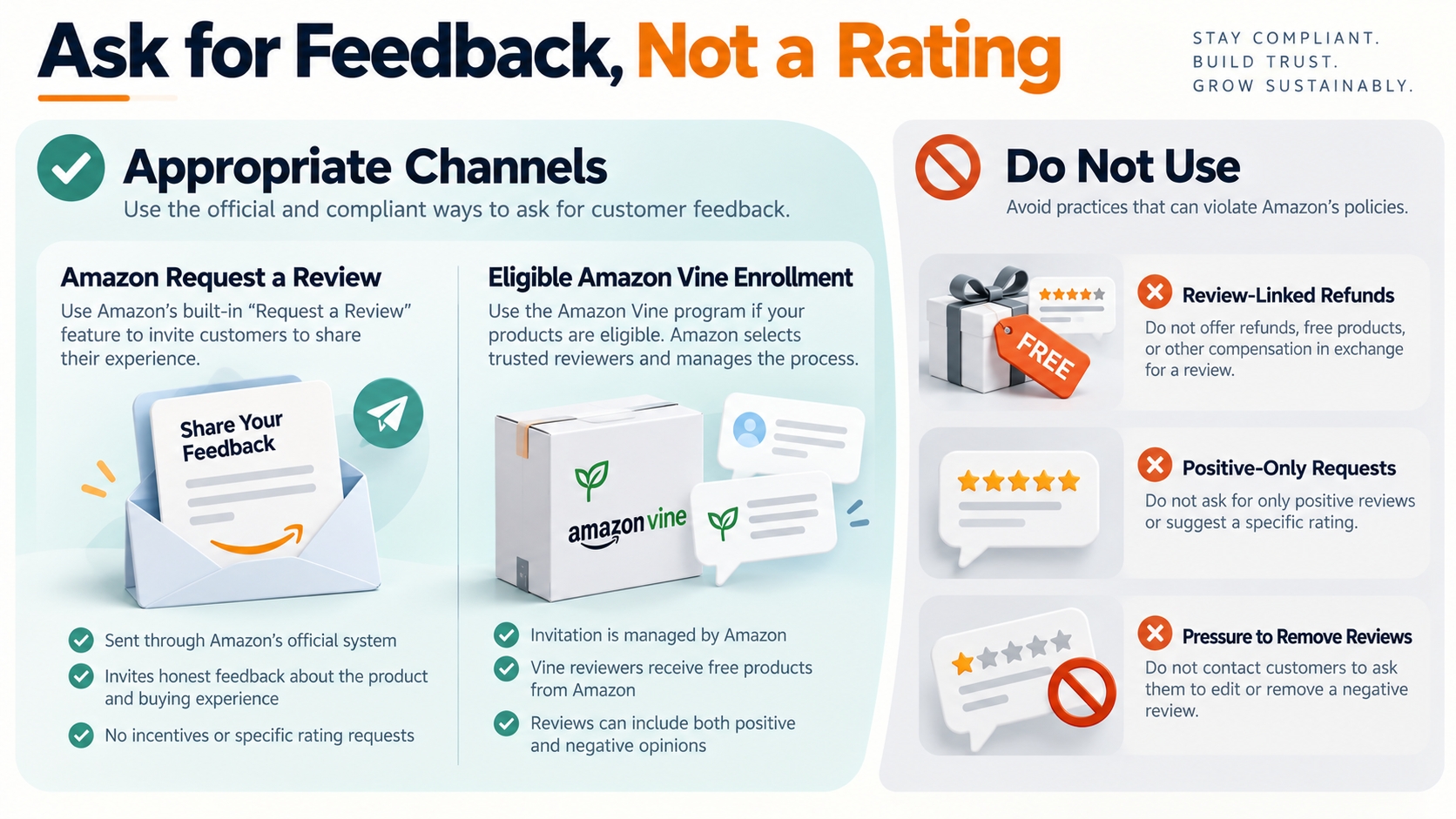
Amazon's Request a Review option in Seller Central sends a standardized request associated with an eligible order. It avoids the need to invent a more persuasive message or decide which customers appear likely to give favorable feedback.
Use the applicable Amazon order and communication eligibility rules. Do not add a separate message promising a benefit for submitting a review or requesting a particular rating.
Neutral wording is necessary, but not enough to authorize an incentive
A message such as "Leave any honest review and receive a refund" still connects a benefit to Amazon review activity. Calling the feedback honest does not eliminate the underlying incentive.
The FTC's Consumer Reviews and Testimonials Rule prohibits specific deceptive practices, including incentives conditioned on positive or negative sentiment. Its guidance also explains that the rule does not prohibit every possible review incentive. Amazon's platform policies can be stricter, so sellers must comply with both rather than assume that an activity permitted under one framework is acceptable under the other.
Product inserts are not a private route around review rules
Packaging inserts and post-purchase communication should not direct only satisfied buyers to leave reviews while routing dissatisfied customers away from the review system. They should not offer gifts, cashback, discounts, or future benefits in exchange for a review.
Providing accurate setup instructions and legitimate customer support information is a separate activity from soliciting reviews. Keep those purposes distinct, and verify any insert content against the current Amazon rules before printing large quantities.
Vine is an official option for eligible products
Amazon Vine provides an authorized way for eligible products to receive independent product reviews from invited Vine Voices. Requirements include an eligible account and product, FBA fulfillment, and fewer than 30 existing reviews for the product detail page, along with other program conditions.
Enrollment is not a purchase of positive reviews. Sellers must accept that an independent Vine review may identify product weaknesses.
Resolve the Problem, Not the Star Rating
A one-star review describing a faulty latch is uncomfortable to receive. It may also be the first visible indication of a manufacturing or packaging problem that deserves immediate attention.
The seller's first question should be whether the reported issue is real and remediable, not how to get the rating removed.
The Customer Reviews tool has defined access and contact rules
Amazon's Customer Reviews tool is available to qualifying Professional sellers with the Brand Representative role for brands enrolled in Amazon Brand Registry. Its public guide describes review monitoring and permitted customer contact for reviews below three stars.
Amazon provides specific options, such as offering a full courtesy refund or requesting additional information to help resolve a customer issue. These communications occur through Amazon's supported workflows and are not invitations to negotiate the rating.
A refund cannot be conditional on changing a review
Offering a genuine remedy for a customer problem is different from telling the buyer that a refund depends on deleting or increasing a star rating. The second arrangement attempts to influence the public review record and should not be used.
Amazon specifically instructs sellers not to attempt to influence ratings or ask customers to remove negative reviews. The FTC also warns that paying to suppress truthful criticism can create deceptive-review concerns.
Separate product complaints from seller feedback
A product review should describe the item and the buyer's product experience. Seller feedback is a separate channel concerning the transaction or service provided by a merchant.
When a comment concerns a late shipment, inspect whether it belongs in the product review or seller-feedback process. Do not assume that an unfavorable shipping complaint is automatically eligible for removal; apply the appropriate Amazon reporting rules and allow Amazon to decide.
A useful response standard: Investigate the reported issue, offer appropriate assistance through permitted channels, document the outcome, and correct any underlying product or process problem. Leave the decision to modify a legitimate review with the customer.
Turn Review Themes into Product Decisions
Reviews are often treated as a public reputation score. For product teams, their greater value can be the details that explain why expectations were met or missed.
A productive workflow begins with a defined question, gathers relevant reviews, checks the context, and turns the findings into an action that can be verified.
Start with specific review themes
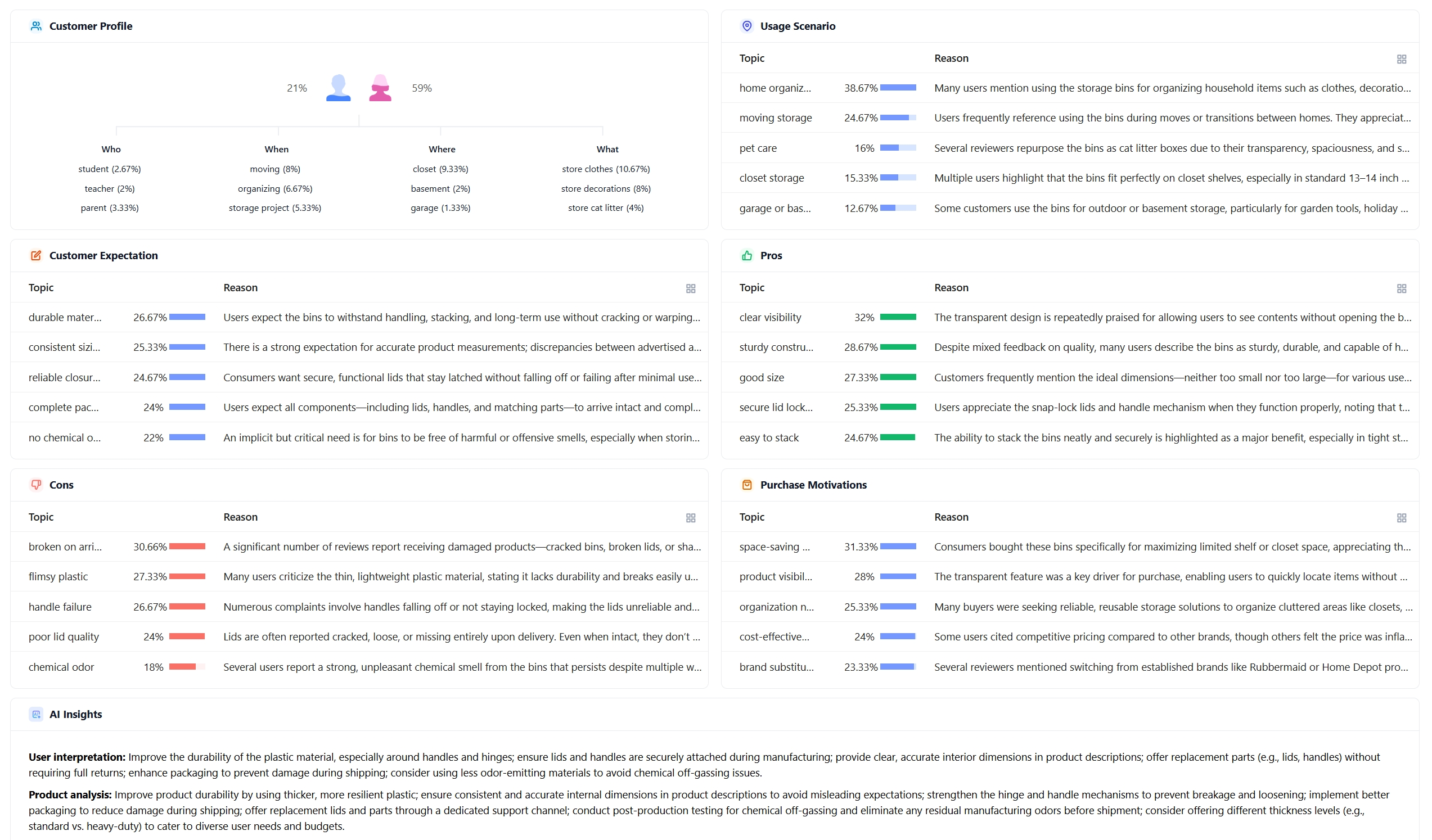
Group relevant feedback by product quality, sizing or fit, usability, instructions, included accessories, packaging, and expectations created by the listing. Keep compliments and criticism together so the analysis does not become a selective search for negative comments.
Compare the same product variation and a clearly defined time period. A parent ASIN's aggregated review experience can conceal problems specific to one size, color, model, or production batch.
Use analysis tools to organize, not authenticate, reviews
SellerSprite's AI Review Analysis guide explains how sellers can examine available reviews from their own products or competitors and organize findings around strengths, weaknesses, usage scenarios, expectations, and purchase motivations.
The tool helps synthesize review content. It does not independently verify that every reviewer purchased the item or determine with certainty whether a review is fraudulent. AI-generated summaries should be checked against the original reviews and relevant product variations.
Turn a theme into a decision
THE OBSERVATION
Several reviews mention that a storage container is smaller than expected.
THE VERIFICATION
Measure the product, inspect the listing dimensions, review the imagery, and compare the relevant variations.
THE CORRECTION
Improve the dimension chart or usage photograph if the product is correct but the presentation is unclear. Escalate to the product team if the physical dimensions differ from specifications.
THE FOLLOW-UP
Examine later complaints and relevant returns while recording other changes that could affect the result.
The action should match the evidence. A misleading image can be corrected in the listing; a recurring manufacturing fault requires supplier investigation. Rewriting marketing copy does not repair a defective product.
Monitor Ratings, Review Growth, and BSR Carefully
Review health is not one number. The average rating describes an aggregate impression, while written feedback, rating volume, recent activity, and product-performance trends provide different kinds of context.
Track them separately. An increase in ratings does not necessarily mean an equivalent increase in written reviews, and neither should be treated as a direct count of new customers.
| Metric | Useful interpretation | Important limitation |
|---|---|---|
| Average rating | Broad customer-satisfaction signal over the displayed rating population. | Does not describe every customer experience or variation. |
| New ratings or reviews | Whether recent feedback activity is changing over a defined interval. | Feedback lags orders; removals and display changes can alter net growth. |
| Recurring negative themes | Which product or expectation problems deserve investigation. | Theme frequency within reviews is not a population-wide defect rate. |
| BSR and sales estimates | Provides demand and market-performance context alongside reviews. | Does not prove that a rating change caused sales movement. |
| Policy concerns | Flags specific reviews or communication tactics that warrant a policy check. | A suspicious pattern is not an established violation without supporting evidence. |
Ratings and written reviews are not identical counts
Amazon supports product ratings that do not require a written review. Therefore, total rating growth should not be labeled "new written reviews" unless the reporting source specifically measures written review entries.
This distinction matters for competitor comparisons and review velocity. The metric name, date window, product variation, and data source should be preserved whenever results are reported.
Track the context around rating changes
SellerSprite's Product & Keyword Tracker guide describes monitoring product prices, ratings, BSR, and other marketplace indicators over time. Those data can provide context when a seller is investigating a change in review activity.
Record launches, packaging changes, promotions, inventory disruptions, and listing revisions. If an average rating improves while the seller also changes the product and price, the trend cannot be assigned to one intervention without stronger evidence.
A Hypothetical Review Investigation
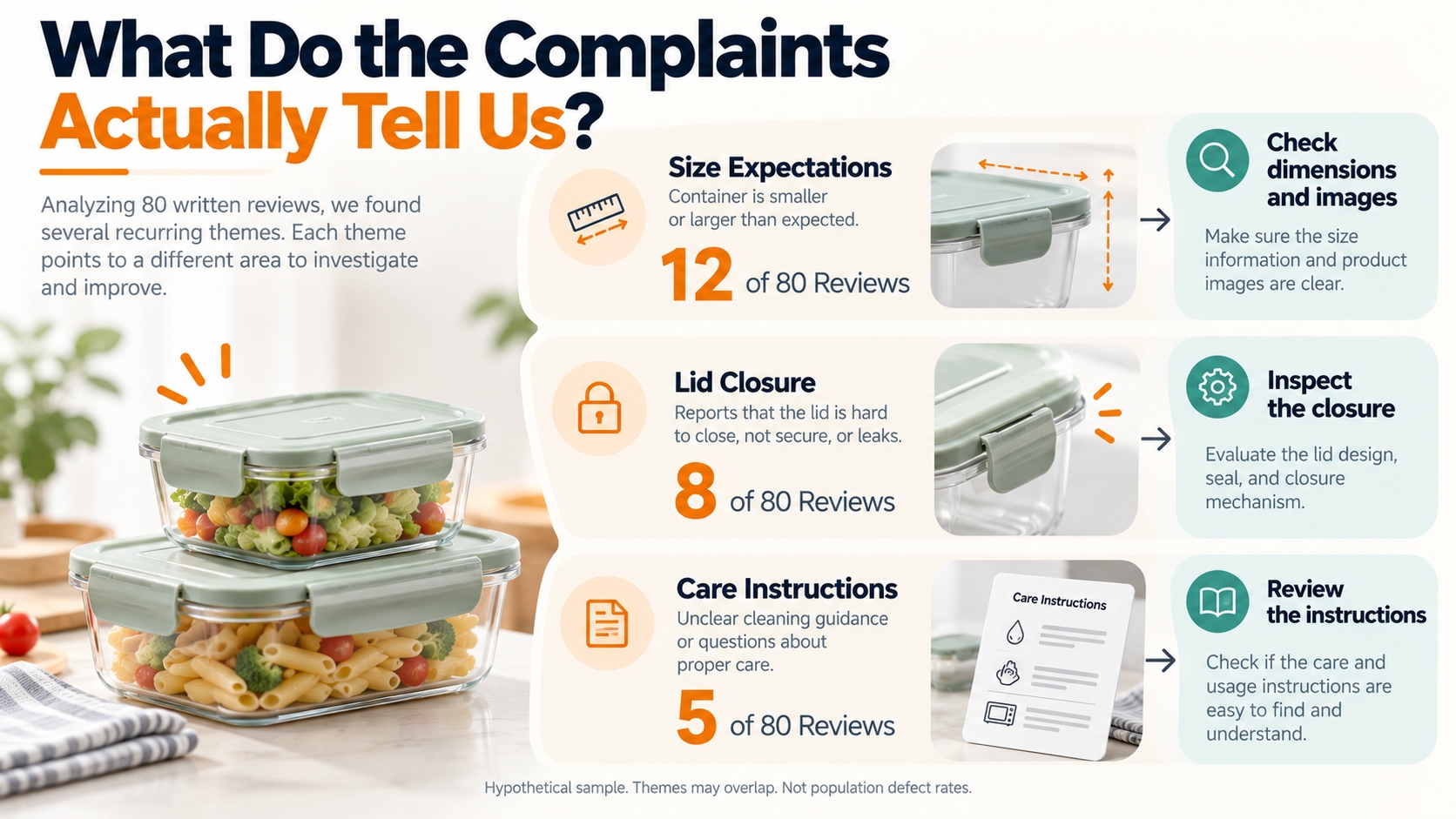
Consider a fictional brand selling a reusable food container. The team reviews 80 relevant written reviews posted during a defined recent period. Twelve mention unexpected size, eight describe difficulty closing the lid, and five discuss unclear care instructions. Some reviews mention more than one issue.
The numbers can help prioritize investigation. They do not establish that the product has a 15% sizing defect rate or that 10% of all customers experience a lid problem.
Illustrative Theme Review
Sample: 80 written reviews from the chosen period.
Size concerns: 12 / 80 = 15% of sampled reviews.
Lid concerns: 8 / 80 = 10% of sampled reviews.
Care-instruction concerns: 5 / 80 = 6.25% of sampled reviews.
Hypothetical example. Categories may overlap, the sample may not represent all buyers, and these percentages describe mentions among reviewed comments rather than verified product defect rates.
Investigate the largest issue first
The team measures the container, reviews the product detail page, and checks whether lifestyle photographs make it appear larger than the stated dimensions. If the physical product is correctly manufactured, the action may be to improve the dimensions and comparison imagery.
The lid concern requires a separate inspection of the closure mechanism and production batches. Revised copy should not be used as a substitute for correcting a verified manufacturing problem.
Define what improvement would look like
The team can monitor whether subsequent reviews continue to report size confusion after the listing is corrected. It can also examine relevant returns and customer support cases where those data are available.
Keep the original review period and the revised period comparable where possible, while recording any changes in price, promotion, product design, or fulfillment. A simple decline in complaint mentions does not, by itself, demonstrate causation.
A Review-Health Routine That Does Not Chase Stars
Review monitoring works best as a recurring quality and customer-experience practice, not an emergency reaction to every low rating.
The right frequency depends on product sales, launch stage, recent changes, and the severity of issues reported. An emerging safety concern deserves immediate investigation; ordinary trend analysis can follow a predictable reporting schedule.
Monitor recent reviews and urgent issues
Review new feedback and prioritize specific concerns involving potential product harm, functionality failures, incorrect product descriptions, or recurring customer confusion. Route serious issues to the people responsible for product safety, quality, operations, and customer support.
Where permitted, use Amazon's communication tools to resolve individual customer issues. Do not offer remedies in exchange for modifying the public review.
Compare themes with competitors and past periods
Check whether competitors receive similar complaints and whether the issues are associated with particular products, versions, or usage circumstances. Compare comparable samples rather than treating different categories as identical customer populations.
Track the changes made to listings, products, and packaging. Keep the team informed about which corrective actions are complete and which observations still need verification.
Review performance without assigning unsupported causes
Monitor rating changes, new review counts, product demand, and customer support outcomes. When several business variables change at once, record the uncertainty instead of attributing a sales increase to review growth alone.
An effective review-health report should end with a clear action: investigate, correct, monitor, or close. It should not be judged solely by whether the average rating increased.
Trust Comes from What the Business Does Next
Amazon's verification labels provide useful information about where some reviews come from. They do not replace a reader's judgment, and they do not give sellers permission to control public feedback.
The practical value of reviews is not limited to a higher star average. Genuine feedback can expose unclear product claims, unexpected use cases, packaging weaknesses, and recurring failures that the business might otherwise overlook.
Sellers build trust by protecting review independence, investigating what customers report, and making product improvements that can be verified. That is more durable than trying to engineer a favorable rating.
FAQs
What does Verified Purchase mean on Amazon?
Amazon explains that the label indicates it confirmed qualifying purchase conditions, including that the reviewer bought the product on Amazon at a price available to most shoppers. The label verifies that transaction context, not the factual accuracy of every claim in the review.
Are Amazon Verified Purchase reviews always genuine?
The badge is a useful purchasing signal but not a universal guarantee of honesty, accuracy, or product quality. Amazon uses broader review-integrity systems to detect suspicious activity. Readers should still consider review detail, product variation, and relevant context.
Are reviews without a Verified Purchase badge fake?
Not necessarily. Some customers have genuine product experience through gifts or purchases outside Amazon and may be eligible to review without the purchase badge. Missing transaction verification does not automatically make the review fraudulent.
What is the difference between a Vine Review and a Verified Purchase review?
Verified Purchase reflects qualifying Amazon transaction checks. Vine Review identifies feedback submitted through Amazon's managed sample program by invited Vine Voices. Vine participants receive products for independent evaluation and are not required to provide favorable ratings.
Can sellers pay customers for honest Amazon reviews?
Sellers should not arrange review-contingent payments, gifts, or refunds outside Amazon's authorized programs. Even if an arrangement avoids demanding five stars, it may violate Amazon's stricter platform rules. The FTC's rules and Amazon's policies must be assessed separately.
How can Amazon sellers request reviews compliantly?
Amazon provides the Request a Review feature for eligible orders, and Amazon Vine is available to qualifying products. Sellers should avoid selective requests, review-linked rewards, pressure to post positive comments, or efforts to remove legitimate criticism.
Can a seller contact a buyer after a negative review?
Eligible brand sellers can use Amazon's Customer Reviews workflow for permitted contact concerning certain low-star reviews. The purpose is customer support or issue resolution, not persuading the customer to change or delete the review. The tool has specific account-role and contact requirements.
Can sellers remove fake or unfair reviews?
Sellers cannot directly edit or remove customer product reviews. They can report content that appears to violate Amazon's community guidelines, with specific supporting details. Amazon decides whether removal is appropriate. A negative or disputed opinion alone is not proof of a policy violation.
What is the difference between Amazon product reviews and seller feedback?
Product reviews concern customers' experiences with the product. Seller feedback concerns the merchant or transaction experience. The two use different Amazon workflows and should not be combined into one reputation score or treated as interchangeable account-health measures.
Does a rise in Amazon reviews mean sales are increasing?
Review activity may accompany sales activity, but it is not a direct sales count. Customers leave feedback after different delays, and not every purchase produces a rating or written review. Use appropriate sales data and historical context rather than converting review growth into guaranteed unit sales.
How can SellerSprite support Amazon review monitoring?
SellerSprite AI Review Analysis helps organize available customer feedback into themes such as product strengths, weaknesses, usage scenarios, and expectations. Product & Keyword Tracker provides historical context on ratings, price, BSR, and related product performance. Neither tool should be represented as an official Amazon review-authenticity certification service.
References
- Amazon: Behind the Scenes, How Amazon Maintains a Trusted Review Experience View
- Amazon: Customer Reviews Tool and Customer Contact Guidelines View
- Amazon: Customer Reviews as a Growth Tool View
- Amazon: Amazon Vine Program Overview View
- FTC: Consumer Reviews and Testimonials Rule, Questions and Answers View
- FTC: Final Rule Addressing Fake Reviews and Testimonials View
- SellerSprite: AI Review Analysis Guide View
- SellerSprite: Product & Keyword Tracker Guide View
- FTC: Featuring Online Customer Reviews, A Guide for Platforms View
By SellerSprite Content Team
The SellerSprite Content Team examines how customer feedback shapes product decisions in Amazon's marketplace. Our review-related editorial work focuses on review interpretation, product variation differences, changing customer expectations, and the limits of marketplace data. We combine review-analysis and product-tracking research with public Amazon and regulatory guidance, emphasizing the distinction between customer observations, verified transactions, and evidence that a seller can independently substantiate.
Last reviewed: October 28, 2026