TL;DR: Amazon wholesale and B2B selling involve two different business decisions. Wholesale sourcing means buying inventory from manufacturers or distributors, usually under negotiated quantities and terms. B2B selling through Amazon Business means offering products to business customers, potentially with business-specific prices, quantity discounts, and bulk configurations. A seller can combine the two, but neither guarantees the other. Start with a qualified supplier and approved product, confirm real demand, then calculate whether the wholesale purchase and discounted selling prices leave enough contribution after fees and fulfillment costs. Do not place a large supplier order simply because the unit price falls at a higher minimum quantity.
Key Takeaways
- Wholesale sourcing and B2B selling are not interchangeable. One concerns where inventory comes from; the other concerns who buys it.
- Supplier qualification comes before purchase volume. Verify the source, product authenticity, applicable brand permissions, invoices, and replenishment terms.
- Amazon Business pricing adds another margin decision. A business price and a quantity discount can lower the realized unit price in separate stages.
- A large order is not necessarily a profitable order. Evaluate contribution per unit, total order contribution, remaining inventory, and cash tied up in the supplier's MOQ.
- Use B2B-specific reports to evaluate B2B results. General marketplace sales estimates help with product research but do not establish how much demand comes from business buyers.
Table of Contents
- Amazon Wholesale and B2B Market: Two Different Transactions
- Find a Supplier You Can Actually Reorder From
- Does the ASIN Have Demand Your Offer Can Reach?
- What Changes When the Buyer Is a Business?
- Business Price Is Not the Same as a Quantity Discount
- The Margin Test: One Supplier Quote, Three Selling Prices
- Thirty Units Sold Does Not Mean the MOQ Has Paid for Itself
- Quantity Discounts, Case Packs, and Pallets Are Different
- Fulfillment, Invoices, and Tax Need Separate Checks
- Did the B2B Discount Actually Help?
- Build a Pilot with a Reorder Gate
- The Advantage Is in the Contract, Not the Category
- FAQs
- References
Scope: This guide focuses on US Amazon sellers evaluating wholesale inventory and Amazon Business as a sales channel. It distinguishes supplier purchasing from business-customer selling. Specific brand approvals, invoices, tax treatment, fulfillment costs, and B2B feature eligibility must be verified for the actual account, product, and transaction. Calculations are hypothetical.
Amazon Wholesale and B2B Market: Two Different Transactions
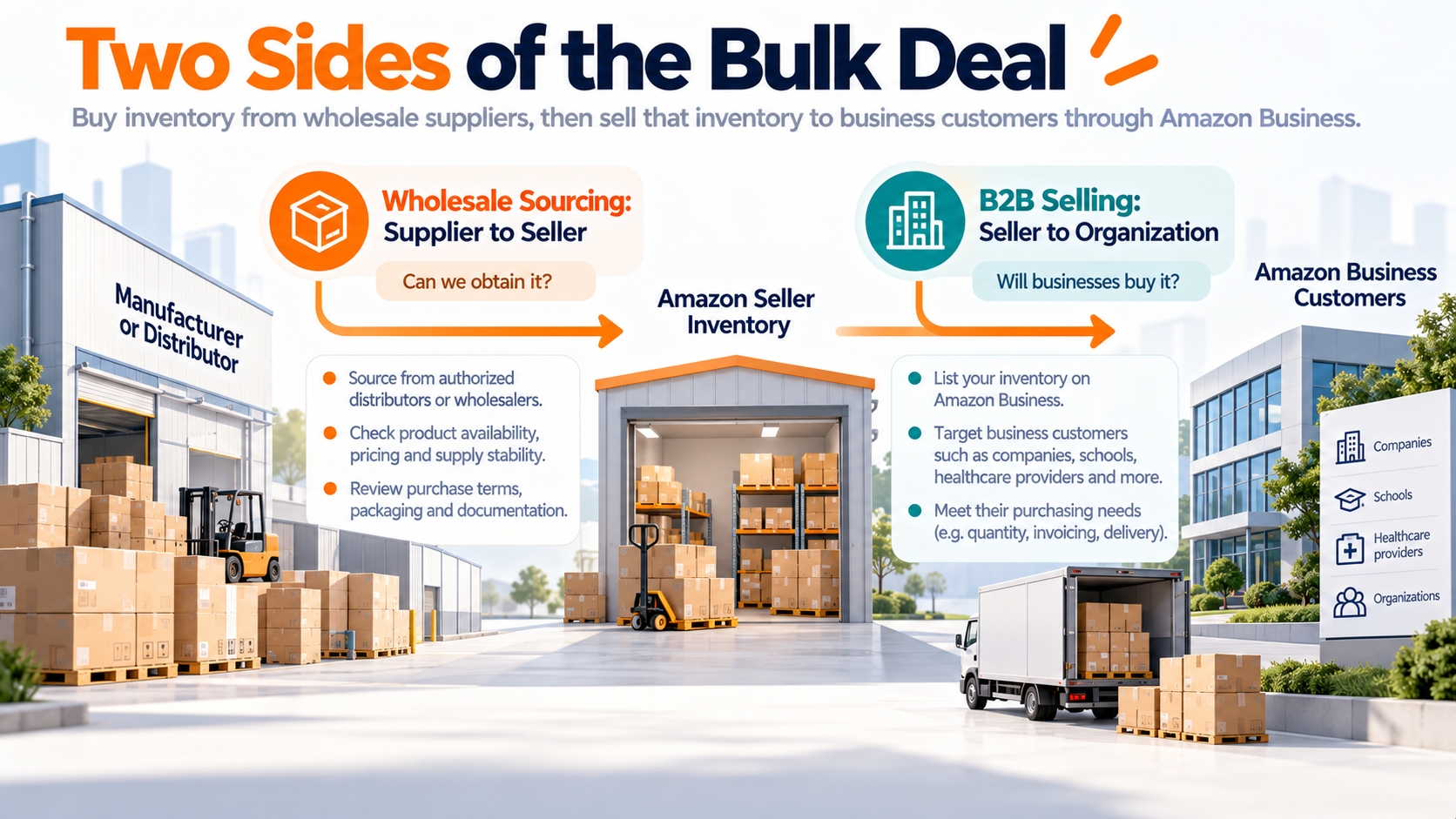
A distributor offers 120 units of a workplace organizer at $7.50 each. A nearby office manager needs 30 organizers and prefers to buy through Amazon. The distributor and office manager are both businesses, but they occupy opposite sides of the seller's operation.
The first transaction determines how inventory is obtained. The second determines how inventory is sold. Understanding the difference is essential before choosing a product, negotiating a minimum order, or setting a discount for business customers.
Wholesale sourcing: buying from an upstream supplier
Wholesale sourcing generally involves purchasing goods from a manufacturer, distributor, or other legitimate supply partner, often at negotiated prices and minimum quantities. A reseller then lists eligible inventory on Amazon and competes for orders.
Wholesale is not inherently an Amazon Business selling program. A seller can purchase inventory wholesale and sell entirely to ordinary retail customers. Supplier eligibility, authorization, and product compliance are separate responsibilities.
B2B selling: offering products to organizational buyers
Amazon Business provides selling tools for reaching verified business customers such as companies, schools, nonprofits, and other organizations. These customers may value bulk availability, business-specific prices, quantity discounts, invoicing, and the ability to find appropriate products for their operations.
A seller can use Amazon Business without sourcing every product through a traditional wholesale contract. Conversely, being approved to purchase from a wholesaler does not automatically mean that the product will attract business buyers.
UPSTREAM: WHOLESALE SOURCING
Can we buy it reliably?
Supplier legitimacy, product authorization, MOQ, unit cost, invoice quality, delivery time, and restock terms.
DOWNSTREAM: AMAZON B2B SELLING
Will businesses buy it profitably?
Buyer demand, relevant ASINs, business prices, quantity tiers, fulfillment, order economics, and payment timing.
The strongest wholesale-to-B2B model connects both sides. It secures dependable inventory at an acceptable cost, then sells it in configurations and quantities that make economic sense for the buyer and the seller.
Find a Supplier You Can Actually Reorder From
A wholesale quote can look attractive without being commercially useful. A distributor might require a large opening order, provide an incomplete catalog, or have uncertain restock dates. Those conditions can be more consequential than a small difference in unit price.
Begin with the supplier relationship. A low price from a source that cannot demonstrate the product's origin or fulfill repeat orders is not the foundation of a reliable inventory business.
Qualify the supplier before requesting a larger discount
Amazon's public guide to finding wholesale suppliers covers supplier research, purchase documentation, logistics, and resale approval. Use it as a starting point, then validate the specific supplier and products involved.
- Source identity: Is the company the manufacturer, an authorized distributor, or another traceable seller? What relationship does it have with the brand?
- Product documentation: Can it provide itemized invoices, manufacturer identifiers, relevant product compliance records, and the documents needed for applicable Amazon approval?
- Commercial terms: What are the MOQ, price breaks, payment terms, freight charges, lead time, and cancellation conditions?
- Receiving quality: Are quantities, packaging versions, labels, expiration dates where relevant, and case configurations consistent?
- Replenishment: How often can the supplier restock, and can it support the same product specifications across orders?
Brand authorization and authentic inventory are separate checks
Wholesale purchasing does not automatically grant permission to list every product on Amazon. Some brand, category, ASIN, or condition restrictions require approval through the seller account.
For branded-product applications, Amazon may request a manufacturer or distributor invoice, or a qualifying brand authorization letter. In its general wholesaler guidance, Amazon describes invoice checks such as supplier identity, itemized products, a recent date, matching buyer details, and a sufficient purchased quantity.
The requirements are application-specific. A commonly described invoice standard, such as a date within the last 180 days and ten purchased units, should not be treated as a universal approval guarantee. Check the actual requirements before placing the order.
Procurement rule: A legitimate invoice is evidence of a transaction, not automatic permission to sell. Never fabricate, alter, or misrepresent a purchase document. If the supplier cannot provide documentation required for the product, resolve that gap before increasing the MOQ.
Ask for the reorder terms, not just the opening price
The first quote often receives the most attention, but the second purchase reveals whether a sourcing strategy can be sustained. Ask whether repeat orders have different MOQs, whether pricing is stable, and what happens when a manufacturer changes the packaging or unit specification.
A supplier may offer a lower unit price for 300 units than for 120. That reduction only helps if the business can sell or otherwise recover the additional inventory without losing the savings through storage, deterioration, or working-capital pressure.
Does the ASIN Have Demand Your Offer Can Reach?
Once a supplier and product pass the initial checks, examine whether Amazon demand can support the proposed inventory commitment. A distributor's bestselling product is not necessarily an attractive Amazon resale opportunity.
The relevant questions concern the exact ASIN, customer demand, historical selling prices, existing sellers, and the share of orders a new offer could realistically capture.
Read BSR and historical demand together
Best Sellers Rank reflects a product's relative sales performance within its Amazon category. It can help identify products with activity, but one current rank is a poor basis for a wholesale order covering several months of inventory.
Check whether demand has been reasonably consistent, seasonal, or unusually elevated during promotions. Review available history for selling prices, BSR, and reviews. If a large wholesale order will take eight weeks to arrive, the demand assessment should consider the product's likely market conditions at the expected receipt date.
Review competition at the offer level
Several merchants may compete to sell the same ASIN. Look at the current offer count, fulfillment methods, availability, prices, and whether the brand or Amazon itself has an active offer.
The Featured Offer is not guaranteed to the lowest-price seller. A wholesale business must assess whether it can participate competitively without continually sacrificing its expected margin.
Use SellerSprite for product-side research, not supplier validation
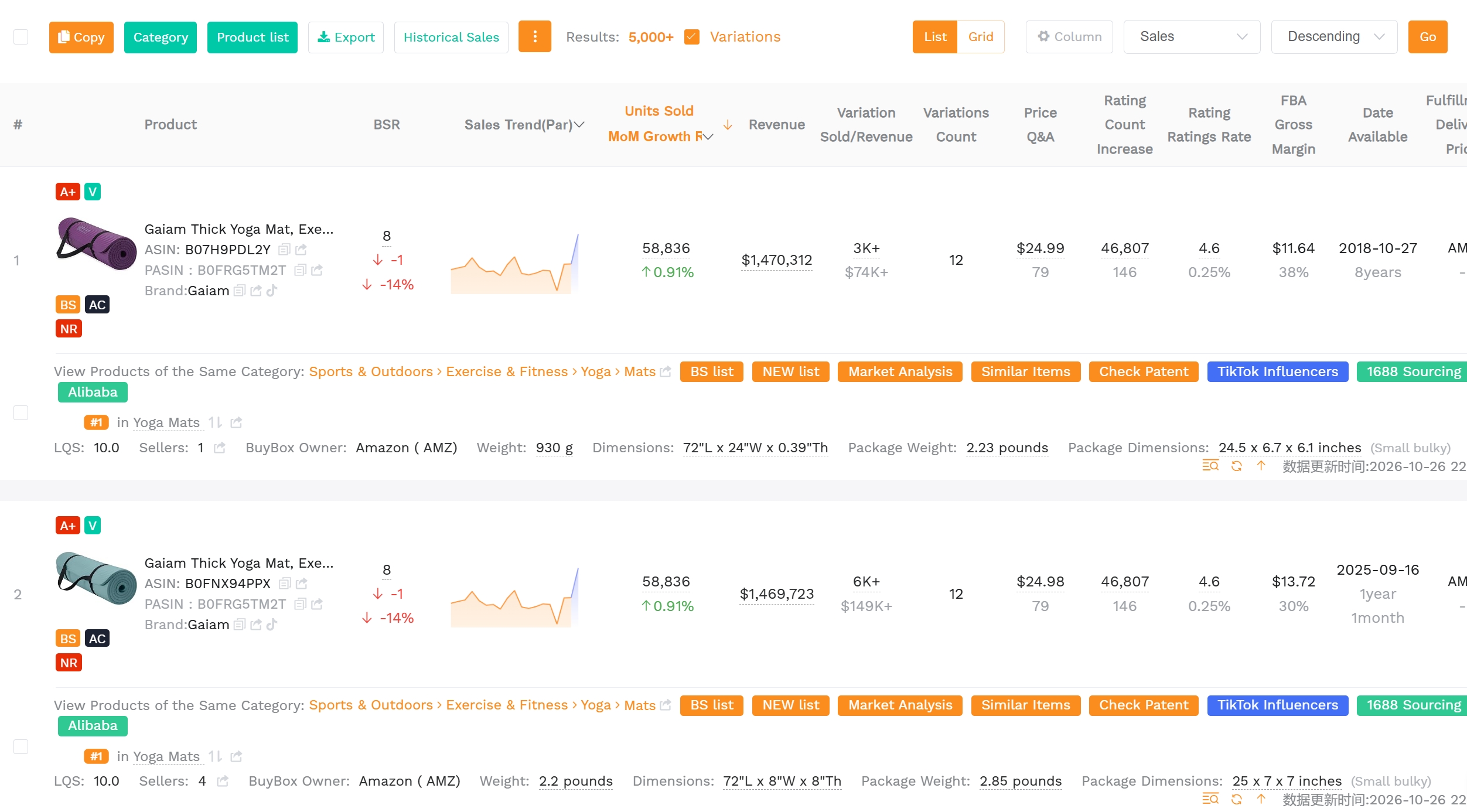
SellerSprite's Product Research walkthrough describes marketplace filters, estimated sales trends, BSR, price history, product comparisons, and tracking workflows.
These signals can help compare the products on a wholesale supplier's price list. They do not establish that the supplier is authorized, that an invoice will be accepted, or that the reseller can obtain a particular share of product-level sales.
They also should not be interpreted as a verified breakdown of Amazon Business customer purchases. B2B-specific sales evidence becomes available from the seller's own account reporting and Amazon Business tools, not from an ordinary estimated market-demand chart.
Research boundary: Product-level market demand is not your expected sales volume. Evaluate the ASIN's history, your offer's competitive position, the supplier's MOQ, and the time required to receive inventory before treating projected sales as a purchasing plan.
What Changes When the Buyer Is a Business?
A consumer might purchase one organizer because a home office needs a little more storage. A company may purchase 30 units to equip a team. Both orders involve the same type of product, but the purchasing requirements and economics can be different.
Business customers may prioritize predictable quantities, repeat availability, procurement documentation, consolidated ordering, and delivery timing. The seller needs to make the product easy to evaluate and purchase in those circumstances.
Amazon Business extends the existing selling operation
Amazon's Amazon Business selling overview describes business pricing, quantity discounts, certifications, business profiles, quote requests, and additional B2B tools. Professional sellers can access these capabilities through B2B Central. They can continue using FBA or seller-fulfilled methods alongside the business-selling features.
Amazon Business does not require an entirely separate seller operation for ordinary eligible B2B offers. Amazon explains that FBA orders from business customers generally draw from the same inventory pool used for retail orders, except inventory reserved through applicable business-only arrangements.
Look for products an organization needs repeatedly
Office supplies, storage and organization products, cleaning supplies, packaging materials, and maintenance items can have organizational use cases. These are examples of product categories to research, not a claim that every item within them has strong B2B demand.
Consider whether the item solves a recurring procurement need, whether multiple units are useful together, and whether a buyer can reorder the same specification. Product compatibility, certifications where relevant, and dependable stock can matter more than novelty.
A buyer account is not proof of a wholesale supply relationship
Amazon Business can also be used by organizations buying supplies for their operations. But purchasing an item at a business price does not, by itself, establish a brand authorization, a manufacturer distribution agreement, or eligibility to resell it on Amazon.
Sellers sourcing for resale still need to verify the supplier, the product, their selling privileges, and the applicable transaction documentation. Business-buyer savings and wholesale-reseller authorization answer different questions.
Business Price Is Not the Same as a Quantity Discount
Setting a competitive retail price is only one part of selling to business customers. Amazon Business also supports business-specific prices and quantity discounts. They can work together, so the seller must understand how each affects the final unit price.
Amazon documents both percentage-based quantity discounts and fixed-price tiers. A quantity discount can apply when a buyer purchases a defined minimum number of units. The resulting price must be checked against costs rather than chosen solely to create a more attractive percentage.
Standard price
The regular selling price for the eligible consumer-facing offer.
Business price
A per-unit price available to Amazon Business customers. A seller may set it below the standard price to provide a business-specific offer.
Quantity discount
An additional eligible price reduction triggered by a purchase quantity, calculated under the configured percentage or fixed-price tier.
Know the reference price for every discount
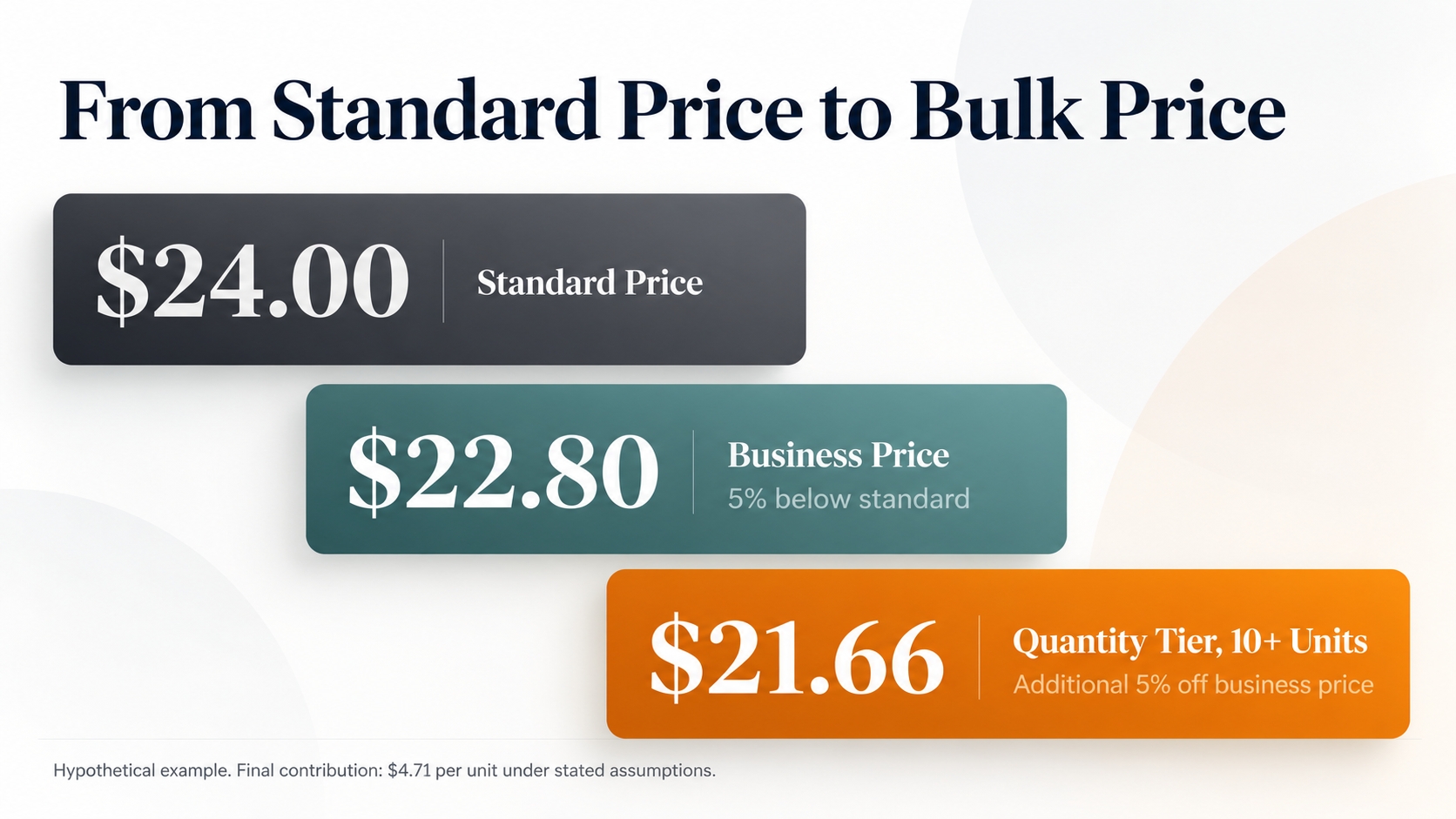
If the standard price is $24.00 and the business price is $22.80, business customers already receive a 5% reduction compared with the standard price.
If a further 5% quantity discount applies to the $22.80 business price for an eligible ten-unit order, the final price is $21.66 per unit. The two reductions are applied in sequence, not added as ten percentage points against the original $24.00 price.
Business Discount Insights can help identify pricing gaps
Amazon's Business Discount Insights tool highlights products that may benefit from business prices or quantity tiers. Depending on the product, it can show B2B Featured Offer pricing, business discount opportunities, and suggested tiers.
Treat the recommendations as inputs. A suggested discount may be competitive while still being too deep for a seller with expensive inventory or fulfillment costs. Review the actual cost basis before applying the recommendation across many SKUs.
Automated business pricing still needs a floor
Amazon supports static B2B prices and automated pricing rules. Automation can keep discounts aligned with other price settings, but sellers need to understand how their chosen rules interact with standard prices, promotions, and minimum thresholds.
For wholesale inventory, set a minimum acceptable realized price that accounts for the supplier's terms and the actual Amazon fees. An automated price rule should not quietly turn a viable wholesale product into a loss-making B2B offer.
The Margin Test: One Supplier Quote, Three Selling Prices
Consider a hypothetical non-regulated workplace organizer sold through FBA. A qualified supplier offers a minimum order of 120 individual units at $7.50 each. After allocated freight, inspection, and preparation, the seller's modeled landed cost is $9.00 per unit.
The seller wants to offer the same eligible unit to ordinary customers and Amazon Business buyers. The following example uses three selling-price scenarios and deliberately excludes any B2B-specific Amazon fee incentives.
First establish the cost of the supplier order
Hypothetical MOQ: 120 Individual Units
Supplier unit cost: $7.50
Allocated freight per unit: $0.90
Allocated inspection and preparation: $0.60
Modeled landed cost: $9.00 per unit
Initial 120-unit inventory commitment: $1,080
This $1,080 represents supplier cost, allocated freight, inspection, and preparation for all 120 units. It does not include future Amazon selling fees or fulfillment charges on orders that have not yet occurred. Taxes, financing, and additional overhead are excluded from the example.
Then compare consumer, business, and bulk prices
Assume a standard consumer price of $24.00, a single-unit business price of $22.80, and a further 5% quantity discount for business purchases of ten or more units. The resulting ten-unit tier price is $21.66 per unit.
For illustration only, assume a referral fee equal to 15% of the selling price, a $4.20 FBA fulfillment cost per unit, and a $0.50 planning allowance for storage and expected inventory problems. These are not current product-specific fee quotes.
| Per-unit economics | Consumer | Business single unit | Business 10+ units |
|---|---|---|---|
| Selling price | $24.00 | $22.80 | $21.66 |
| Landed cost | -$9.00 | -$9.00 | -$9.00 |
| Illustrative referral fee | -$3.60 | -$3.42 | -$3.25 |
| Illustrative FBA cost | -$4.20 | -$4.20 | -$4.20 |
| Storage and problem allowance | -$0.50 | -$0.50 | -$0.50 |
| Modeled contribution | $6.70 | $5.68 | $4.71 |
The business quantity tier leaves $4.71 in modeled contribution per unit, compared with $6.70 for a consumer sale. The tier has reduced contribution by $1.99 per unit before fixed overhead, income tax, and additional unmodeled costs.
The referral fee at $21.66 is calculated as $3.249 and rounded to $3.25 per unit for this example. Actual Amazon fee calculations and settlement rounding may differ.
A 30-unit business order changes the total, not the unit economics
Hypothetical 30-Unit Business Order
Order revenue: 30 × $21.66 = $649.80
Landed inventory cost: 30 × $9.00 = $270.00
Illustrative referral fees: 30 × $3.25 = $97.50
Illustrative FBA fees: 30 × $4.20 = $126.00
Allowance: 30 × $0.50 = $15.00
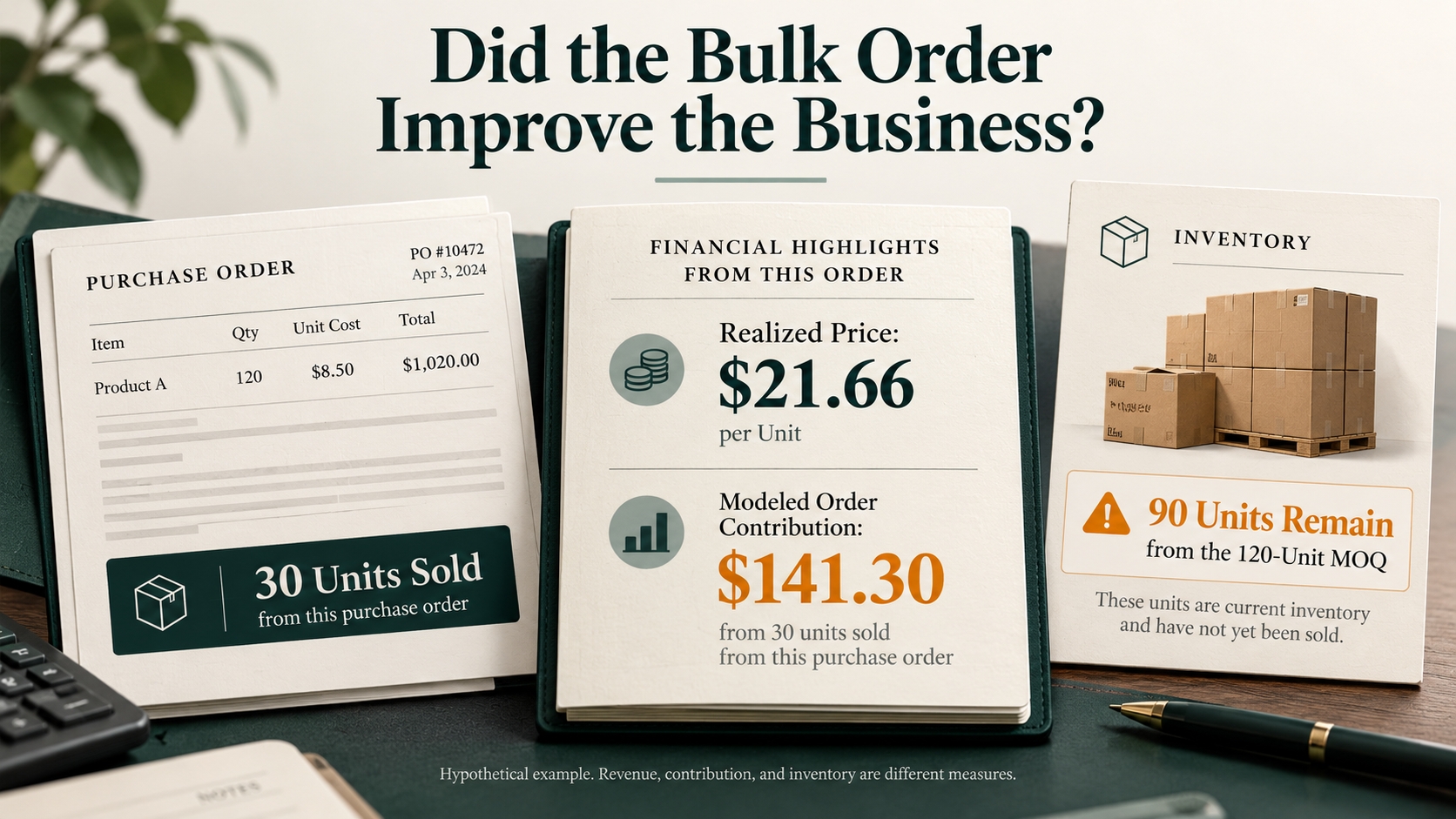
Modeled order contribution: $141.30
The $649.80 is revenue, not profit. The $141.30 is modeled contribution on those 30 units, not the net profitability of the entire 120-unit supplier purchase.
Do not count unverified B2B fee savings
Amazon describes possible referral-fee reductions and FBA multi-unit fulfillment discounts for qualifying Amazon Business orders. The rules vary according to purchase value, quantities, discount configuration, fulfillment method, and product eligibility.
Those savings are deliberately omitted from the worked example. Do not assume that every 30-unit business order qualifies for the largest available discount or that a fulfillment saving applies to all product dimensions and order types.
Before changing a business price, use Amazon's current product-specific fee information and verify any qualifying B2B fee reductions. Amazon's Revenue Calculator can help compare FBA and seller-fulfilled estimates, but the seller must also include its own landed inventory and operating costs.
Thirty Units Sold Does Not Mean the MOQ Has Paid for Itself
The wholesale supplier required the seller to purchase 120 units, but the hypothetical business order used only 30. Ninety units remain. Their future sale, storage, and potential recovery value are still unresolved.
That distinction matters because wholesale transactions usually commit cash before a buyer has purchased the inventory.
INITIAL INVENTORY COMMITMENT
$1,080
120 purchased units at a modeled landed cost of $9.00 each.
REMAINING INVENTORY
90 units
$810 in modeled landed inventory cost remains tied to unsold units.
The $810 is the original landed cost attributable to remaining units, not a guaranteed resale value and not an immediate additional loss. Whether inventory can be recovered at cost depends on future selling prices, demand, condition, and the appropriate accounting treatment.
MOQ discounts can hide an inventory problem
Suppose a supplier offers a lower unit price when the buyer increases the order from 120 to 300 units. The saving looks attractive when expressed per unit, but the larger order also commits substantially more cash and inventory.
Calculate the difference in total cash required, not only the difference in unit cost. Then ask how long it would take to sell the additional quantity under a conservative sales assumption. Freight, warehousing, damage, and price changes may offset the negotiated saving.
A wholesale reorder needs a cash-flow test
A profitable completed sale does not mean the cash has returned to the business immediately. Supplier payments, receiving lead times, FBA availability, sales settlement, and business-customer invoicing all affect cash timing.
Before placing the next purchase order, compare remaining inventory, observed sales pace, supplier lead time, the upcoming payment schedule, and the cash needed for operating expenses. Do not reorder solely because a product is displaying attractive estimated sales.
Quantity Discounts, Case Packs, and Pallets Are Different
When a business customer wants 30 units, the seller may be able to fulfill one order containing 30 individual products. That is not automatically the same as offering a manufacturer case pack containing 30 units.
The distinction affects catalog accuracy, product identifiers, packaging, fulfillment charges, and eligibility for certain bulk-selling features.
| Structure | What the buyer orders | Seller consideration |
|---|---|---|
| Quantity discount | Multiple individual units of an eligible offer at a quantity-based price. | Check tier pricing, stock availability, and applicable per-unit fulfillment costs. |
| Case pack | A defined package containing multiple units, sold as a configuration. | Verify its package quantity, product identifier, labeling, dimensions, and listing eligibility. |
| Pallet | A larger configuration of units or cases on a transport platform. | Confirm packaging hierarchy, handling, transportation, and supported fulfillment arrangements. |
Amazon Bulk Services has additional requirements
Amazon describes a Bulk Services program for eligible case-pack and pallet listings. Certain benefits depend on meeting program-specific seller, brand, package-identifier, and product-configuration requirements.
A seller should not assume that placing an offer on an existing case-pack listing automatically qualifies for package-hierarchy referral-fee discounts. The official guidance distinguishes standard case-pack listing methods from qualifying package hierarchies.
Do not create a new configuration merely to advertise a bulk price
If the customer is buying ten separate units, the listing must accurately describe those units. If the seller is offering a manufacturer case pack, its contents, package identifiers, and product detail page must match that configuration.
Consider the additional receiving, packaging, barcode, and shipment consequences before switching formats. Larger configurations are not necessarily more efficient for every ASIN or fulfillment method.
Fulfillment, Invoices, and Tax Need Separate Checks
The product may be suitable for bulk purchasing but poorly suited to the intended fulfillment model. A 30-unit order of lightweight organizers has different shipping implications from a pallet of heavy equipment.
Before offering deeper discounts, confirm how the actual order will be handled, when payment becomes available, and what documentation the buyer requires.
FBA and seller fulfillment remain separate cost decisions
Amazon Business supports FBA and seller-fulfilled orders. FBA can simplify picking, packing, delivery, and customer service, while FBM may offer more direct control over certain large or specialized shipments. Neither option is automatically cheaper for every bulk order.
Compare the actual unit or package configuration, shipping destination, weight, dimensions, and fulfillment charges. Bulk discounts should reflect genuine savings or commercial value, not an assumption that several units in one order always incur one fulfillment fee.
Pay by Invoice affects cash timing
Amazon Business customers may qualify for Pay by Invoice. Amazon's public US guidance explains that it handles the invoicing administration and customer credit process, while seller proceeds can be subject to an invoiced-order payment schedule.
Amazon describes payment protection under its program and states that seller funds are credited when the buyer pays or by the applicable guaranteed release point. Actual settlement and bank-transfer timing still matters to a seller that must pay its wholesale supplier before receiving proceeds.
Do not build a purchasing plan on an assumption that every business order is paid into the bank account immediately. Review current US invoiced-order terms and account payment reports before committing cash to the next supplier order.
Tax-exempt purchasing is not universal
Amazon Business offers tax-exemption features for qualified business purchases. Eligibility depends on the buyer, the transaction, and applicable tax rules. Having an Amazon Business account does not mean every purchase is automatically tax-exempt.
Wholesale purchasing can also involve resale certificates and state-specific tax obligations. Sellers should confirm the treatment of supplier purchases and customer orders with an appropriately qualified tax professional rather than use a single universal assumption in their unit economics.
Business procurement requirements can matter beyond price
Organizational buyers may look for consistent availability, business profiles, appropriate certifications, and reliable item descriptions. Amazon supports certain certification and profile features for eligible sellers, but does not issue the underlying certifications itself.
Use only accurate credentials and product claims. A business profile is not a substitute for legitimate documentation, and a buyer's need for a particular certification does not establish that every wholesale supplier can meet it.
Did the B2B Discount Actually Help?
After a business price or quantity tier goes live, the question is no longer whether the discount looks competitive. It is whether the seller's actual results justify the lower price and additional inventory commitment.
Amazon provides B2B Central and business-oriented sales reports to help sellers examine these results. Evaluate business sales and non-business sales separately rather than crediting the B2B discount for every change in total ASIN activity.
Read units, orders, traffic, and contribution together
| Metric | Useful question | Interpretation caution |
|---|---|---|
| B2B units and orders | Are business customers purchasing more units per order? | More units do not necessarily mean a higher contribution margin. |
| Average realized B2B price | How deep are the discounts actually taken by buyers? | Averages can hide different quantity tiers and product mixes. |
| B2B page traffic and conversion | Are relevant business shoppers reaching and ordering the product? | Changes may reflect price, seasonality, availability, or other factors. |
| B2B Featured Offer percentage | How often does the seller obtain prominent business-offer placement? | A competitive price does not guarantee that placement. |
| Net contribution and cash timing | Do completed business orders support the wholesale purchase and replenishment plan? | Revenue does not reveal unsold stock, fees, invoice delays, or fixed costs. |
Compare like-for-like periods and products
Amazon's public business-report guidance covers B2B Central, business-customer segments, sales and traffic reports, quantity discount impact, and ASIN-level analysis.
Compare equivalent periods where possible. If price, inventory availability, seasonality, promotion, or other product conditions changed at the same time, do not assume that a B2B quantity discount alone caused an increase in sales.
Use a contribution view, not revenue alone
A larger B2B order can increase revenue while reducing contribution per unit. The relevant outcome is the additional contribution and operating value gained from the order, after the applicable costs and discounts.
If a quantity tier attracts new orders that otherwise would not have occurred, the business may benefit despite a lower per-unit margin. If the same customers would have purchased at the existing price, the discount may reduce contribution without creating much additional demand. Ordinary before-and-after reports alone cannot fully establish that counterfactual.
A reporting principle: Track B2B and B2C orders separately, then reconcile both to the same inventory and cost records. Do not add B2B units on top of total units when those business sales are already included in the total.
Build a Pilot with a Reorder Gate
A wholesale-to-B2B strategy should begin with a controlled order that tests the assumptions most likely to fail. That can include supplier reliability, ASIN eligibility, incoming product quality, competitive pricing, and actual business-customer demand.
A 30-day review period can be useful as an operating checkpoint, although the right test length depends on supplier lead time, listing activation, and sales activity. Do not treat thirty days as a universal requirement or assume every product will generate enough orders during that period.
Before committing inventory
- Verify the actual supplier, brand relationship, product authenticity, and Amazon selling approval.
- Confirm exact ASIN specifications, pack quantities, condition, and any relevant compliance requirements.
- Analyze historical marketplace demand, selling prices, and competing offers.
- Calculate landed cost, MOQ cash requirements, normal selling margin, business-price margin, and quantity-tier margin.
- Establish the reorder trigger, maximum acceptable cash exposure, and response if units fail inspection or demand underperforms.
During receiving and launch
Verify what the supplier shipped against the purchase order, invoice, and Amazon listing. Record substitutions, damage, missing items, and the time required to make inventory available for sale.
Configure business prices only after the actual product and costs are confirmed. For a new B2B pricing experiment, start with a narrow SKU group rather than applying aggressive discount rules across the entire catalog.
Review the pilot and decide what to do next
REORDER
Product eligibility and supply quality remain sound, observed sales support a realistic inventory turnover, and contribution is sufficient under current costs and prices.
RENEGOTIATE OR REVISE
Demand is plausible, but the supplier's MOQ, freight, payment terms, fulfillment method, or business discounts leave too little contribution.
STOP
Product authenticity or authorization cannot be established, demand is inadequate, inventory fails inspection, or the costs cannot support a compliant and sustainable offer.
A seller should also review whether the business-customer segment actually adds value. Some products may perform better as ordinary retail offers without deeper quantity discounts. Others may justify a purpose-built case pack or a stronger wholesale supply agreement after repeat demand becomes evident.
The Advantage Is in the Contract, Not the Category
Amazon wholesale and B2B selling can work together when supply reliability and buyer demand reinforce each other. A good supplier agreement helps maintain inventory quality and predictable costs. A well-designed Amazon Business offer makes it easier for organizations to buy the right quantity without destroying the seller's margin.
Neither side compensates automatically for weakness on the other. A large business order cannot make an unreliable supply chain safe, and a low wholesale unit cost does not create organizational demand.
The sustainable opportunity is the one the seller can document, replenish, price, fulfill, and reconcile. That is a stronger basis for growth than the size of the first bulk order or the discount printed on the supplier's quote.
FAQs
What is the Amazon wholesale and B2B market?
It involves two related activities: purchasing inventory from wholesale suppliers for resale, and selling products to business customers through Amazon Business. A seller may use both, but buying at wholesale does not automatically create business-customer demand or confer selling approval.
How do I start selling wholesale products on Amazon?
Research legitimate manufacturers or distributors, verify product eligibility and required approvals, review supplier invoices, and assess historical product demand. Negotiate MOQ and delivery terms, calculate actual selling costs, and begin with a manageable inventory order before expanding.
Is Amazon Business the same as buying from a wholesaler?
No. Amazon Business is a business purchasing and selling environment. A business customer may buy supplies through it, while a wholesale sourcing relationship involves obtaining inventory from an appropriate supplier under agreed commercial terms. Buying through Amazon Business does not itself grant brand resale authorization or guarantee that a purchase document meets Amazon seller approval requirements.
Do I need a separate Amazon Business seller account?
Amazon Business selling features are available to eligible Professional Amazon sellers through B2B Central. Sellers can continue operating their retail offers and use FBA or seller fulfillment. A separate ordinary consumer-selling account is not required simply to begin using the standard Amazon Business tools.
Can I sell branded wholesale products without authorization?
Product-specific approval and documentation requirements vary. Some branded products can be offered by eligible resellers, while other brands or ASINs require additional approval. Amazon may request a manufacturer or distributor invoice, or an appropriate brand authorization letter. Verify eligibility in the actual account before placing a wholesale purchase.
What is the difference between a business price and a quantity discount?
A business price is a per-unit offer for eligible Amazon Business buyers. A quantity discount provides additional pricing based on the number of units purchased, using a percentage or fixed-price tier. Sellers should calculate the final realized price rather than adding discount percentages incorrectly.
Do Amazon Business sellers get lower referral or FBA fees?
Certain business orders, discounts, and eligible bulk configurations may qualify for specific referral-fee or fulfillment-cost reductions. The benefit depends on the current program conditions, order value, quantity, product, and fulfillment method. Do not automatically apply a discount to every B2B order.
Are case packs and quantity discounts the same thing?
No. A quantity discount applies pricing rules when buyers purchase multiple units of an offer. A case pack is a defined packaging configuration containing multiple units. Case-pack listings, product identifiers, and package hierarchies have their own requirements and may qualify for different programs.
How does Amazon Business Pay by Invoice affect sellers?
Qualified business buyers may pay through Amazon's invoicing system. Amazon administers the eligible invoiced payment process, but the seller's funds may be released on a different schedule from ordinary charged orders. Wholesale sellers should account for that timing when planning supplier payments and replenishment.
How can sellers measure Amazon B2B demand?
Use available B2B Central dashboards and Amazon business reports to review business orders, units, traffic, conversion, average selling prices, and quantity discount outcomes. Compare appropriate periods while accounting for pricing, seasonality, and inventory availability. General ASIN sales estimates do not disclose the complete business-buyer segment.
How much profit can Amazon wholesale sellers make?
There is no universal margin. Results depend on sourcing cost, MOQ, freight, Amazon fees, competitive prices, business discounts, inventory sell-through, and other operating expenses. In the hypothetical example above, contribution varies from $6.70 per retail unit to $4.71 per bulk-discounted business unit before fixed overhead and taxes.
How can SellerSprite support Amazon wholesale research?
SellerSprite Product Research and the browser extension can help sellers compare product-level estimated demand, BSR, historical prices, and competitive conditions when evaluating a supplier catalog. These tools do not replace supplier qualification, Amazon brand approval, or B2B Central reporting for actual business-customer sales.
References
- Amazon: How to Find Wholesalers for Your Ecommerce Business View
- Amazon: Three Ways to Sell Branded Products View
- Amazon: Amazon Business Selling Program View
- Amazon: How to Find B2B Products to Sell View
- Amazon: How to Set Business Prices and Quantity Discounts View
- Amazon: Optimize B2B Prices with Business Discount Insights View
- Amazon: How to Sell Case Packs and Pallets View
- Amazon: How Amazon Business Invoices Work for Sellers View
- Amazon: Estimate Selling Fees and Fulfillment Costs View
- SellerSprite: Product Research Guide View
- Amazon: Get Actionable B2B Insights with Business Reports View
- SellerSprite: Chrome Extension Guide View
By SellerSprite Content Team
The SellerSprite Content Team covers the commercial decisions behind Amazon product selection and marketplace operations. For wholesale and B2B subjects, our editorial research examines supplier qualification, ASIN-level demand, purchase-order economics, competitive selling conditions, and the differences between product estimates and completed transactions. We draw on SellerSprite's marketplace research capabilities and primary-source Amazon documentation to explain how sourcing, pricing, inventory, and fulfillment decisions affect business outcomes.
Last reviewed: October 27, 2026