TL;DR: Organic and sponsored rankings on Amazon are not competing forces—they’re complementary engines that, when optimized together, dramatically increase product visibility, conversion rates, and long-term profitability. This guide reveals how U.S. Amazon sellers can leverage both to dominate search results.
Key Takeaways
- Organic ranking is earned through Amazon SEO—product relevance, keyword optimization, conversion rate, and customer satisfaction—while sponsored ranking is paid via Amazon’s pay-per-click (PPC) advertising platform.
- Running sponsored ads can indirectly boost organic ranking by increasing click-through and conversion rates, signaling to Amazon’s A9 algorithm that your product is relevant and desirable.
- Top-performing U.S. sellers use a dual strategy: leveraging sponsored ads for immediate visibility and using the resulting data to refine listings for long-term organic dominance.
- Keyword optimization is the bridge between organic and sponsored success—consistent, data-backed keyword targeting across both channels maximizes synergy.
- Tools like SellerSprite’s Amazon Rank Tracker help monitor both organic and sponsored keyword performance in real time, enabling agile optimization.
Table of Contents
Note on marketplaces: This guide is specifically optimized for the US market.
What Is Organic Ranking on Amazon?
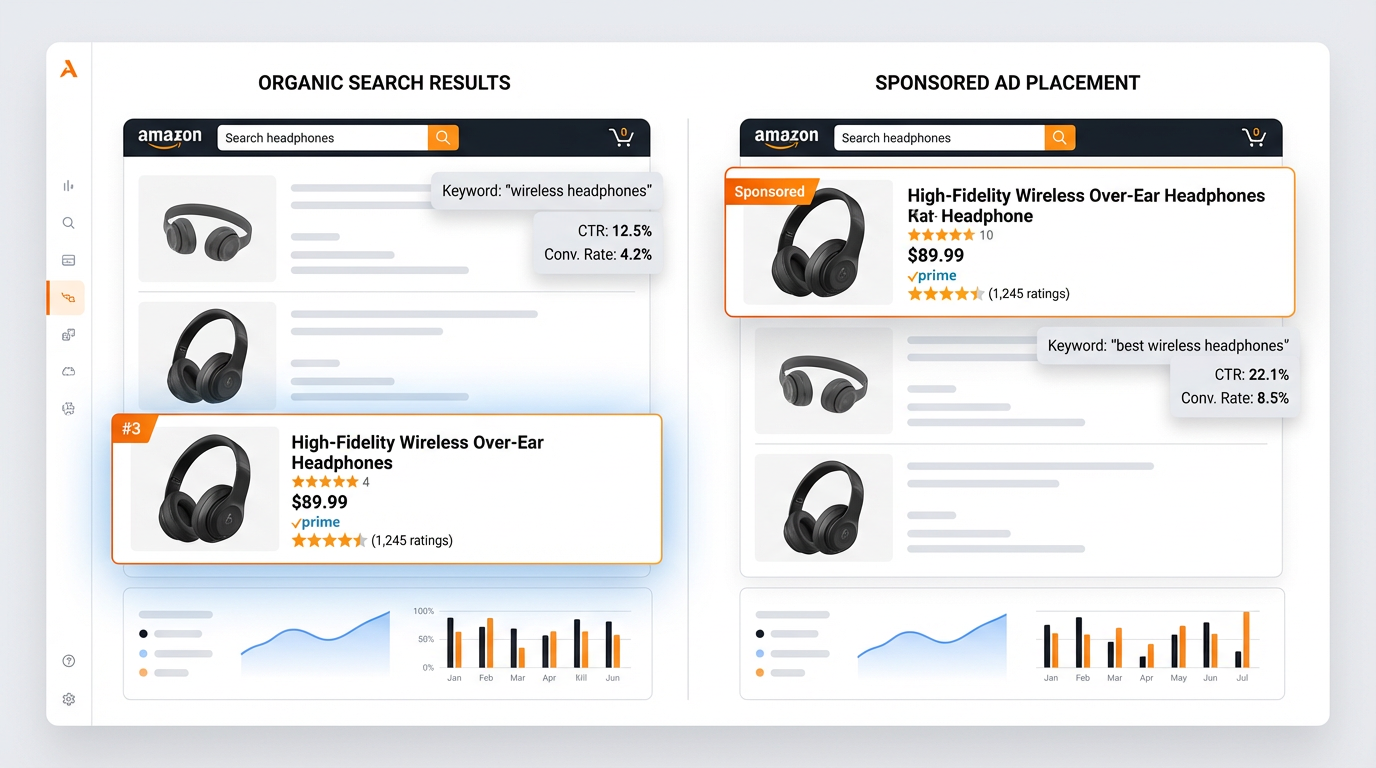
Organic ranking refers to where your product appears in Amazon’s search results based on relevance, performance, and customer behavior—without paid promotion. It’s determined by Amazon’s A9 algorithm, which evaluates hundreds of factors to decide which products best match a shopper’s query.
Key drivers of organic ranking include:
- Keyword Relevance: How well your product title, bullet points, backend keywords, and description match the search term.
- Conversion Rate: Products that convert more frequently (sales per view) are ranked higher because Amazon prioritizes customer satisfaction.
- Customer Reviews and Ratings: High ratings and positive feedback signal trust and quality.
- Click-Through Rate (CTR): Listings that attract more clicks from search results are seen as more relevant.
- Inventory Availability: Products that are consistently in stock perform better organically.
- Order Defect Rate and Fulfillment Speed: Operational excellence impacts visibility.
Unlike paid ads, organic ranking is earned—not bought. It’s the foundation of sustainable growth on Amazon. But it takes time. A new product might take weeks or even months to climb the organic ladder—especially in competitive niches.
What Is Sponsored Ranking on Amazon?
Sponsored ranking refers to a product’s placement in Amazon’s pay-per-click (PPC) advertising system—commonly known as Sponsored Products, Sponsored Brands, and Sponsored Display ads. These ads appear at the top, middle, or bottom of search results and on product detail pages.
Unlike organic results, sponsored placements are auction-based. Sellers bid on keywords, and Amazon’s algorithm determines ad placement based on:
- Bid Amount: How much you’re willing to pay per click.
- Ad Relevance: How closely your product matches the search query.
- Expected Click-Through Rate (eCTR): Amazon predicts how likely users are to click your ad.
- Conversion History: Past performance of your product or ASIN in converting ad clicks into sales.
The biggest advantage of sponsored ranking? Immediate visibility. Even if your product is new or has a low organic rank, you can appear at the top of search results the moment your campaign goes live.
However, this visibility comes at a cost. You pay every time someone clicks your ad—whether they buy or not. That’s why ROI depends on smart keyword selection, compelling creatives, and continuous optimization.
How Organic and Sponsored Rankings Work Together
Many sellers treat organic and sponsored rankings as separate strategies. But the most successful Amazon brands understand they’re deeply interconnected. In fact, they create a powerful feedback loop.
Here’s how the synergy works:
1. Sponsored Ads Drive Initial Sales and Data
When you launch a new product, organic ranking is typically low. By running targeted sponsored campaigns, you generate early sales, reviews, and engagement—all of which feed into Amazon’s algorithm as positive signals.
For example, if your ad for “organic dog treats” converts at a high rate, Amazon interprets this as strong customer demand and relevance. This can boost your organic ranking for that keyword—even when the ad isn’t running.
2. Organic Ranking Reduces Ad Costs
As your organic ranking improves, your product appears higher in search results naturally. This increases your organic CTR and sales volume, which in turn improves your ad’s Quality Score (or “relevance” in Amazon’s system).
A higher Quality Score means you can win ad placements at lower bids. In other words, better organic performance makes your PPC campaigns more cost-effective.
3. Sponsored Data Informs Organic Optimization
Sponsored campaigns generate rich keyword performance data. You can see which search terms drive clicks, conversions, and sales.
Smart sellers use this data to refine their product listings. For instance, if “grain-free puppy treats” converts well in ads, they’ll add that phrase to their title, bullets, and backend keywords—boosting organic ranking for that term.
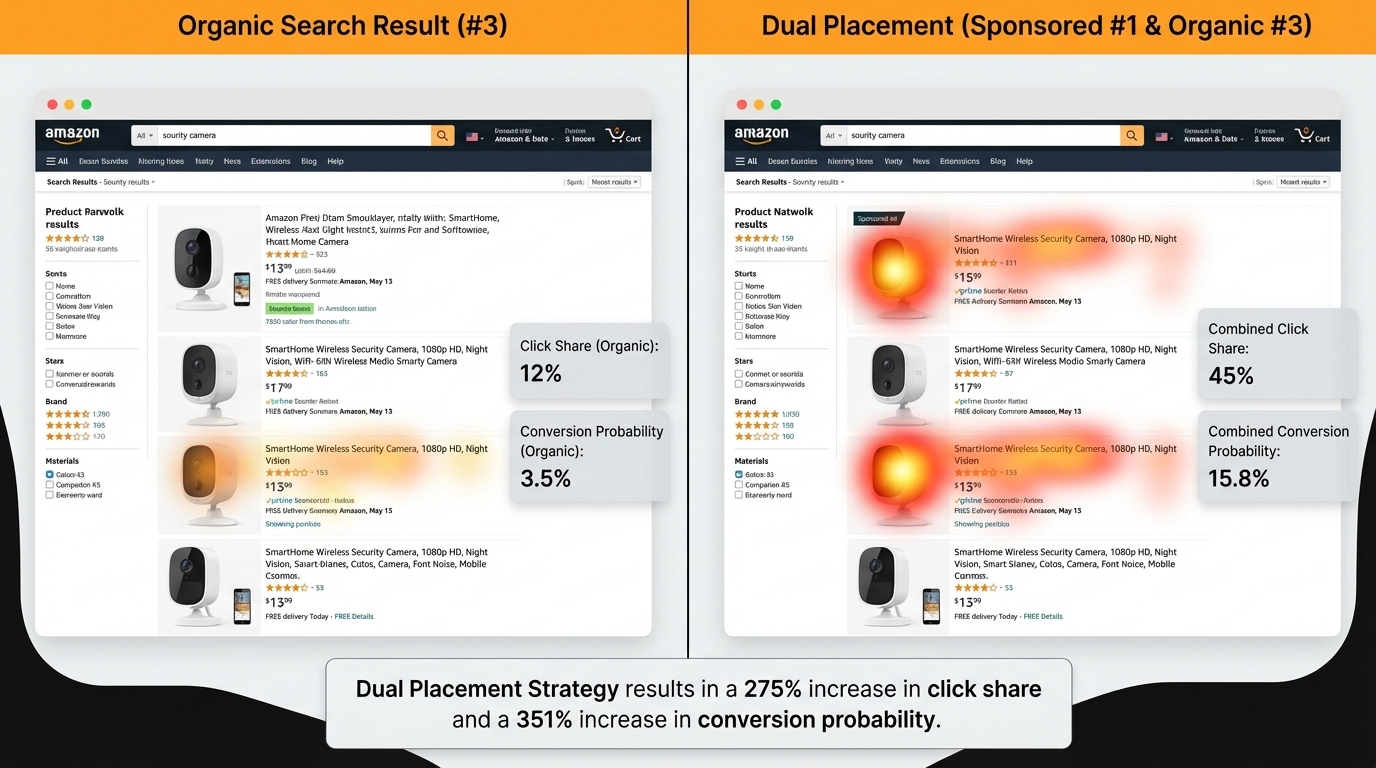
4. Dual Presence Dominates Search Results
When a product ranks both organically and in sponsored ads, it appears multiple times on the first page. This “dual presence” increases brand visibility, trust, and click-through rates.
A 2023 study by Marketplace Pulse found that products appearing in both organic and sponsored results capture up to 68% of total clicks for competitive keywords—compared to 22% for organic-only and 15% for sponsored-only listings.
Benefits of Combining Organic and Sponsored Strategies
The synergy between organic and sponsored rankings isn’t just theoretical—it delivers measurable business outcomes. Here’s what U.S. sellers gain:
1. Faster Time to Profitability
New products often struggle to gain traction. Sponsored ads provide instant visibility and sales momentum, while the resulting performance data accelerates organic growth. This shortens the path from launch to profitability.
2. Lower Customer Acquisition Cost (CAC)
As organic ranking improves, you rely less on paid ads to generate sales. This reduces your overall advertising cost per sale (ACoS) and increases profit margins.
For example, a seller might start with a 45% ACoS on a new product. After 8 weeks of combined optimization, organic sales grow to 60% of total volume, and ACoS drops to 28%—a 38% improvement in efficiency.
3. Increased Market Share in Competitive Niches
In crowded categories like fitness gear or baby products, appearing in both organic and sponsored results gives you a competitive edge. Shoppers are more likely to trust and click on products they see multiple times.
4. Better Keyword Insights and Listing Optimization
Sponsored campaigns act as a real-time market research tool. You learn which keywords convert, which ones are overpriced, and which long-tail terms are underserved.
Use this data to optimize your title, bullets, and backend keywords. For instance, if “non-slip yoga mat for women” converts better than “eco-friendly yoga mat,” update your listing to reflect the higher-performing term.
5. Resilience Against Algorithm Changes
Amazon’s algorithm updates can disrupt organic rankings overnight. But if you’re also running sponsored ads, you maintain visibility during the transition. This gives you time to diagnose and fix issues without losing sales momentum.
Step-by-Step: Optimizing Both Rankings for the Same Product
Here’s a proven 6-step framework U.S. sellers can use to maximize the synergy between organic and sponsored rankings:
Step 1: Audit Your Current Keyword Strategy
Start by analyzing which keywords your product currently ranks for—both organically and in ads. Use tools like SellerSprite’s Keyword Rank Tracker to get a side-by-side comparison.
Look for:
- Keywords where you rank organically but don’t advertise on
- Keywords where you run ads but have poor organic rank
- High-volume, low-competition keywords you’re missing
Step 2: Launch or Optimize Sponsored Campaigns
Create targeted Sponsored Product campaigns using high-intent keywords. Focus on:
- Exact Match: For precise control and conversion tracking.
- Phrase Match: To capture slight variations.
- Auto Campaigns: To discover new keyword opportunities.
Set competitive bids and monitor performance weekly. Pause underperforming keywords and scale winners.
Step 3: Extract High-Converting Keywords from Ad Reports
Download your Search Term Report from Amazon Advertising. Identify keywords with:
- High conversion rate (≥10%)
- Low ACoS (≤30%)
- Good impression share
These are your “golden keywords”—the ones shoppers are actively searching for and buying.
Step 4: Optimize Your Listing for Those Keywords
Update your product title, bullet points, description, and backend search terms to include your top-performing keywords. But don’t stuff—write naturally and focus on clarity and persuasion.
Example:
- Before: “Eco-Friendly Yoga Mat – Non-Slip, Lightweight.”
- After: “Non-Slip Yoga Mat for Women – Eco-Friendly, Extra Thick, Ideal for Hot Yoga.”
This increases keyword relevance and improves organic ranking potential.
Step 5: Monitor Organic Rank Movement
Use a rank tracking tool to monitor how your organic position changes for targeted keywords after listing updates. Look for improvements within 1–2 weeks.
If no movement occurs, revisit your keyword selection or consider external factors like increased competition or seasonal trends. For deeper insights, read our guide on keyword volatility.
Step 6: Reinvest Savings into Scaling
As organic sales grow, reduce your ad spend on high-ranking keywords. Redirect that budget to test new products, expand into new categories, or bid on more competitive terms.
This creates a self-sustaining growth loop: ads fuel organic growth, organic growth reduces ad costs, and savings fund further expansion.
Common Mistakes That Break the Synergy
Even experienced sellers make errors that undermine the organic-sponsored synergy. Avoid these pitfalls:
1. Running Ads Without Optimizing the Listing First
If your listing has poor images, weak copy, or irrelevant keywords, your ads will waste money. Always optimize your product page before launching campaigns.
2. Ignoring Ad Data for SEO
Many sellers run ads and collect sales, but never use the keyword data to improve their organic presence. This is like driving a car with one hand tied behind your back.
3. Overbidding on Low-Intent Keywords
Broad match campaigns can generate traffic, but if the keywords don’t align with buyer intent, you’ll get clicks without conversions—hurting both ad performance and organic signals.
4. Neglecting Long-Tail Keywords
Short, generic terms (e.g., “yoga mat”) are highly competitive. Long-tail keywords (e.g., “extra thick non-slip yoga mat for tall women”) have lower search volume but higher conversion rates and are easier to rank for organically.
5. Failing to Track Performance Holistically
If you’re only looking at ad metrics (ACoS, spend) or only organic rank, you’re missing the big picture. Use a unified dashboard to track both, like SellerSprite’s Rank Tracking Hub.
FAQ
How do organic and sponsored rankings work together to boost sales on Amazon?
Organic and sponsored rankings create a feedback loop: sponsored ads generate early sales and data, which improve organic ranking. In turn, higher organic rank increases click-through and conversion rates, making ads more efficient. This dual presence on search results increases visibility, trust, and overall sales volume.
What are the benefits of improving organic ranking while running sponsored ads on Amazon?
Improving organic ranking while running ads reduces your reliance on paid traffic, lowering your advertising cost of sales (ACoS). It also increases your product’s credibility and visibility, leading to higher click-through rates and conversions. Over time, this synergy leads to sustainable growth and higher profitability.
How can Amazon sellers in the US optimize both organic and sponsored rankings for the same product?
U.S. sellers should start by optimizing their product listing for relevant keywords, then launch targeted sponsored campaigns. Use ad performance data to identify high-converting search terms and update the listing accordingly. Monitor both organic and sponsored rankings using tools like SellerSprite, and continuously refine based on real-time insights.
Next Steps
- Start tracking your keyword rankings—both organic and sponsored—using SellerSprite’s free rank tracker.
- Run a Sponsored Products campaign on 5 high-intent keywords and analyze the search term report after 2 weeks.
- Update your product listing with at least 3 top-performing keywords from your ad data.
References
- How Amazon Keyword Ranking Works: A Complete Guide View
- Keyword Volatility: Why Rankings Dance and How to React View
- How to Track Amazon Keyword Ranking View
- Amazon Rank Tracking Guide: Analytics and Insights View
By SellerSprite Success Team
The SellerSprite Success Team combines deep expertise in Amazon algorithm dynamics, data analytics, and e-commerce growth strategy. With years of hands-on experience helping thousands of U.S. sellers optimize their organic and paid performance, we deliver actionable insights grounded in real-world results. Our content is reviewed for accuracy, relevance, and alignment with Amazon’s evolving best practices.