TL;DR: An Amazon seller lists a two-pack kitchen organizer for $19.90. A customer finds a similar-looking product on Temu for $7.90. The difference looks impossible to defend.
But the Temu listing is for one organizer, not two. Its material may be different. The delivery promise might not be the same, and shipping charges or promotional conditions may change at checkout.
The seller still has a competitive problem to investigate. It is simply not yet clear how large that problem is.
Amazon and Temu marketplace competition is changing how sellers think about pricing, sourcing, product differentiation, and customer expectations. Yet competing successfully requires more than matching a number displayed on another marketplace.
The useful question is not whether Amazon or Temu is universally cheaper or better. It is whether a particular Amazon product offers enough verifiable value, convenience, and customer relevance to justify its price while remaining profitable for the seller.
Key Takeaways
- Compare products, not just prices. Pack quantity, materials, dimensions, shipping charges, discounts, delivery estimates, and return conditions affect what customers actually receive.
- Amazon and Temu are not identical selling environments. Both connect merchants with consumers, but available fulfillment services, seller tools, promotional models, and customer experiences differ.
- A low competing price is a research signal, not an automatic instruction to discount. Sellers need to understand their contribution margin and how much additional volume would be required after a price reduction.
- Product differentiation must be real and understandable. Better specifications, compatibility information, durability, packaging, or customer support can support a different offer when those benefits are genuine.
- The US import environment has changed. The former broad duty-free treatment for many low-value shipments cannot be assumed under the rules in effect in 2026.
- Keep Amazon demand analysis separate from Temu observations. Amazon product and keyword tools can help evaluate Amazon competition, but they do not automatically reveal verified Temu sales volumes or customer conversion rates.
Table of Contents
- Amazon and Temu Marketplace Competition Is a Product-Level Problem
- Amazon vs Temu: What Customers Are Actually Comparing
- Why an $8 Listing May Not Be an $8 Competitive Threat
- Which Products Are Most Exposed to Price Competition?
- Research Amazon Demand and Temu Offers Separately
- The Margin Test Before Matching a Lower Price
- Compete on Value That Customers Can Verify
- How US Import Changes Affect the Competitive Picture
- Should an Amazon Seller Also Sell on Temu?
- Decide Whether to Defend, Adapt, or Walk Away
- The Winning Response Is Not Always a Lower Price
- FAQs
- References
Scope: This guide focuses on Amazon.com sellers competing for US consumer purchases. Platform operations, import rules, fulfillment availability, and promotional terms change over time. The article uses publicly available information current through October 2026. All fictional product comparisons and financial calculations are labeled as hypothetical.
Amazon and Temu Marketplace Competition Is a Product-Level Problem
Amazon and Temu both operate ecommerce marketplaces where third-party merchants offer products to consumers. Their competitive overlap is especially visible when shoppers can find items with similar functions and appearances on both platforms.
Temu launched in 2022. Its parent company, PDD Holdings, describes a marketplace model built around merchant participation, supply chain efficiency, broad product selection, and attractive prices. Its 2025 annual report also discusses logistics partners and the platform's international expansion.
Amazon, meanwhile, combines a large third-party seller marketplace with services such as Fulfillment by Amazon, advertising, brand-building tools, and account-level business reporting. Sellers can use these services to build offers around product relevance, fulfillment, and customer experience.
The same buyer can make different decisions on different occasions
A shopper purchasing an inexpensive decorative accessory may prioritize price and accept a longer wait. The same shopper buying an item for an event later that week may place greater weight on the displayed delivery date and confidence that the product will meet expectations.
Neither behavior makes one marketplace universally superior. It means purchase criteria change with the product, the situation, and the individual offer.
A similar-looking product is not necessarily an equivalent product
Two products may look nearly identical in thumbnails but differ in dimensions, quantity, materials, tolerances, included accessories, durability, or intended use.
Those differences may be commercially meaningful, or they may not justify a premium at all. The seller needs evidence rather than assumptions about where the products were manufactured or which platform lists them.
The useful competitive question: If a customer compares these two offers on the same day, for the same intended use, what specific reasons would justify choosing the Amazon listing?
Amazon vs Temu: What Customers Are Actually Comparing
Marketplace comparisons often turn into broad statements about cheaper products, faster shipping, or better quality. These statements can be misleading because pricing, delivery services, product quality, and seller performance vary within both marketplaces.
A stronger comparison focuses on the individual offer and the factors a buyer can observe or verify.
| Factor | Amazon | Temu | What to check |
|---|---|---|---|
| Product price | Prices vary by seller, product, and promotion. | Competitive pricing is a central part of the platform's value proposition. | Unit count, variation, eligible discounts, and checkout total. |
| Fulfillment | Offers may use FBA or seller-managed delivery. | Offers can involve different merchants and logistics arrangements. | Displayed delivery date, shipping charges, and fulfillment conditions. |
| Product information | ASIN detail pages may include images, specifications, reviews, and enhanced brand content. | Listings present product descriptions, options, images, and customer feedback. | Whether key specifications are clear, accurate, and comparable. |
| Returns | Return eligibility and handling depend on the item and applicable policy. | Return conditions also depend on the product and applicable offer terms. | Actual return window, conditions, fees, and exclusions. |
| Seller economics | Category referral fees and optional fulfillment or advertising charges apply. | Commercial terms and fees depend on the seller program and arrangement. | Actual seller agreement, variable costs, and contribution margin. |
The comparison should not assume that every Amazon order is Prime-eligible or that every Temu order ships internationally. Both platforms can involve different fulfillment arrangements, and a shopper's actual options depend on the listing and location.
For sellers, these differences determine where competition is most direct. A basic accessory with no meaningful differentiation faces a different challenge from a product whose dimensions, quality, and after-sales support are central to the purchase.
Why an $8 Listing May Not Be an $8 Competitive Threat
The biggest mistake in a cross-marketplace price comparison is treating the lowest visible product price as the total price of an equivalent purchase.
Start by matching the number of usable units and the product's essential specifications. Then account for the delivery conditions and discounts actually available to the shopper.
A hypothetical two-pack comparison
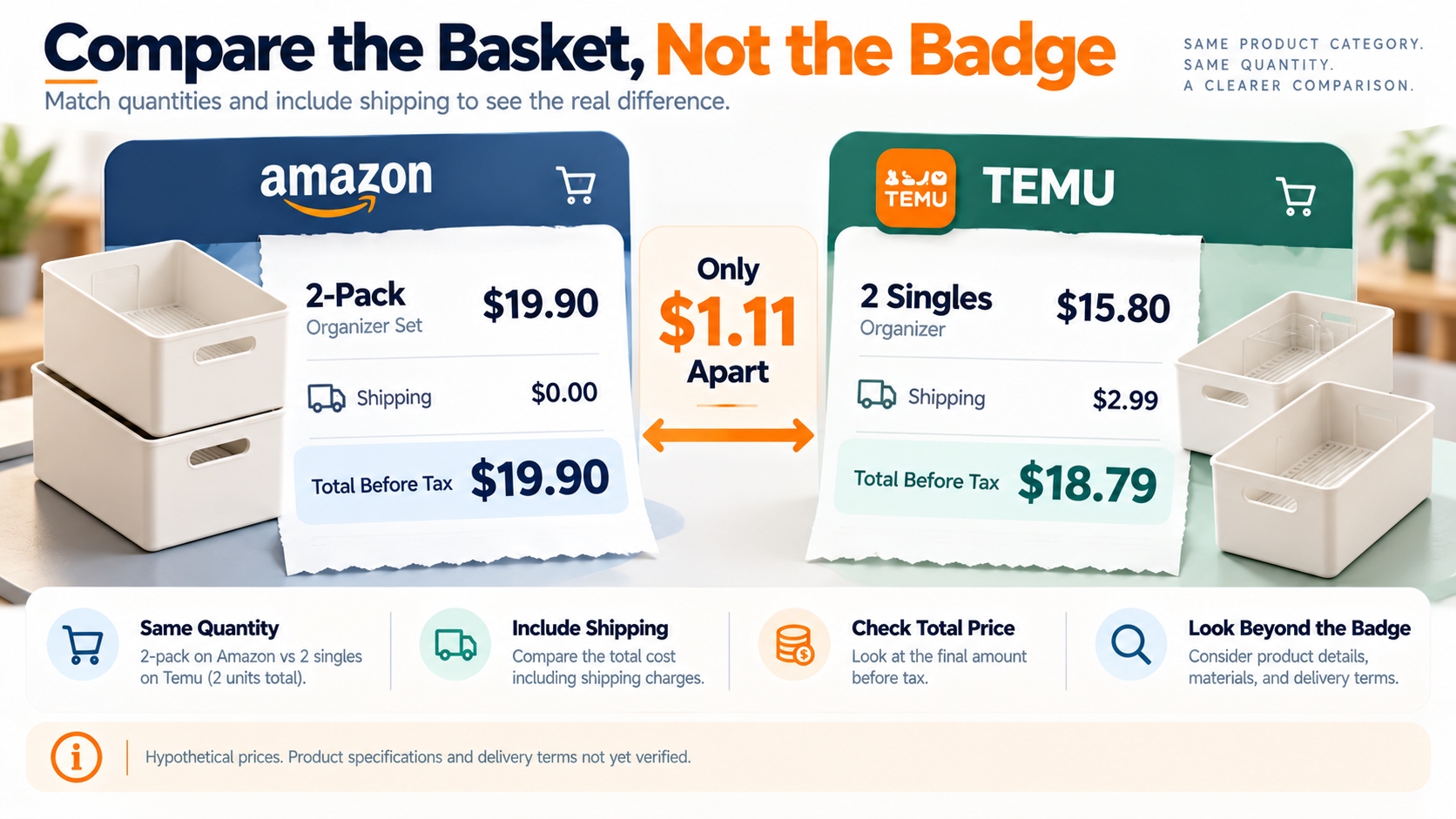
Imagine two offers for kitchen organizers. The Amazon listing sells a two-pack. The Temu listing sells one unit, so a buyer needs to order two to receive the same quantity.
| Comparison item | Amazon offer | Temu offer |
|---|---|---|
| Displayed product price | $19.90 | $7.90 |
| Items per listing | 2 | 1 |
| Quantity purchased | 1 two-pack | 2 singles |
| Product subtotal | $19.90 | $15.80 |
| Assumed shipping charge | $0.00 | $2.99 |
| Total before tax | $19.90 | $18.79 |
| Effective price per organizer | $9.95 | $9.40 |
The initial listing prices appear to differ by $12.00. Once the quantity is standardized and the hypothetical shipping charges are applied, the two-item checkout difference is only $1.11 before tax.
That does not establish that the products are equivalent. Materials, dimensions, durability, accessories, and actual delivery terms still need to be checked.
The prices and shipping charges above are invented. They are not current Amazon or Temu offers. The comparison assumes no first-order coupon or other promotional discount and excludes sales tax.
A better comparison uses four layers
01 / PRODUCT EQUIVALENCE
Match the unit count, specifications, dimensions, materials, and included components.
02 / ACTUAL CHECKOUT CONDITIONS
Include applicable shipping charges, quantity requirements, discounts, and taxes where appropriate.
03 / DELIVERY AND RETURNS
Compare the available delivery promise, return conditions, and any limitations relevant to the purchase.
04 / CUSTOMER USE
Ask whether the products will perform the same job for the same buyer, not merely whether the pictures look similar.
Which Products Are Most Exposed to Price Competition?
Temu's low-price positioning does not create the same competitive pressure for every Amazon category. The strongest exposure tends to arise where shoppers perceive products as interchangeable and can easily compare prices.
This is a product-positioning question rather than a fixed ranking of safe and unsafe categories.
Undifferentiated products have the weakest pricing defense
Consider a generic accessory manufactured to common specifications and sold under numerous brand names. If buyers see no meaningful difference in function, durability, packaging, or delivery, the cheapest acceptable offer may be difficult to compete against.
Adding a logo to a widely available product does not necessarily create a value proposition. Before entering such a market, a seller should determine whether any genuine improvement would matter enough to support the required margin.
Specification-sensitive products create opportunities for clarity
Some purchases depend heavily on dimensions, compatibility, installation requirements, or materials. When customers cannot easily verify those details from a listing, an accurate and well-documented offer can reduce purchase uncertainty.
That advantage must be demonstrated. An Amazon product that claims a stronger material or better fit should have the specifications, testing, or other relevant evidence to support the statement.
Urgency can change how customers value delivery
Delivery timing can be important for replacement parts, event supplies, or items needed for an immediate task. In these situations, the available delivery date may outweigh a relatively modest price difference.
This does not mean Amazon is always faster. Temu also supports different fulfillment arrangements, including local sellers. Sellers should compare the delivery promises shown for the actual offers rather than assume their own marketplace has a permanent advantage.
Regulated products are not automatically attractive opportunities
A seller may see an opportunity to distinguish a compliant product from listings with unclear information. However, products involving safety, electrical standards, children, health, or food-contact materials can carry significant regulatory requirements.
Do not assume that a competitor's low price means it is noncompliant, or that compliance is guaranteed merely because a product appears on Amazon. Verify applicable requirements independently before sourcing or making claims.
A useful dividing line: If customers cannot identify a meaningful difference between the offers, the seller may be facing a structural pricing problem. If customers have important unanswered questions about the product, improving the offer and its explanation may be more valuable than discounting.
Research Amazon Demand and Temu Offers Separately
Cross-marketplace research is most reliable when sellers distinguish what they can measure on Amazon from what they can directly observe on Temu.
A Temu product page can reveal an offer's visible price, specifications, promotion conditions, delivery information, and available customer feedback. Those observations do not automatically provide verified monthly unit sales or product-level profitability.
Start with relevant Amazon search demand
Identify the searches that describe the intended product and customer problem. Separate broad category terms from more specific searches involving size, material, function, compatibility, or use case.
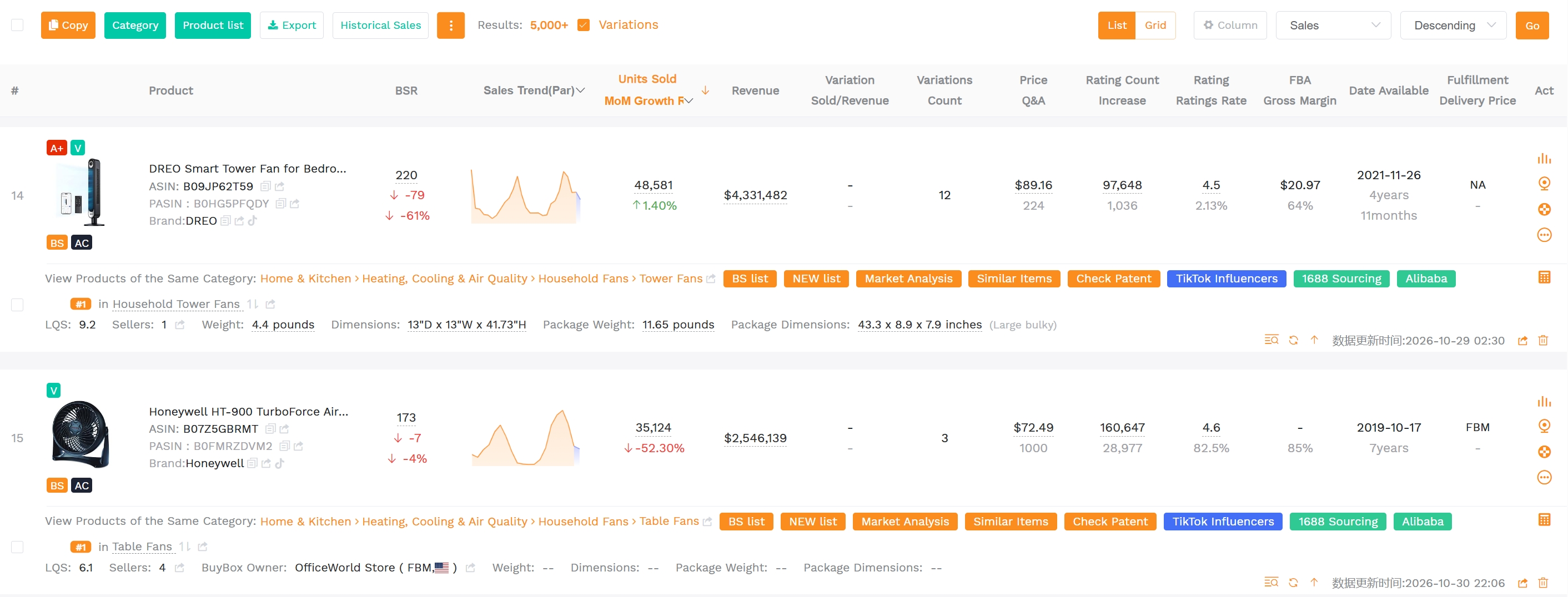
SellerSprite Keyword Research and Reverse ASIN can help sellers study Amazon search demand and identify keywords associated with competing ASINs. Product Research can provide additional context about estimated sales, prices, BSR, reviews, and historical performance.
Keyword selection should be based on genuine product relevance. For a deeper discussion of demand and intent, see SellerSprite's Amazon keyword research guide, which explains how to evaluate search terms rather than simply choose the highest-volume phrase.
Examine the actual Amazon competitive set
For each high-priority keyword cluster, review the products customers are most likely to consider. Compare the visible price range, product attributes, review themes, delivery options, and the quality of the information presented.
Historical price, BSR, estimated sales, and review trends can help distinguish an established market pattern from a short-lived promotion or inventory disruption.
These third-party estimates are not direct access to competitors' completed transaction records. They should be used for directional analysis and checked against other evidence before major inventory decisions.
Use Temu to understand alternative offers
Search for products with comparable functions and specifications. Record the date, relevant variation, quantity, visible price, available discount conditions, shipping terms, and return information.
If the comparison is strategically important, consider obtaining product samples through legitimate purchasing channels. Physical examination may reveal differences that listing photographs do not establish.
Do not assume that every Temu listing comes from the same manufacturer or that a similar photograph establishes a common supply chain. Similar appearance alone is insufficient evidence of identical sourcing.
Use first-party Amazon data when eligible
For qualifying brand owners, Amazon Brand Analytics includes Search Query Performance, Search Catalog Performance, and other dashboards showing aggregated customer search and shopping behavior.
These can help answer whether a listing's challenge concerns impressions, clicks, cart additions, or purchasing behavior on Amazon. They do not establish how much of any change was caused by Temu.
| Question | Relevant evidence | Interpretation limit |
|---|---|---|
| Is there demand? | Amazon search data, BSR, estimated sales, and historical product trends. | Demand on Amazon does not equal verified demand on Temu. |
| How intense is Amazon competition? | Relevant ASINs, price history, ratings, review themes, and offer quality. | Competitor estimates are not audited seller financials. |
| What alternatives exist on Temu? | Visible product specifications, current offers, shipping terms, and samples. | A visible offer does not reveal its actual conversion or profit. |
| Why is my listing underperforming? | Amazon sessions, conversion, advertising data, stock availability, and customer feedback. | A change in sales does not prove a Temu-related cause. |
| Should I lower my price? | Contribution margin, comparable checkout prices, demand, and a controlled test. | Lowering prices does not guarantee enough additional orders. |
The Margin Test Before Matching a Lower Price
An Amazon seller might recognize a genuine lower-priced substitute and still decide not to match it. The reason is simple: a price cut changes the contribution available from every completed order.
The relevant calculation should include the seller's own product costs, Amazon fees, fulfillment expenses, and advertising. Comparing retail prices without those expenses gives an incomplete view of what the business can sustain.
A hypothetical Amazon product at $25
Consider a private-label product currently selling for $25.00. The seller is considering reducing its price to $22.00 in response to cheaper competing offers.
The following costs are invented for illustration. The referral fee uses an assumed 15% rate, which is not the correct rate for every Amazon category.
| Cost or contribution | Current price | Lower price |
|---|---|---|
| Selling price | $25.00 | $22.00 |
| Landed product cost | -$7.50 | -$7.50 |
| Illustrative referral fee | -$3.75 | -$3.30 |
| Illustrative FBA fulfillment cost | -$4.00 | -$4.00 |
| Returns and storage allowance | -$1.00 | -$1.00 |
| Assumed advertising cost per order | -$3.00 | -$3.00 |
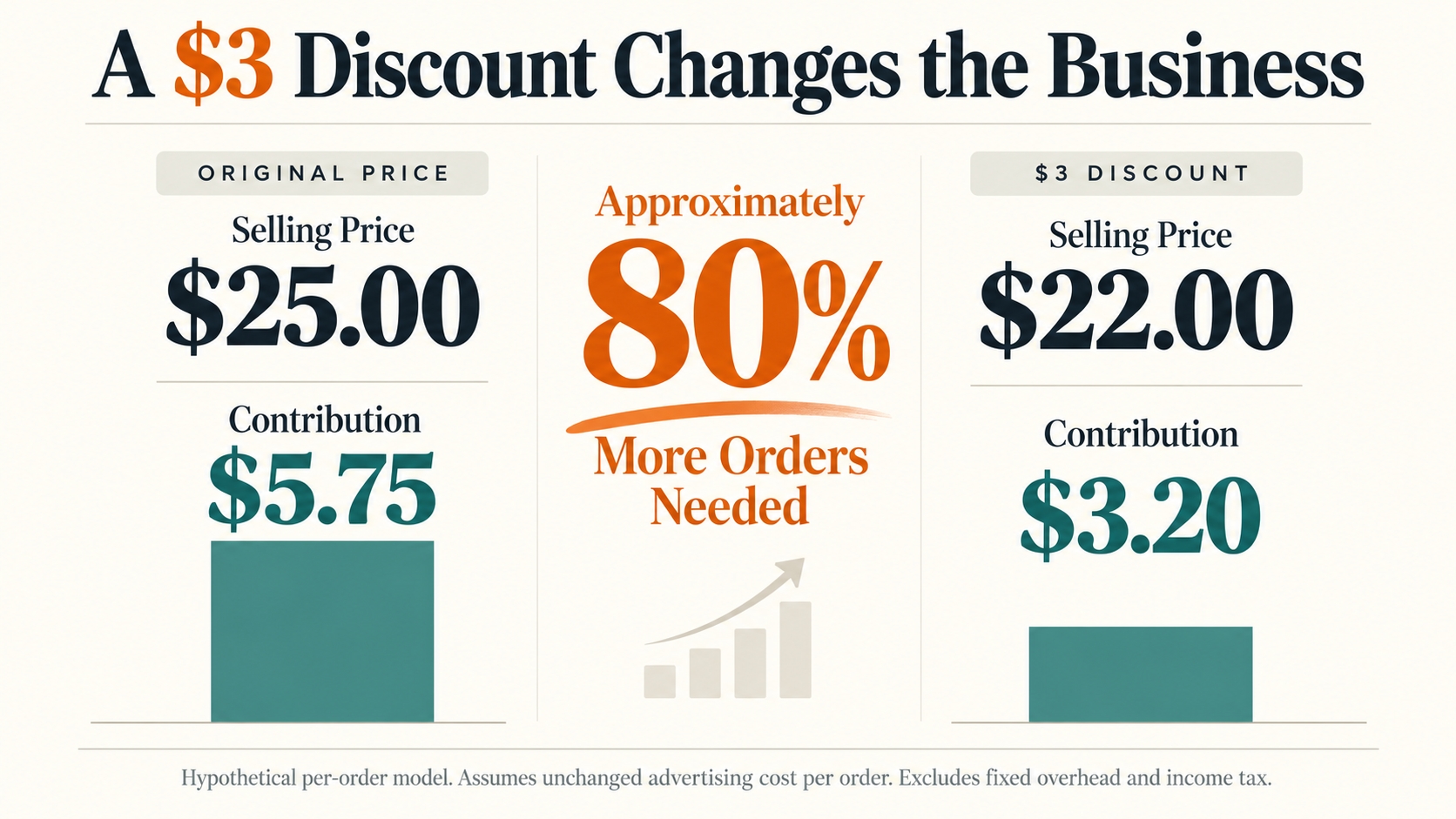
| Contribution after modeled costs | $5.75 | $3.20 |
A $3 price reduction lowers the contribution remaining after the modeled costs from $5.75 to $3.20 per order. The contribution falls by $2.55, or approximately 44.3%.
The price cut may attract more buyers. The problem is that the seller now needs considerably more orders to generate the same total contribution.
How much more volume would be required?
Hypothetical Volume Requirement
Contribution at $25.00: $5.75 per order
Contribution at $22.00: $3.20 per order
$5.75 / $3.20 = 1.796875
The seller would need approximately 80% more completed orders to maintain the same total contribution under the simplified assumptions.
That does not mean an 80% increase is likely. It is the modeled requirement, not a forecast. The calculation assumes product costs and average advertising cost per order remain unchanged, with no extra promotions or other costs.
Fixed overhead and income tax are also excluded. In practice, advertising efficiency, refund rates, and other expenses may change when the price changes.
Amazon referral fees depend on product category, and FBA costs vary with product characteristics and the services used. Sellers should verify the actual charges using Amazon's fee and revenue estimation resources before making a pricing decision.
A price cut needs a reason beyond competitive anxiety
Discounting can be appropriate when a product has room in its margin, buyers are genuinely price-sensitive, and the seller has evidence that the lower price could improve the business outcome.
It is more questionable when the product already has thin margins, the competing offer is not equivalent, or conversion problems originate from listing clarity, reviews, inventory availability, or an unsuitable audience.
Compete on Value That Customers Can Verify
When matching the lowest visible price is uneconomic, the next question is whether the Amazon offer can be improved in a way that customers actually value.
Product differentiation is not simply adding stronger adjectives to a listing. It requires a meaningful reason for a buyer to prefer one product over another.
Improve the product where complaints reveal a real problem
Review customer feedback for recurring issues involving dimensions, assembly, weak materials, packaging failures, or missing components. Determine whether the problem originates in product design, manufacturing quality, instructions, or inaccurate listing information.
If a better component or revised design solves a documented customer problem at a viable cost, the improvement may create a defensible advantage. That conclusion should be tested through product samples, specifications, and customer experience rather than assumed from competitor reviews alone.
Explain specifications without exaggeration
Clear product images, dimensions, compatibility details, material information, and realistic demonstrations help customers understand the offer. For some products, accurate information is more persuasive than a generic claim of premium quality.
Amazon Ads recommends detailed, high-quality product pages with informative titles, images, and useful product information because shoppers need those details before purchasing.
Avoid unsupported comparisons such as "safer than Temu products" or "better than every competitor". A seller may describe its own verified specifications without making claims about untested competing products.
Treat fulfillment as an offer attribute
For eligible products, Amazon FBA offers order fulfillment services that can include Prime delivery benefits, customer service, and returns handling. These services have associated costs that must be included in the seller's economics.
A seller should not pay for faster fulfillment without understanding whether customers value it for that product. But when delivery timing matters, the available promise may support an offer that is not the cheapest.
Avoid turning review management into a competitive tactic
Reviews can reveal product strengths and weaknesses, but they should not be manipulated to create an artificial difference between listings.
The FTC's Consumer Reviews and Testimonials Rule prohibits specified deceptive review practices, including purchasing fake reviews and paying for reviews conditioned on a particular sentiment.
The sustainable alternative is to improve the product and customer experience, then use compliant methods to collect authentic feedback.
How US Import Changes Affect the Competitive Picture
Discussions of Temu's pricing often refer to the former US de minimis exemption for low-value imported packages. That historical explanation cannot simply be repeated as though the import rules remain unchanged.
US Customs and Border Protection announced the suspension of duty-free de minimis treatment for low-value shipments from all countries beginning August 29, 2025. Federal regulatory changes in June 2026 established an indefinite suspension for relevant postal and non-postal imports, alongside updated entry procedures.
CBP subsequently extended the compliance date for certain new electronic international-mail entry requirements to January 20, 2027. That extension concerns implementation of specified entry procedures; it does not restore the former broad de minimis exemption.
The publicly accessible CBP guidance on updated international mail entry rules explains the 2026 process for certain low-value postal shipments previously affected by de minimis treatment.
Import policy affects costs, but not all offers equally
Import duties and processing requirements depend on factors such as product classification, country of origin, shipment method, and applicable exceptions or trade measures.
A locally stocked item, a direct international order, and an Amazon FBA product imported in bulk may have different logistics and inventory economics. The retail price displayed to the customer does not reveal the entire cost structure behind the offer.
Temu is not limited to one fulfillment arrangement
PDD Holdings describes Temu as working with logistics and fulfillment partners across markets. Temu's public partner documentation also distinguishes cross-border and local sellers in the United States and other supported regions.
Therefore, it would be inaccurate to characterize every Temu order as a package shipped directly from China to a US household.
Likewise, an Amazon product is not necessarily manufactured in the United States. The actual country of origin and import arrangement matter more than the marketplace name when evaluating trade-related costs.
What sellers should update: Recalculate landed cost and customs assumptions for current purchase orders. Do not base a 2026 competitive strategy on an old claim that all parcels valued below $800 can enter the United States duty-free.
Should an Amazon Seller Also Sell on Temu?
Marketplace competition creates a second strategic question: should an Amazon seller defend its existing channel, or explore Temu as another place to reach customers?
The answer depends on whether the seller can operate profitably under the applicable Temu program, maintain control over its brand and inventory, and avoid creating unnecessary problems across sales channels.
Cross-listing is not automatically a growth strategy
A seller may reach additional customers through another marketplace, but more listings also introduce new operational work. Fees, returns, fulfillment expectations, inventory allocation, reporting, and payment terms need to be understood.
Do not assume Temu has one universal seller fee schedule or fulfillment arrangement. The actual economics depend on the seller's eligible program and agreement.
Consider channel positioning before offering the same SKU everywhere
A brand may choose distinct bundles or product variations for different channels. This can serve different customer needs, but the variations should be genuine and commercially useful rather than cosmetic devices intended to disguise identical offers.
If the same item appears at substantially different prices across channels, consider how customers may interpret the difference. Account for applicable contractual terms, promotional conditions, and platform policies before making a pricing decision.
Test the contribution of the new channel, not just its order count
A successful cross-marketplace test should include the realized selling price, platform charges, fulfillment expenses, returns, promotions, inventory carrying costs, and additional operational requirements.
Revenue from a new channel is not necessarily incremental to the brand if customers simply shift purchases away from an existing profitable channel. Examine total business contribution where the data allow, while acknowledging that exact customer-level incrementality may be difficult to establish.
Decide Whether to Defend, Adapt, or Walk Away
The outcome of competitive research should be a decision about a specific product. It should not end with a broad conclusion that Temu is either a threat to every Amazon seller or irrelevant to established brands.
Three responses are possible. They are not stages that every product must pass through.
DEFEND
The offer has real advantages
Preserve a viable price and make verified differentiation, product information, delivery, and customer experience easier to understand.
ADAPT
The product needs a better value equation
Test an appropriate change to price, sourcing, product design, bundle configuration, or listing clarity within a defined budget.
WALK AWAY
The economics cannot support the offer
Avoid additional inventory or marketing commitments when credible differentiation and sustainable contribution are both missing.
Make the test answer one question
Suppose customers repeatedly ask whether an accessory fits a particular product model. A better compatibility image may be more informative than a discount test. The business can evaluate whether clearer information improves the purchasing experience and relevant conversion.
For an item with clear specifications but meaningful price sensitivity, a controlled price experiment may be more appropriate. Set the test duration, budget exposure, inventory conditions, and metrics before changing the offer.
Avoid changing the price, advertising budget, product images, and promotion simultaneously if the purpose is to understand which action helped. Where a controlled experiment is not available, document the concurrent changes and interpret results cautiously.
Review the measures that can change the decision
Amazon sellers should look beyond keyword rank or ad-attributed sales when judging the response to marketplace pressure.
| Measure | Question answered | Important caution |
|---|---|---|
| Relevant search visibility | Is the product reaching relevant Amazon shoppers? | Visibility alone does not indicate profitable demand. |
| Conversion | Does the offer persuade relevant visitors to purchase? | Traffic mix, pricing, stock, and promotions can affect the result. |
| Contribution per order | Does the completed sale retain sufficient value after modeled costs? | Contribution is not automatically final net profit. |
| Total business contribution | Did the additional orders justify the change in costs? | Align time periods and account for additional expenses. |
| Customer feedback and returns | Did the product change improve the customer experience? | Small samples and delayed returns limit interpretation. |
Record why the decision was made
Keep a simple decision record for each affected ASIN: the comparable Temu offer, the verified product differences, the Amazon demand evidence, the minimum acceptable contribution, and the action selected.
Document the assumptions that could reverse the decision. For example, a lower supplier cost may make an otherwise unprofitable price competitive, while increased returns or advertising costs may make the same price unsustainable.
This record makes it easier to revisit a product without relying on memory or treating every new low-priced listing as an emergency.

The Winning Response Is Not Always a Lower Price
Amazon and Temu compete for consumer attention, but an individual seller does not need to answer that competition with a universal pricing strategy.
A cheap-looking alternative may be genuinely equivalent, or the offers may differ in quantity, specifications, delivery, or checkout conditions. A lower Amazon price may attract additional orders, but those orders may contribute less to the business than expected.
The strongest response begins with an accurate comparison, follows with a realistic contribution calculation, and ends with a product-specific decision.
Some products deserve a clearer listing or a genuine redesign. Some deserve a limited pricing test. Others may no longer support the economics required to justify another purchase order.
For Amazon sellers, the goal is not to win every comparison against Temu. It is to build offers that customers have a reason to choose and that the business can afford to keep selling.
FAQs
What is the main difference between Amazon and Temu?
Amazon and Temu are both ecommerce marketplaces, but their seller services, available fulfillment programs, promotional approaches, and commercial arrangements differ. Amazon offers programs such as FBA, Brand Analytics, and advertising services. Temu emphasizes broad selection and competitive prices through a merchant marketplace supported by logistics and fulfillment partners. The actual customer experience depends on the product and seller.
Is Temu always cheaper than Amazon?
No universal price comparison is valid across all products. Temu often competes through low displayed prices, but buyers should compare equivalent quantities, specifications, discounts, shipping charges, and checkout totals. A lower single-item price does not necessarily mean the full purchase costs proportionally less.
Why can Temu products appear much cheaper than Amazon listings?
Possible factors include sourcing arrangements, merchant pricing, promotions, operating costs, inventory strategies, and differences in product specifications or fulfillment. The displayed price alone does not establish which factor is responsible. Avoid assuming every Temu product uses the same manufacturing or shipping model.
Is Amazon losing sales because of Temu?
Temu is a competing shopping destination, but an individual Amazon seller cannot determine that Temu caused a sales decline solely from lower sales or BSR changes. Pricing, advertising, inventory availability, seasonal demand, reviews, and other competition may also affect results. Product-level evidence is needed before assigning a cause.
Should Amazon sellers match Temu prices?
Only when the comparison is relevant and the resulting economics make sense. Calculate contribution after product cost, Amazon fees, fulfillment, advertising, returns, and other applicable expenses. A price cut that reduces contribution per order may require substantially more completed sales to maintain the same total contribution.
Which Amazon products face the greatest competition from Temu?
Products that customers perceive as interchangeable and easy to compare on price may face stronger pressure. Products with meaningful specifications, verified improvements, important compatibility requirements, or time-sensitive delivery needs may offer more opportunities for differentiation. Actual competitive exposure depends on the individual product, not a fixed category list.
Does Temu only ship products directly from China?
No. Temu's publicly available seller documentation distinguishes cross-border sellers from local sellers, and PDD Holdings describes a network of logistics and fulfillment partners. Buyers should check the actual delivery terms rather than assume every order follows the same international route.
Is the US $800 de minimis exemption still available for Temu orders in 2026?
The former broad duty-free de minimis treatment for low-value imports has been suspended under the applicable US rules. CBP introduced further entry procedures in 2026 and extended certain international mail compliance deadlines into 2027. Those procedural extensions do not restore the former general exemption. Specific import treatment still depends on the goods and applicable legal provisions.
Can Amazon sellers sell their products on Temu as well?
Potentially, if they meet the applicable Temu seller program requirements. Before expanding, evaluate enrollment eligibility, commercial terms, fulfillment responsibilities, return handling, inventory allocation, and contribution after all channel-specific costs. Selling on another platform does not automatically increase total business profit.
Can I buy products from Temu and resell them on Amazon?
Purchasing a product on Temu does not automatically establish that it is eligible for resale on Amazon. Sellers must verify product authenticity, condition, category and brand restrictions, intellectual property rights, applicable safety requirements, and Amazon documentation rules. Retail purchase records may not satisfy every sourcing or authenticity verification request.
How can an Amazon private-label brand compete without reducing prices?
Start with improvements customers can verify: better product specifications, accurate dimensions, useful instructions, meaningful bundles, reliable fulfillment, and clear product information. Analyze customer complaints and compare actual alternatives before making manufacturing or listing changes. Unsupported quality claims are not a substitute for real differentiation.
Can SellerSprite compare Amazon and Temu sales directly?
SellerSprite helps sellers research Amazon products, keywords, competition, estimated sales, BSR, prices, and historical trends. These capabilities support analysis of the Amazon side of the competitive landscape. They should not be presented as direct verification of Temu unit sales, conversions, or seller profitability.
How often should Amazon sellers review Temu competitors?
There is no universal schedule. Review direct competitive alternatives when planning new inventory, considering a price change, investigating a meaningful sales shift, or evaluating a product improvement. More frequent monitoring may be appropriate in categories with rapidly changing promotions. Record observation dates because prices and available offers can change.
References
- PDD Holdings: 2025 Annual Report, Form 20-F, Filed April 29, 2026. View
- Temu Partner Platform: Seller Authorization Guide, Including US Cross-Border and Local Seller Types. View
- Amazon: Fulfillment by Amazon, Service Overview and Eligibility. View
- Amazon: Estimate Fees and Costs. View
- US Customs and Border Protection: Executive Order 14324, Suspending Duty-Free De Minimis Treatment for All Countries. View
- US Customs and Border Protection: Updated Global Guidance for International Mail, 2026. View
- US Customs and Border Protection: International Mail Entry Type 13 Mandatory Implementation Date Extended to January 20, 2027, October 14, 2026. View
- Amazon: Brand Analytics, Customer Search and Shopping Insights. View
- Federal Trade Commission: The Consumer Reviews and Testimonials Rule, Questions and Answers. View
- SellerSprite: Product Research Guide. View
- SellerSprite: Amazon Keyword Research Tool, Keyword Mining Guide. View
- SellerSprite: Amazon Keyword Research, New User Guide. View
By SellerSprite Content Team
The SellerSprite Content Team studies Amazon competition through product-level evidence, search behavior, pricing patterns, and seller economics. Our marketplace strategy coverage examines how sellers can distinguish meaningful competitive threats from misleading comparisons and use Amazon-specific research to evaluate demand, positioning, and profitability. For cross-platform topics such as Amazon and Temu, we separate observable marketplace offers, official company disclosures, and regulatory information from assumptions that require further verification. Our editorial aim is to help sellers make defensible product and pricing decisions rather than react to isolated price tags or unsupported market claims.
Last reviewed: October 31, 2026