Choosing between Amazon FBA and FBM is not a one-time account decision. It is a SKU-level operating choice that should reflect product size, sales velocity, storage time, delivery expectations, return complexity, internal capacity, and fully loaded cost. Many sellers use both methods because the best answer can change by product, season, and inventory position.
Choose FBA when outsourcing storage, pick-and-pack, shipping, customer service, and returns creates more value than the related fees, inbound requirements, and inventory constraints. Choose FBM when your operation can meet Amazon's delivery and service expectations economically and you need direct control over inventory, packaging, or specialized handling. A hybrid model is often strongest when different SKUs require different fulfillment systems or when one method provides backup capacity for the other.
Key takeaways
- Compare total operating cost, not only Amazon fees. FBA and FBM shift costs to different places, so both models need the same product, price, return, and sales assumptions.
- Decide by SKU. Size, weight, velocity, seasonality, margin, fragility, customization, and storage needs can make the right method different across one catalog.
- Value capacity and control explicitly. FBA can reduce daily fulfillment work, while FBM can preserve packaging, inventory, and process control when the seller can operate reliably.
- Plan for exceptions. Stockouts, aged inventory, carrier failures, returns, peak demand, and product changes should be included before a method is approved.
- Re-evaluate after material changes. A fee update, packaging revision, new carrier rate, change in sales velocity, or shift in return rate can reverse the original decision.
FBA and FBM describe who performs fulfillment. They do not define whether a seller uses private label, wholesale, reselling, arbitrage, or another sourcing model. The same business can use FBA for one SKU, FBM for another, and both methods for a third. If you are still deciding how sourcing, account setup, listings, pricing, and fulfillment connect, start with the full Amazon selling setup guide before making the fulfillment choice in isolation.
The comparison below is a decision framework, not a universal winner table. FBA may be operationally strong but financially weak for one product. FBM may preserve control but become fragile when volume rises. The most defensible answer uses the same assumptions for both methods, records the source of each input, and identifies the operational failure that would trigger a change.
| Decision area | FBA question | FBM question | Evidence to retain |
|---|---|---|---|
| Cost | Do Amazon fulfillment, storage, inbound, return, and inventory costs create acceptable contribution? | Can the seller cover carriers, packaging, labor, facilities, support, returns, and exceptions economically? | Dated fee estimates, carrier quotes, labor assumptions, return allowance, and actual order data |
| Control | Can standardized Amazon handling support the product and customer promise? | Does direct access to inventory, packaging, or specialized handling create enough value to justify operating it? | Packing standard, handling requirements, damage records, and customer-support themes |
| Capacity | Can inbound planning and FBA inventory levels support expected sales without excess stock? | Can the warehouse and carrier network maintain service during normal and peak volume? | Forecast, inbound lead time, daily order capacity, cutoff rules, and contingency plan |
| Risk | What happens if inventory ages, inbound is delayed, or FBA stock becomes unavailable? | What happens if staffing, packing, tracking, delivery, or return capacity fails? | Scale and stop rules, incident log, backup offer plan, and owner |
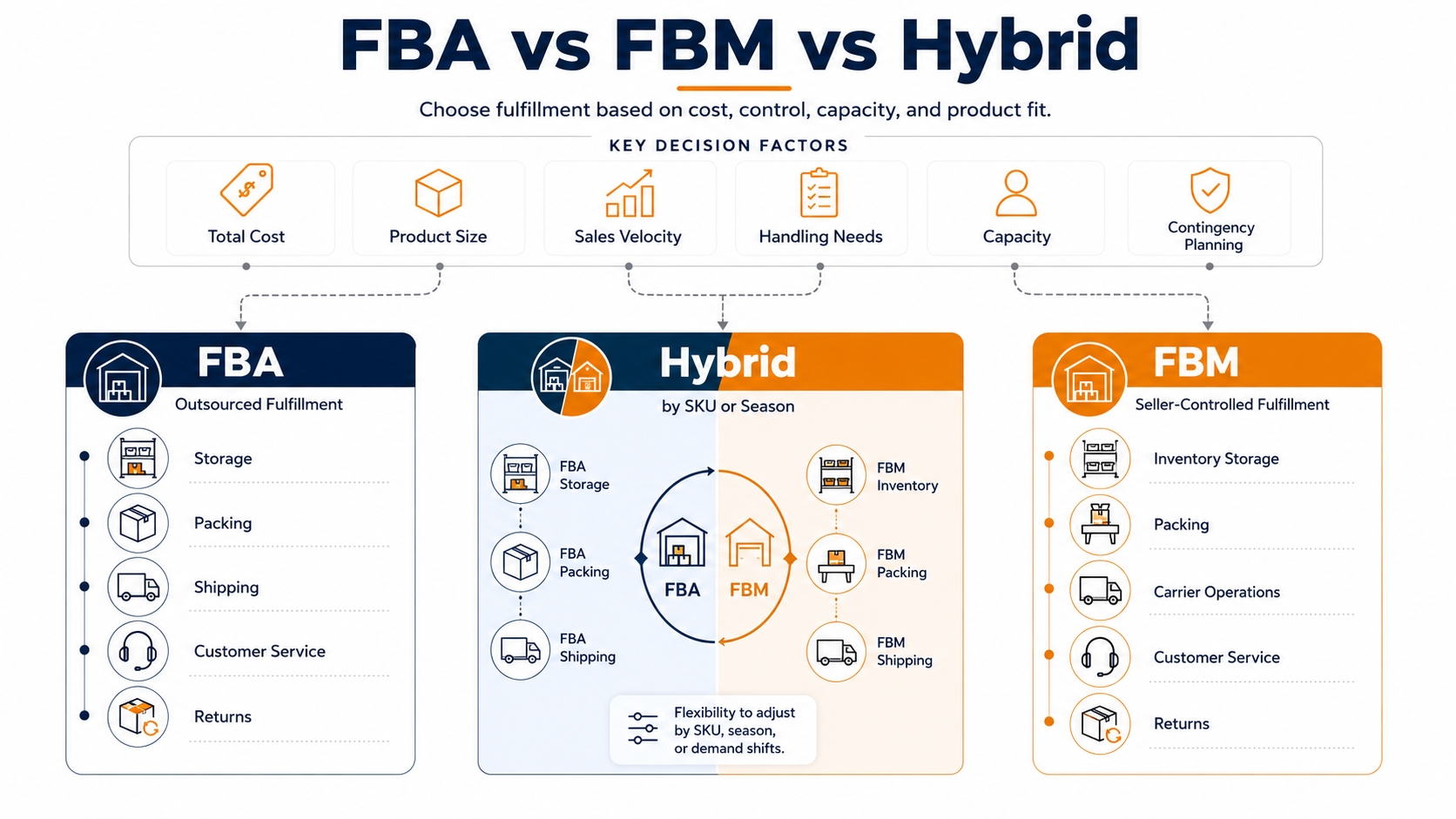
What do Amazon FBA and FBM mean?
Fulfillment by Amazon (FBA) is a program in which a seller sends eligible inventory into Amazon's fulfillment network. Amazon then stores the units and handles picking, packing, shipping, customer service, and returns for FBA orders. The seller still owns the commercial decisions around product selection, listing accuracy, pricing, inventory planning, compliance, and profitability.
Fulfilled by Merchant (FBM) means the seller controls fulfillment instead of sending those units into FBA. Inventory may be held in the seller's own facility or in a contracted logistics operation, but the seller remains responsible for accurate availability, handling, shipment confirmation, delivery performance, customer service, returns, and the costs of running the operation.
Both methods can be used within one Amazon selling account, and Amazon states that sellers can choose one method for eligible products or combine them by product. The decision is separate from the Individual or Professional selling plan. It is also separate from the sourcing model, so a private-label seller, wholesaler, or reseller may use FBA, FBM, or a hybrid arrangement.
FBA transfers routine fulfillment execution to Amazon. FBM keeps fulfillment execution under the seller's control. Neither method transfers responsibility for choosing a compliant product, maintaining accurate listings, or protecting unit economics.
Amazon FBA vs FBM at a glance
The table below separates platform handling from business responsibility. It also avoids treating control as automatically good or outsourcing as automatically efficient. Control creates value only when the seller can operate it consistently; outsourcing creates value only when the service and cost structure fit the SKU.
| Dimension | FBA | FBM | Decision implication |
|---|---|---|---|
| Inventory location | Eligible inventory is sent into Amazon's fulfillment network. | Inventory stays in a seller-controlled or contracted facility. | Compare access, storage requirements, inbound lead time, and replenishment risk. |
| Order execution | Amazon picks, packs, ships, and handles core customer service and returns for FBA orders. | The seller or logistics partner picks, packs, ships, supports, and processes returns. | Quantify both labor saved and control surrendered. |
| Cost structure | Published fulfillment and storage-related fees plus inbound, inventory, and exception costs. | Carrier, packaging, labor, warehouse, software, customer service, return, and failure costs. | Use fully loaded per-order cost for both methods. |
| Packaging control | Standardized fulfillment process with program-specific preparation and packaging requirements. | Greater control over materials, presentation, inserts, and specialized handling, subject to Amazon policy. | Choose control only when it supports a real product or customer requirement. |
| Scalability | Can reduce the seller's routine fulfillment workload as volume grows, subject to inventory planning and program constraints. | Can scale when warehouse, labor, carrier, systems, and support capacity are designed for the demand. | Model the next volume tier, not only today's order count. |
| Prime path | Eligible FBA offers can use Amazon's Prime delivery experience. | Seller Fulfilled Prime is a separate program with prequalification, trial, and ongoing performance requirements. | Do not assume standard FBM automatically carries Prime branding. |
Is FBA or FBM cheaper?
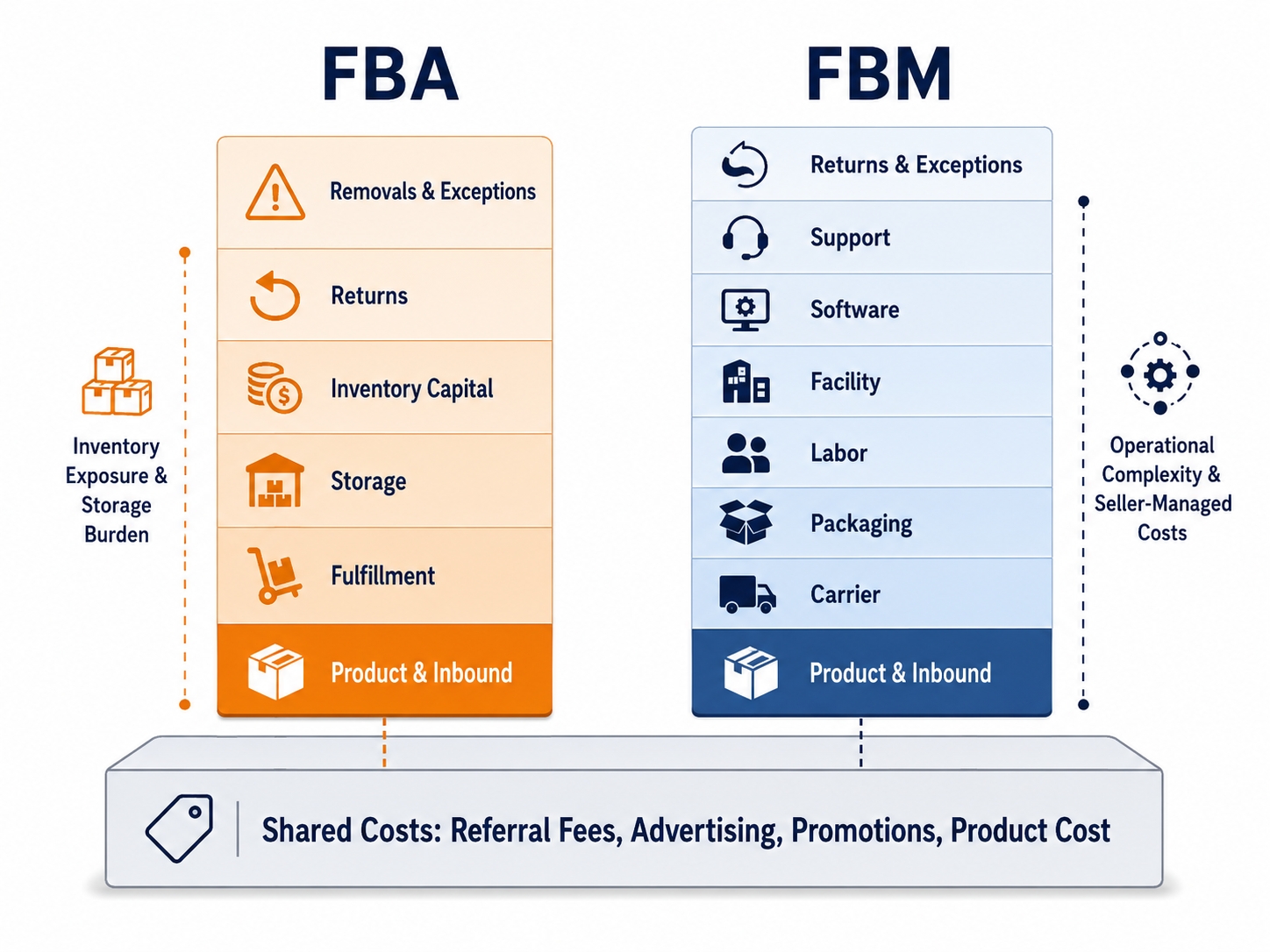
Neither method is automatically cheaper. FBA converts much of fulfillment into published Amazon charges, but the seller still carries product cost, inbound movement, inventory financing, storage exposure, and other program-related costs. FBM avoids FBA fulfillment and storage charges for those orders, but the cost moves into carriers, packaging, labor, facilities, software, customer service, returns, and operating failures.
A valid comparison uses the same SKU, dimensions, weight, sales price, monthly units, sales pattern, return assumptions, and customer promise. If the FBA model uses stable demand while the FBM model uses a peak-demand carrier surcharge, or one method includes returns while the other does not, the result is not decision-grade evidence.
Contribution per order = Selling price minus referral fee, selling-plan allocation, product and inbound cost, fulfillment cost, storage or facility cost, advertising, promotions, returns allowance, customer-service cost, and other variable operating costs.
Build the FBA cost stack
Amazon's current FBA materials describe fulfillment costs that are influenced by product characteristics such as weight and dimensions, plus storage costs based on the space inventory occupies. Depending on the product and workflow, sellers may also need to account for inbound placement, preparation or labeling, aged inventory, returns processing, removal, disposal, liquidation, and the cost of stock that is unavailable or slow-moving.
Build the FBM cost stack
FBM costs are often underestimated because they are spread across multiple budgets. Count carrier rates, packaging, warehouse labor, equipment, facility allocation, shipping software, order management, customer service, return labels, inspection, reshipments, delivery claims, weekend or peak coverage, and the cost of maintaining backup capacity. Include owner time when the business has not yet hired a fulfillment team.
| Cost layer | FBA inputs | FBM inputs | Common error |
|---|---|---|---|
| Routine fulfillment | FBA fulfillment fee based on the current product and program inputs. | Pick, pack, materials, labor, postage, software, and facility allocation. | Comparing the FBA fee with postage alone. |
| Inventory movement | Preparation, labeling, inbound freight, placement options, receiving delay, and shipment discrepancies. | Inbound freight to the seller facility, unloading, put-away, movement, and replenishment labor. | Treating supplier-to-warehouse freight as product cost in only one model. |
| Storage and capital | Monthly storage, aged inventory exposure, removal decisions, and cash tied up before sale. | Facility rent, rack or bin allocation, utilities, insurance, shrinkage, and working capital. | Treating seller-owned space as free. |
| Returns and support | Applicable return-processing, reimbursement, removal, damage, disposal, and nonrecoverable unit costs. | Return label, service time, receiving, inspection, refund, reshipment, restocking, disposal, and unrecovered cost. | Using the same return rate but excluding method-specific handling cost. |
| Exception capacity | Stockout recovery, emergency inbound, stranded inventory, shipment investigation, and backup fulfillment. | Overtime, temporary labor, expedited carrier service, failed delivery, capacity reservation, and backup warehouse. | Modeling only an error-free average order. |
Use Amazon's calculator, then add the costs it cannot know
Amazon's Revenue Calculator can compare estimated fees, costs, and revenue for Amazon fulfillment and the seller's own fulfillment method. Enter the same product dimensions, weight, category, price, and shipping assumptions for both sides. Then add internal FBM costs, supplier and inbound terms, advertising, returns, financing, and any other business-specific inputs that are not represented accurately by the default estimate.
Treat every calculator result as a dated estimate. Save the inputs, not only the final number, so the team can explain why a decision changed when fees, dimensions, rates, or demand move.
Match fulfillment to product characteristics
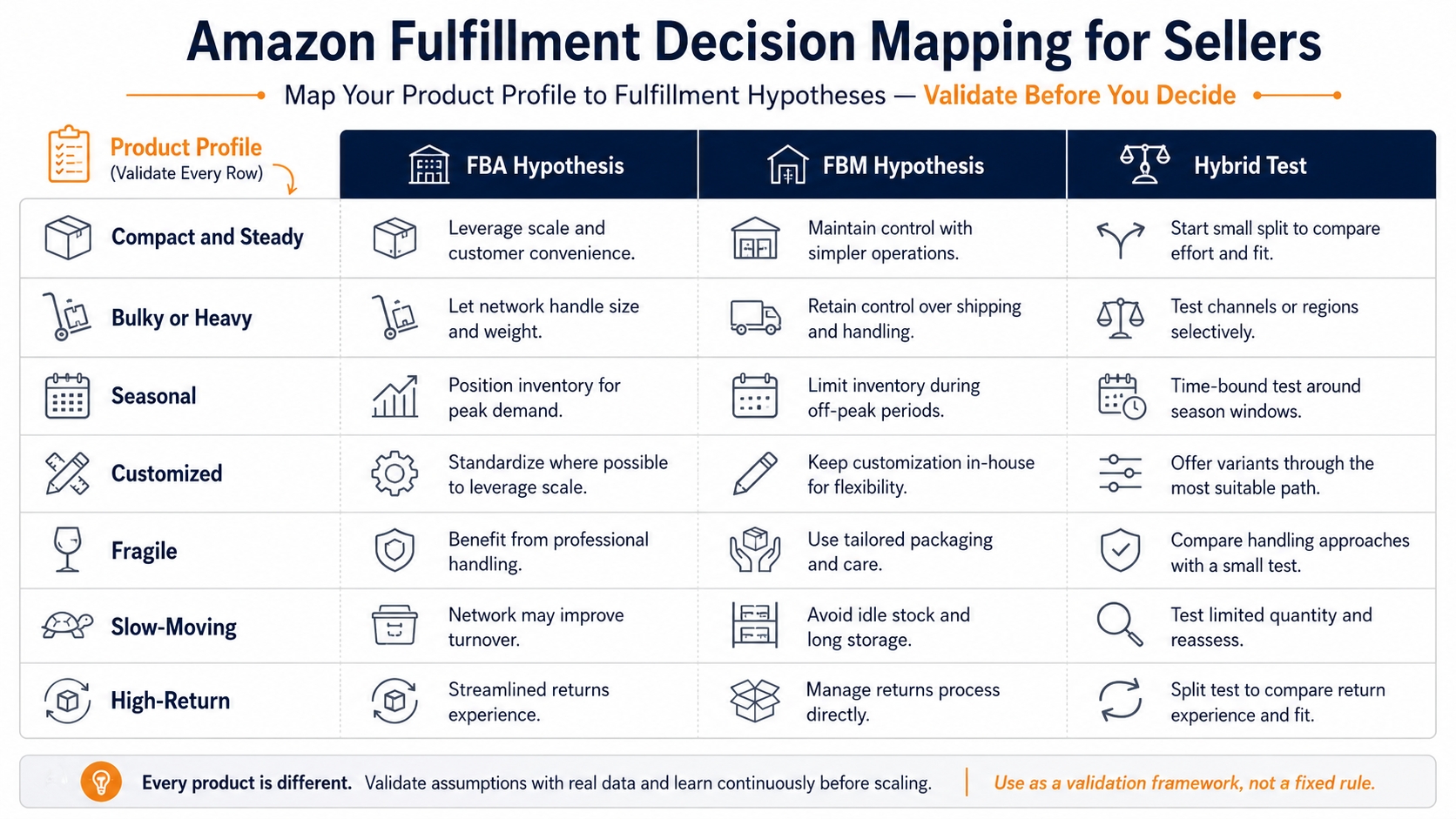
Product fit often matters more than a general preference for outsourcing or control. A method that works for a compact, steady-selling item may be weak for an oversized, seasonal, fragile, customized, or slow-moving SKU. Evaluate each product in its customer-ready package because dimensions, weight, preparation, and return handling directly affect fulfillment cost and operational risk.
The indicators below are directional, not automatic rules. A bulky product can still work with FBA when demand and margin support it. A lightweight product can still work better with FBM when it needs customization or specialized quality checks. The point is to identify which assumptions must be tested.
| Product pattern | Why FBA may fit | Why FBM may fit | What to test |
|---|---|---|---|
| Compact and steady-selling | Standardized handling and predictable sell-through may support efficient inventory placement. | A strong internal shipping rate or existing capacity may still produce lower total cost. | Contribution, replenishment lead time, stockout risk, and actual order labor |
| Bulky or heavy | FBA may simplify a difficult shipping operation when margin and velocity support the costs. | Seller-negotiated freight, regional fulfillment, or specialized packaging may be more economical. | Dimensional weight, handling damage, storage, zones, and return freight |
| Seasonal | FBA can support peak order execution if inbound inventory is positioned accurately and on time. | FBM can preserve access to inventory and reduce long post-season storage when capacity is available. | Inbound deadline, peak capacity, cutoff dates, residual stock, and markdown plan |
| Customized or fragile | FBA may fit only when the product and required handling are eligible and standardized. | FBM can support final inspection, personalization, specialized packaging, and controlled carrier selection. | Defect rate, packing time, damage, customer promise, and exception handling |
| Slow-moving or uncertain | A small FBA test may still validate demand if storage and removal exposure are controlled. | FBM can keep inventory accessible and limit FBA storage exposure during validation. | Minimum test quantity, sell-through, storage duration, and stop rule |
Compare control, capacity, customer service, and returns
Control is one of the clearest differences between FBA and FBM, but it should be priced rather than praised. With FBM, the seller can choose packaging materials, warehouse workflows, carrier services, cutoff times, quality checks, and return inspection. Those choices can improve a specialized customer experience, but they also create responsibilities that must be staffed, monitored, and maintained every day.
FBA reduces direct involvement in routine order execution and core post-order service for FBA units. This can free time and operating attention, especially as volume grows. The tradeoff is that the seller has less day-to-day control over fulfillment execution and must work within FBA preparation, inbound, storage, inventory, and program requirements.
The strongest decision asks where control changes the outcome. A handwritten note may not justify an entire FBM operation for a commodity product. Direct access to serialized, fragile, high-value, or customized inventory may be essential. Document the customer or product requirement that the control is meant to protect.
FBA operating questions
- Can the product meet current FBA eligibility, preparation, packaging, and inbound requirements?
- Can the team forecast and replenish inventory early enough to avoid lost availability?
- Does the margin absorb fulfillment, storage, inbound, return, and exception costs?
- What is the plan for aged, stranded, damaged, excess, or returned inventory?
FBM operating questions
- Can the operation ship accurately and on time across every active region and service level?
- Are staffing, packing, carrier, support, and return capacity documented for peaks?
- Can inventory availability and handling times remain accurate in Seller Central?
- Who owns failed delivery, damage, reshipment, refund, return inspection, and escalation?
How inventory and cash flow change the decision
FBA inventory has to be prepared, shipped, received, and made available before it can support customer orders. That creates an inbound lead-time problem in addition to a demand-forecast problem. Sending too little can create stockouts and emergency replenishment; sending too much can increase storage exposure, tie up cash, and force removal or liquidation decisions.
FBM usually keeps inventory closer to the seller's control and can make the same units available to multiple channels when the systems and agreements support it. The tradeoff is that warehouse space, labor, and carrier capacity must remain available even when demand is volatile. A facility can appear inexpensive at average volume and fail economically when peak staffing or expedited shipping is required.
Build a cash timeline for each method. Include supplier payment, freight, receiving, time to sale, storage, customer delivery, returns, Amazon settlement timing, and the delay before returned or removed inventory becomes usable again. Contribution margin can look healthy while the cash cycle is too long for the business to replenish safely.
Choose the method that the business can keep in stock without creating unacceptable excess, emergency replenishment, or capacity risk. A lower cost per order does not help when the offer cannot remain available or the cash cycle prevents reordering.
Where Seller Fulfilled Prime fits
Seller Fulfilled Prime is not the same as standard FBM. It is a separate program for sellers that fulfill products outside Amazon while meeting the program's delivery and performance requirements. Amazon's current public page says sellers need a Professional selling account, must prequalify by meeting performance requirements, and must successfully complete a 30-day trial before enrollment.
During the trial, sellers demonstrate that their operation can meet the required delivery experience; Prime branding is not displayed until the trial is passed and enrollment is active. Amazon also states that ongoing performance is reviewed and that continued failure can lead to Prime offers being disabled or program disenrollment. Current terms, eligible regions, metrics, templates, and carrier requirements should be checked inside Seller Central before planning around the program.
Seller Fulfilled Prime can change the strategic value of FBM for an operation with strong warehousing and delivery capabilities, but it should not be treated as a shortcut. The fulfillment system must already be able to maintain the promised customer experience, and the economics must include the capacity required to do so.
When a hybrid FBA and FBM strategy makes sense
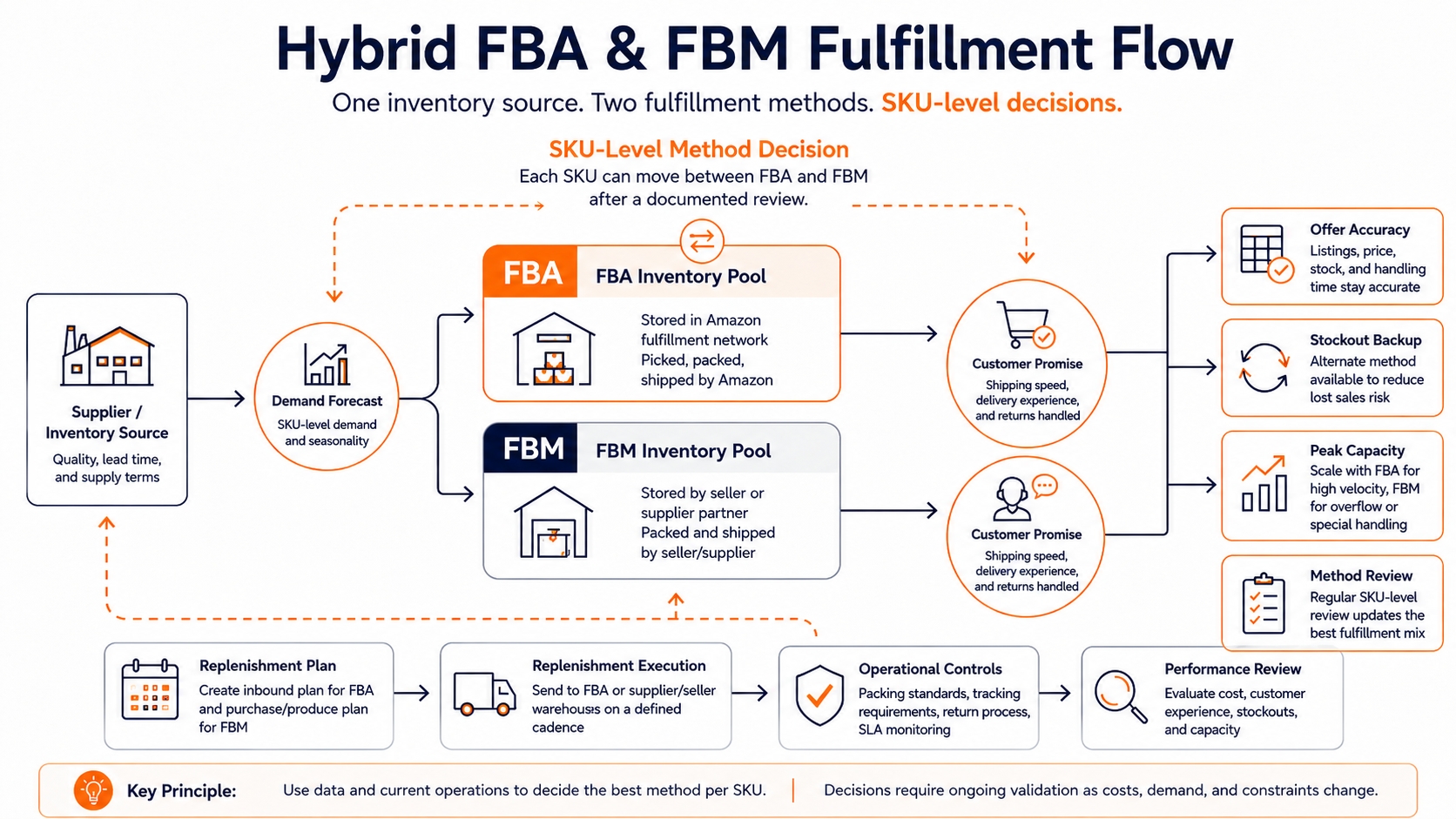
A hybrid strategy assigns fulfillment by SKU, inventory pool, region, or time period instead of forcing the whole catalog into one method. Amazon states that sellers can use FBA, FBM, or a combination. The operational benefit is flexibility; the operational risk is that two inventory and order systems must remain accurate at the same time.
Hybrid fulfillment can support backup availability when FBA inventory is constrained, seller-controlled handling for specialized units, FBA for fast-moving standard products, FBM for oversized or seasonal inventory, or a controlled migration from one method to another. It should not create duplicate or inaccurate offers, hidden inventory conflicts, or a delivery promise the seller cannot maintain.
| Hybrid use case | Potential value | Control required | Failure to avoid |
|---|---|---|---|
| FBA with FBM backup | Preserves another fulfillment path when FBA availability is constrained. | Accurate offer, inventory, handling, carrier, and routing rules. | Backup offer is active but cannot meet the displayed promise. |
| Split by product type | Uses FBA for standardized, fast-moving units and FBM for specialized, bulky, or customized units. | SKU-level costing, listing accuracy, and separate service standards. | A catalog-wide average hides unprofitable or operationally weak SKUs. |
| Seasonal inventory split | Positions a controlled quantity in FBA while keeping additional stock accessible for replenishment or FBM. | Forecast, replenishment trigger, peak warehouse capacity, and end-of-season exit plan. | Excess remains in the wrong location after the demand window closes. |
Build a SKU-level FBA vs FBM scorecard
A scorecard makes the decision reproducible and prevents the team from choosing based on one attractive metric. It should preserve the raw inputs and the final reasoning. A numeric score can help organize evidence, but it should not hide a disqualifying constraint such as product ineligibility, missing warehouse capacity, unacceptable margin, or an unsupported delivery promise.
Use a simple rating scale for each dimension, then require a written explanation for any major difference between the two methods. Weight the dimensions only when the business can explain why one factor matters more for that SKU. Revisit the score when the product, packaging, cost, demand, or service environment changes.
| Scorecard dimension | Input to document | Evidence that may favor FBA | Evidence that may favor FBM |
|---|---|---|---|
| Fully loaded contribution | Base, downside, and break-even contribution per order using identical sales assumptions. | FBA costs remain acceptable after inbound, storage, return, and inventory exposure. | Actual carrier, labor, facility, support, and return costs produce stronger contribution. |
| Customer promise | Delivery expectation, packaging need, customization, support, and return experience. | Standardized fulfillment and Amazon-managed post-order flow fit the product. | Specialized packing, inspection, delivery, or support creates measurable value. |
| Demand pattern | Monthly units, weekly variability, seasonality, promotion effects, and forecast error. | Stable demand supports planned inbound and inventory turnover. | Seller access to stock and flexible capacity better absorbs uncertain or intermittent demand. |
| Operational capacity | Daily capacity, peak capacity, staffing, cutoff times, carrier coverage, and incident response. | Outsourcing removes a material internal constraint and the SKU fits FBA requirements. | The seller has tested capacity and can meet the promise with acceptable risk. |
| Inventory and cash risk | Lead time, safety stock, storage period, stockout impact, residual value, and cash cycle. | Inventory can be positioned accurately with healthy turnover and controlled excess. | Direct inventory access materially reduces exposure or supports multiple channels. |
Run a 30-day FBA vs FBM decision test
A 30-day test is an editorial operating recommendation, not an Amazon requirement. Its purpose is to replace assumptions with comparable evidence while limiting inventory and service exposure. The window may need to be longer for low-volume, highly seasonal, or slow-return products, but the same measurement discipline applies.
Freeze the assumptions
Record product dimensions, weight, selling price, forecast units, return rate, advertising assumption, FBA estimate, FBM cost sheet, inventory quantity, service promise, and the decision thresholds. Use the same basis for both methods.
Verify operational readiness
Confirm FBA receiving and availability where applicable. For FBM, run the complete pick, pack, ship, tracking, support, and return workflow. Record labor time and every exception instead of using an idealized standard.
Measure orders and exceptions
Track contribution per order, handling time, shipment confirmation, delivery issues, stockouts, customer contacts, returns, damage, reshipments, and inventory movement. Separate one-time setup cost from recurring cost, but do not hide the setup cost from the investment decision.
Stress-test the next volume tier
Model what happens if units increase, price drops, returns rise, inbound slows, carrier rates change, or peak labor is needed. Confirm that the chosen method can survive a reasonable downside rather than only matching the first month's average.
Choose scale, hold, switch, or hybrid
Compare actuals with the prewritten thresholds. Record why the SKU will remain in the method, move to the other method, use both, or pause until a product, cost, or capacity problem is corrected.
Metrics to capture
Where SellerSprite fits in the decision
SellerSprite can support the market, product, keyword, and scenario research that sits around an FBA vs FBM decision. It does not determine Amazon eligibility, replace the Amazon Revenue Calculator, confirm warehouse capacity, or guarantee that either method will be profitable. Keep marketplace estimates separate from current Amazon terms and the seller's own operating data.
Third-party search, sales, and competitor estimates can help prioritize products and scenarios. They cannot establish current Amazon fees, FBA eligibility, FBM service capacity, future demand, revenue, or profitability. Use current Amazon sources and your own dated operating evidence for the final decision.
Common FBA vs FBM decision mistakes
Most weak decisions do not fail because the seller chose the wrong acronym. They fail because the comparison excluded costs, used mismatched assumptions, ignored capacity, or was never revisited after the SKU changed. Use the following patterns as review prompts.
| Mistake | Why it distorts the decision | Better control | Evidence to review |
|---|---|---|---|
| Compare FBA fees with postage only | FBM labor, packaging, facilities, software, service, returns, and failures disappear from the model. | Build fully loaded per-order cost for both methods. | Time study, carrier invoice, facility cost, support log, and return records |
| Use one decision for the whole catalog | Product size, velocity, margin, handling, and return profiles differ. | Approve fulfillment at SKU or product-family level. | SKU-level contribution, dimensions, velocity, returns, and handling requirements |
| Treat internal labor as free | The owner or team absorbs fulfillment work that cannot scale without cost. | Record minutes per order and price the next staffing tier. | Pick, pack, support, return, reconciliation, and exception time |
| Ignore inventory-location risk | The model misses inbound delay, stockout, excess storage, emergency shipping, or inaccessible stock. | Model replenishment, safety stock, storage duration, and backup availability. | Lead time, forecast error, stockout days, aged units, and emergency cost |
| Assume Prime solves weak economics | A delivery badge or promise cannot make an unprofitable product healthy. | Approve the cost and customer promise separately. | Contribution, conversion context, return rate, and program requirements |
| Never schedule a re-evaluation | Fees, rates, dimensions, demand, capacity, and return behavior change. | Set quarterly and event-triggered reviews. | Fee notices, rate cards, package changes, velocity, returns, and incident logs |
Amazon FBA vs FBM decision checklist
Choose fulfillment with evidence, not habit
Compare the same SKU under both methods, include the costs and risks that sit outside the visible fee line, then repeat the decision when the product or operation changes.
Frequently asked questions
Is FBA or FBM cheaper?
It depends on the SKU and operation. Compare current Amazon FBA estimates with fully loaded FBM costs using the same dimensions, weight, price, volume, return rate, and service assumptions. Include inventory, labor, storage or facilities, customer service, and exception costs instead of comparing only the FBA fulfillment fee with carrier postage.
Can I use FBA and FBM at the same time?
Yes. Amazon states that sellers can use one method or combine methods by product. A hybrid approach can support different product needs, seasonal inventory, migration, or backup availability, but the seller must maintain accurate inventory, offers, handling times, and customer promises for each active method.
Does FBM mean I must ship every order personally?
No. FBM means fulfillment remains under the seller's responsibility rather than being performed through FBA for those units. A seller may use its own team or a contracted logistics provider, but it remains responsible for accurate inventory, shipment, delivery performance, customer service, returns, and compliance with current Amazon requirements.
Can an FBM offer display Prime branding?
Standard FBM does not automatically provide Prime branding. Seller Fulfilled Prime is a separate program. Amazon's current public guidance says sellers must have a Professional selling account, prequalify by meeting performance requirements, and successfully complete a 30-day trial before enrollment. Verify current terms in Seller Central.
How often should sellers re-evaluate FBA vs FBM?
Review the decision on a regular cadence, such as quarterly, and after any material change in Amazon fees, package dimensions, carrier rates, sales velocity, return rate, warehouse capacity, inbound lead time, product design, or customer-service requirements. A method that was correct at launch may not remain correct as the SKU or operation changes.
References
- Amazon: FBA vs FBM
- Amazon: Estimate fees and costs
- Amazon: Fulfillment by Amazon
- Amazon: Fulfilled by Merchant
- Amazon: Seller Fulfilled Prime
- Amazon: Standard selling fees
Scope and limitations: Unless a source states otherwise, Amazon policy, program, and cost references in this article relate to US public pages reviewed on September 3, 2026. Marketplace, account, product, category, fee, eligibility, and interface details can differ and can change. Amazon calculators and SellerSprite data are estimates and research inputs, not guarantees of eligibility, demand, revenue, service performance, or profitability. This article is educational and is not legal, tax, accounting, insurance, or financial advice.