Deciding what to sell on Amazon matters more at the time you think over that Amazon is projected to claim 60% of all U.S. online sales by 2026 . More than 55,000 independent Amazon sellers generated over $1 million in sales in 2024. Sellers averaged more than $290,000 in annual sales . The chance is massive, but finding the best selling products on amazon requires understanding what products are in high need right now.
We've created this piece to help you identify high need products to sell and find the most profitable items to sell on amazon. We'll explore trending categories and proven research methods. You'll also learn about the automation strategies that 89% of top sellers now use to stay competitive.
What's Driving Amazon Product Demand in 2026
Consumer Behavior Shifts Post-2025
Consumer spending patterns no longer follow predictable paths. Sentiment remains poorer than pre-2020 levels, yet spending continues at steady rates. This disconnect creates an unusual market where shoppers simultaneously trade down in some categories while splurging in others. The best products to sell on amazon aren't necessarily the cheapest or most premium items. They're the ones that deliver perceived value in the right context.
Health and wellness concerns now drive 58% of American food and beverage purchases. 80% of consumers check whether products are processed before buying. Shoppers scan for "natural" labels (41%), "no hormones or steroids" (38%), and organic certifications (30%). The move extends beyond groceries. Four in 10 Americans demonstrate deal-driven or cost-conscious shopping habits, which forces brands to compete on factors beyond price alone.
The 60% Market Share Reality
Amazon captured 37.6% of U.S. retail e-commerce spending in 2024 and maintained its lead despite increased competition. Prime members spend differently. The platform's 185 million U.S. Prime members spend an average of $1,400 annually compared to $600 for non-Prime customers. Third-party sellers account for approximately 60% of Amazon's unit sales. This creates network effects where more sellers attract more customers, which then attracts more sellers.
Recent data shows Amazon gaining an additional 200 basis points of market share during May promotional periods. The platform pulled ahead while overall online spend growth decelerated from 7% to 4% year-over-year.
Why Automation Changed Product Selection
Sellers who used Product Opportunity Explorer saw a 1.79% lift in gross sales 12 months after adoption. The tool analyzes search terms, purchasing behavior, competitive pricing and customer reviews to reveal high demand products to sell with low competition. AI now tracks consumer behavior patterns immediately and surfaces niche markets and emerging trends before they peak. Manual guessing is no longer necessary.
Thirty-five percent of retailers expect to deploy customized AI recommendations within the next year. 68% plan agentic AI implementation for operational activities within 12 to 24 months. This automation determines what products are in high demand right now by processing data volumes impossible to analyze manually.
High Demand Products to Sell on Amazon Right Now
Beauty & Personal Care Winners
Skincare dominates with medicube Toner Pads Zero Pore Pad 2.0 ranking #1 in Beauty & Personal Care. Mighty Patch acne patches moved over 182,000 units. eos Shea Better Body Lotion and Neutrogena Makeup Remover Wipes each generated over 66,000 sales. The beauty products market is expected to generate $646 billion in revenue in 2025, with personal care products representing $282 billion. Hair growth products, pimple patches and Gua Sha tools remain evergreen best selling products on amazon.
Kitchen & Home Essentials
Insulated water bottles lead kitchen sales. The Stanley Quencher generated 88,436 reviews, while Owala FreeSip captured 113,315 reviews. Kitchen scales from Etekcity sold 144,325 units. Food Network's January 2026 bestsellers included a Cosori 9-in-1 Air Fryer at $90 (originally $120) and a NutriBullet Personal Blender at $50. Cookware sets, the Carote 21-piece set at $130 in particular, moved as high demand products to sell.
Tech Accessories & Electronics
Screen protectors dominate with Ailun's iPhone protector accumulating over 1.1 million reviews. Protective cases account for 32-34% of total mobile accessories market revenue, and 68% of smartphone owners use them. Wireless chargers show 7.8% annual growth. Portable chargers and USB-C cables remain most profitable items to sell on amazon, with charging accessories showing guaranteed repeat purchase patterns.
Health & Wellness Products
Vaginal probiotics for pH balance rank #1 in Health Care Products. The wellness economy is projected to hit $7 trillion by 2025. Essential oils and aromatherapy diffusers lead stress management products. Supplements including multivitamins and Omega-3 show over 7% annual growth.
Pet & Baby Categories
Amazon Basics dog pee pads topped pet supplies with 222,061 reviews. The baby products market will reach $475.20 billion by 2030. Baby monitors and swaddle blankets represent what products are in high demand right now.
Seasonal & Trending Items
Winter apparel dominated 2026 holiday sales. Runcati Mens Pea Coats moved 1,066 units monthly at $49.53 retail. Hummingbird gifts sold 2,657 units, while seasonal decorations and kids' backpacks kept steady velocity through Q4.
How to Find the Best Products to Sell on Amazon
Research tools remove the guesswork from deciding what to sell on Amazon. Four proven methods help you identify best-selling products before competitors flood the market.
Finding products with specific criteria used to be tough, until tools like SellerSprite's Product Research came along. It scans millions of ASINs across Amazon markets and lets you filter by revenue, sales velocity, competition, and more. Here's the exact 3-step process smart sellers use:
- Go to SellerSprite Product Research and select your target Amazon marketplace (US, UK, etc.).
- Set revenue filters, like minimum $10K monthly revenue, and exclude saturated categories like Books or Digital Media.
- Sort by sales velocity to see top performers rise to the top, then dive into opportunity scores and competitor analysis.
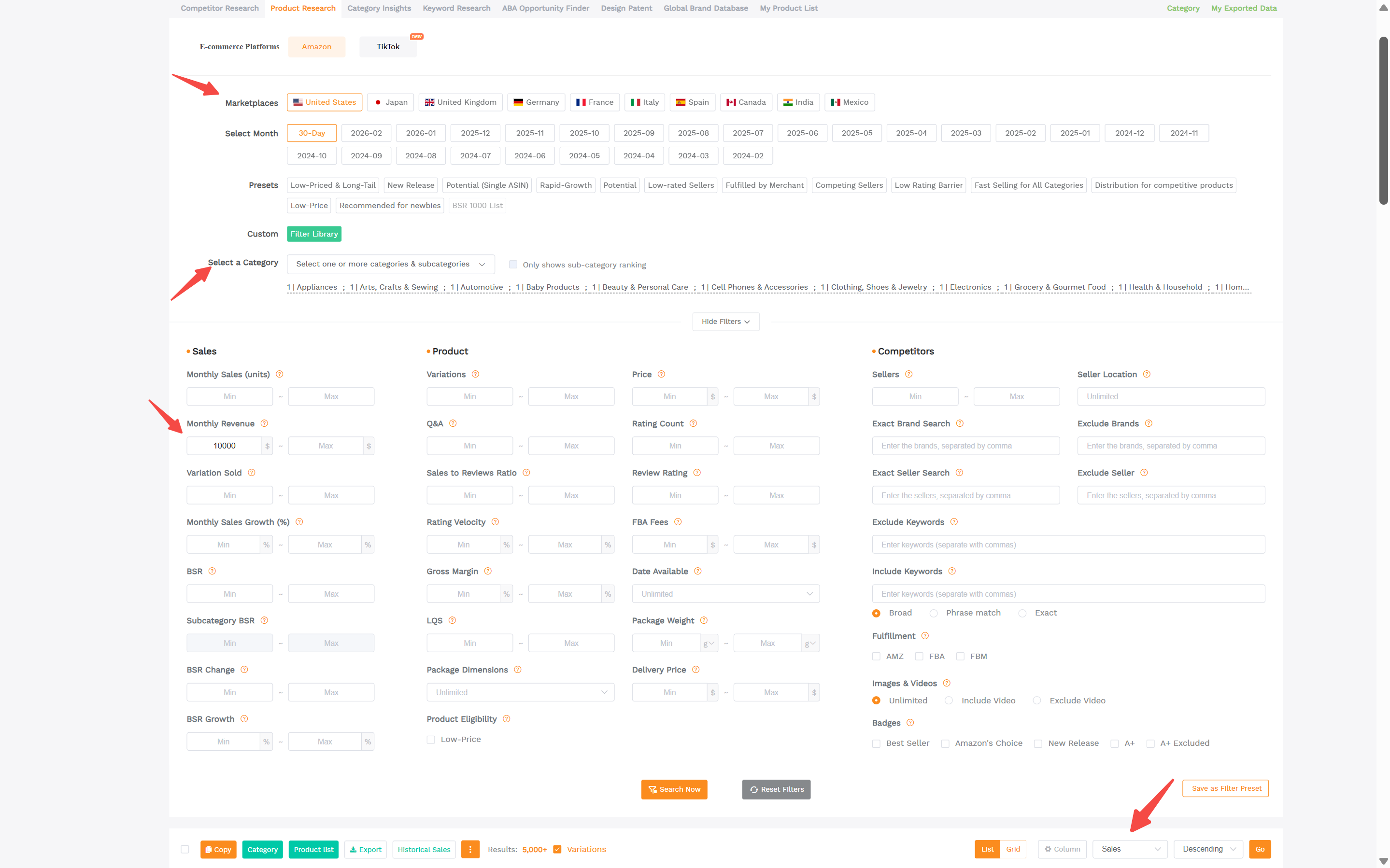 Play with different filters to uncover hidden gems, then validate using the methods below.
Using Amazon Best Sellers Lists Effectively
Best Sellers lists update hourly based on sales performance. You can access specific categories and subcategories to view the top 100 items in each segment. Each product displays its Best Sellers Rank (BSR), a number assigned after at least one sale that indicates how well an item performs within its category. Lower BSR numbers signal higher sales velocity. Products ranked in the top few dozen to a few thousand show strong sales and frequent movement, depending on category.
Product Opportunity Explorer for Informed Decisions
Professional Sellers in the US, Germany, France, Spain, and Italy can access this tool. It uses customer search and purchase behavior to locate market gaps. Access personalized recommendations based on your sales history through Seller Central → Growth → Product Opportunity Explorer. Sellers who participated saw a 1.79% lift in gross sales 12 months after adoption.
The tool organizes data into "niches," collections of search terms representing specific customer needs. Each niche provides four tabs: Products (ASIN-level details), Search Terms (search volume and conversion data), Insights (20 data points across three timeframes), and Trends (360-day metric changes).
Analyzing Customer Reviews for Product Gaps
Customer reviews reveal what's missing from current offerings. Ninety-five percent of customers read online reviews before purchasing, and products with positive reviews are 270% more likely to be bought. Read both positive and negative feedback on high-ranking products to spot recurring complaints about durability, sizing, or missing features. You can design improvements that address these pain points when you spot them.
Tracking Movers & Shakers for Early Trends
Movers & Shakers explains products with the biggest sales rank gains over 24 hours. This list shows percentage growth for each product and updates hourly, helping you identify emerging sales before categories become saturated. Install SellerSprite Chrome Extension to view sales estimates and competitor data on Amazon pages live. Products showing 300% rank increases with fewer than 50 reviews often signal test-order candidates worth proving right.
Smart Selling Strategies Winning Sellers Use in 2026
You solve half the equation when you find the best-selling products on Amazon. Execution strategies determine profitability.
Profit Margins Over Sales Volume
Net margins of 15-20% separate profitable sellers from struggling ones. Amazon businesses that last maintain 25-30% gross margins minimum after all costs. Track profitability at the SKU level rather than overall revenue. A bestseller generating $20,000 each month might lose money after FBA fees, advertising, and storage costs. Flag products with margins below 10% and decide whether to reprice, repackage, or discontinue them.
Review Collection Automation for Higher Conversions
Review automation increases conversion rates by 4-5% for every star rating increase. Tools that automate Amazon's Request a Review button ensure compliant and consistent outreach to every eligible order. Products moving from 3.5 to 4.5 stars see conversion rates jump from 24% to 29%.
Inventory Forecasting Prevents Stockouts
Accurate forecasting prevents both stockouts and long-term storage fees. Calculate reorder points using sales velocity, lead times (60-120 days), and safety stock of 15-45 days. Update forecasts each week rather than each month to capture demand changes before running out.
Product Bundling for Competitive Advantage
Product bundles create unique SKUs competitors can't replicate. Mixed bundling produces higher revenue than pure bundles by offering flexibility. HexClad saw bundles account for 30% of Amazon sales by pairing complementary cookware items.
Listing Optimization with Search Data
Amazon's Search Query Performance report reveals where shoppers drop off between impressions and purchases. Low click-through rates signal weak main images or titles, while high cart adds but low purchases indicate pricing friction. Install SellerSprite Chrome Extension to view immediate sales estimates and competitor data on product pages.
Conclusion
Success on Amazon in 2026 comes down to combining the right research tools with solid execution strategies. We've shown you how to identify high-demand products using Best Sellers lists and Product Opportunity Explorer, along with customer review analysis. You should prioritize profit margins over raw sales volume and automate the repetitive tasks that slow most sellers down. Begin with one category and confirm demand with data. Then scale your operations step by step. Sellers who act now will capture the chances before the market becomes saturated.
FAQs
Q1. What types of products are expected to be in high demand in 2026? Products showing strong growth include mouth tape (134% year-over-year growth), flat back earrings (65% growth), sleep bonnets (64% growth), blue light therapy lights (38% growth), hair repair masks (30% growth), and sleep earbuds (31% growth). Additionally, beauty and personal care items, kitchen essentials like insulated water bottles, tech accessories such as screen protectors, health and wellness products, and pet supplies continue to show strong demand.
Q2. How much can sellers realistically earn on Amazon per month? Most Amazon sellers earn between $1,000 and $25,000 in monthly revenue, which typically translates to approximately $200 to $5,000 in net profit after accounting for fees, inventory costs, and advertising expenses. The top 20% of sellers surpass $50,000 per month, while about 30% start under $500 but experience growth within their first year of selling.
Q3. What is Amazon's projected market position for 2026? Amazon is projected to capture 60% of all U.S. online sales by 2026, building on its 37.6% share of U.S. retail e-commerce spending in 2024. The platform's 185 million U.S. Prime members spend an average of $1,400 annually, and third-party sellers account for approximately 60% of Amazon's unit sales, creating strong network effects.
Q4. Which product categories are currently selling fastest on Amazon? Beauty and personal care products like skincare toner pads and acne patches, kitchen essentials including insulated water bottles and air fryers, tech accessories such as screen protectors and phone cases, health and wellness items like probiotics, and pet supplies including dog pee pads are among the fastest-moving categories with proven sales velocity.
Q5. What profit margins should Amazon sellers target for sustainable business? Successful Amazon sellers maintain gross margins of 25-30% minimum after all costs, with net margins of 15-20% separating profitable sellers from struggling ones. It's important to track profitability at the individual product (SKU) level rather than overall revenue, and consider discontinuing or repricing products with margins below 10%.