TL;DR: An Amazon FBM calculator helps you accurately estimate self-fulfillment profit by accounting for all costs from product and shipping to labor and returns. Use it to compare FBM vs. FBA and uncover hidden profitability levers.
Key Takeaways
- An FBM calculator considers not just Amazon fees but also packaging, carrier shipping, labor, returns, and hidden operational costs.
- FBM often beats FBA for oversized, slow-moving, or fragile products where shipping control offsets higher service costs.
- Buy Box eligibility and customer trust require careful management of shipping speed and seller metrics when using FBM.
Table of Contents
Note on marketplaces: This guide is specifically optimized for the US market.
Quick Answer
A Amazon FBM calculator is a specialized tool that estimates your net profit when you choose to fulfill orders yourself instead of using Amazon's FBA service. It subtracts all expenses including product cost, Amazon selling fees, packaging, shipping, labor, returns, and miscellaneous operational costs from your selling price. This gives you a clear picture of your true margin per unit. Because FBM puts you in direct control of storage, packing, and delivery, accurately tallying these inputs is the only way to gauge whether self-fulfillment will be more lucrative than handing inventory over to Amazon.
FBM Can Win When Shipping Control Offsets Labor and Service Costs
FBM shines when the cost and quality advantages of managing your own shipping outweigh the extra time and labor required. For example, if you negotiate deeply discounted carrier rates due to high volume, you can often ship large items for less than Amazon's fulfillment fees. Similarly, sellers of fragile or high-value goods may want to use custom packaging that Amazon won't provide, reducing damage claims and returns. Even the ability to hand-write a thank-you note or include a branded insert can boost repeat purchases, which is a factor no automated fulfillment center can replicate. In these scenarios, the FBM profit calculator may reveal a wider margin than what FBA delivers after accounting for labor and service costs.
FBM Cost Inputs
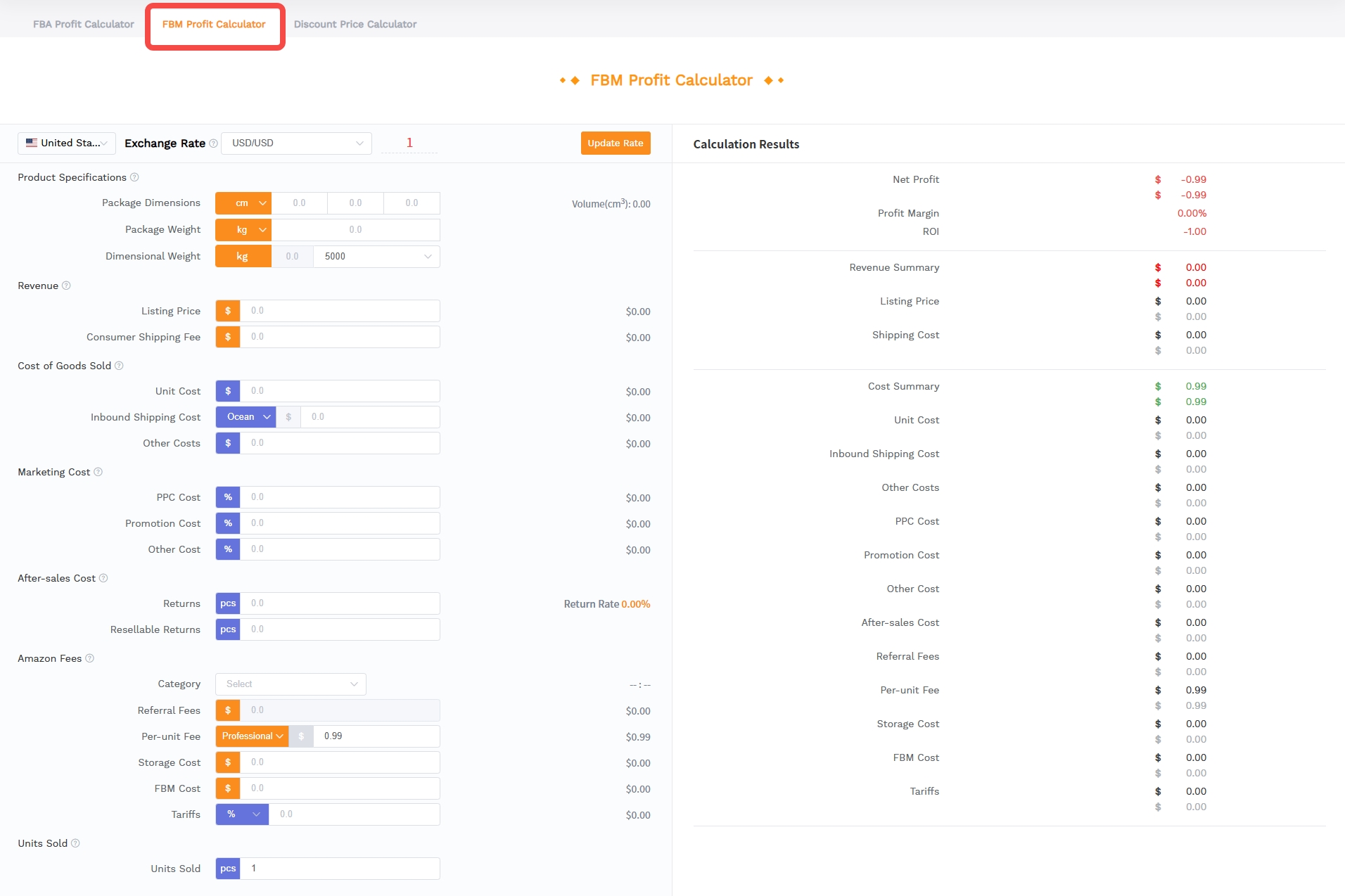
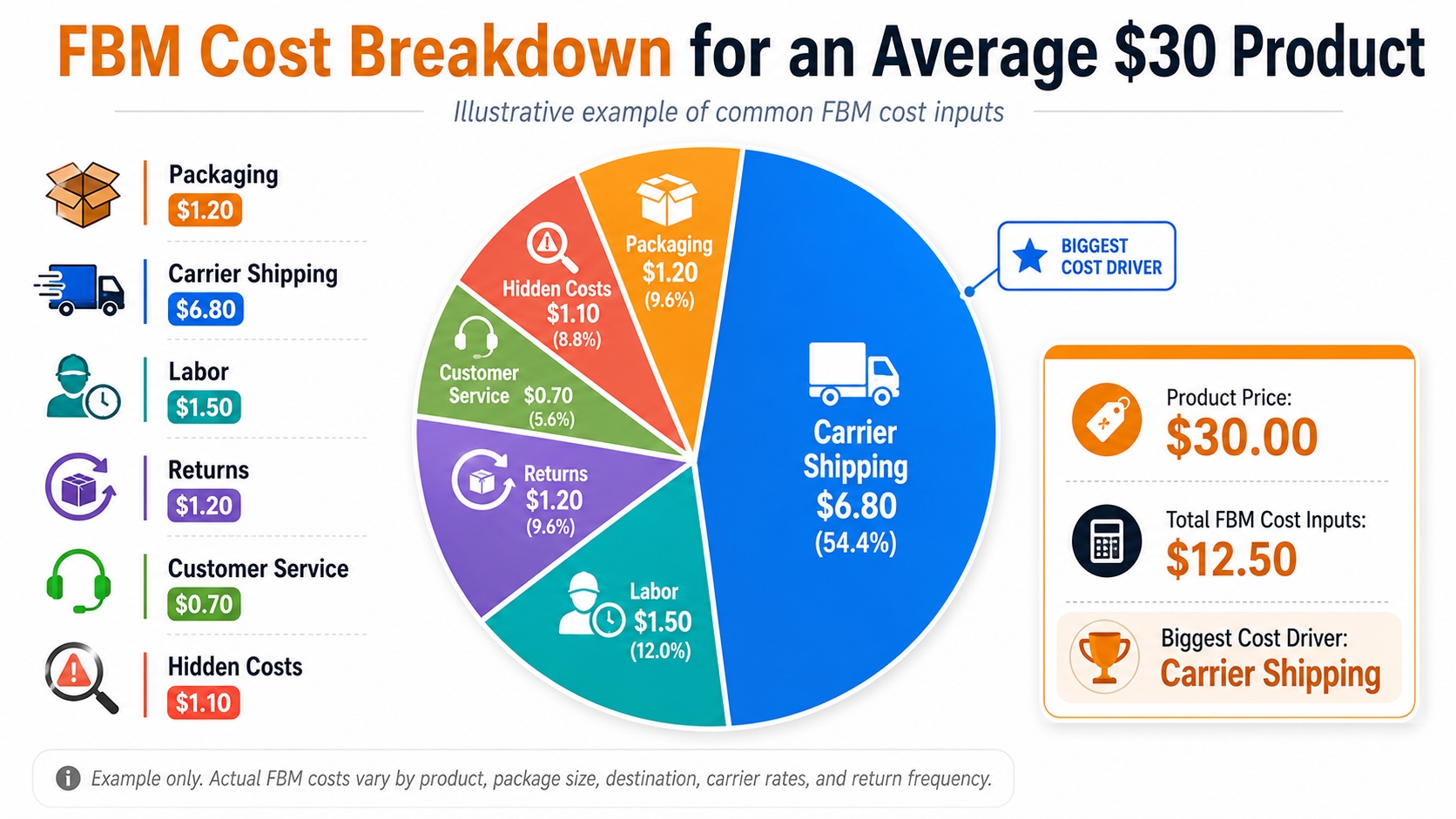
To use an FBM profit calculator effectively, you must understand every cost component that eats into your revenue. Unlike FBA, where Amazon consolidates many fees into a single fulfillment charge, FBM requires you to monitor and enter each expense separately. Below, we break down the key inputs, from the obvious (shipping) to the easily overlooked (labor and returns). For a broader look at all Amazon fees, see our Amazon calculator guide.
Packaging Cost
Packaging includes everything that protects your product during transit: boxes, bubble wrap, tape, void fill, and any branded tissue or inserts. Don't forget the cost of custom packaging if you use it. To calculate per-unit packaging, add up all materials used for a typical order. For instance, a standard small box may cost $0.50, plus $0.20 for bubble wrap and $0.10 for tape, totaling $0.80 per unit. Multi-pack and oversized items will drive this higher. Also, factor in the waste factor, such as damaged boxes or mis-packed orders that require redoing. A good FBM profit calculator will let you enter packaging as a flat amount or a percentage of the selling price.
Carrier Shipping Cost
This is the rate you pay to UPS, FedEx, USPS, or a regional carrier. Shipping cost depends on package weight, dimensions, destination zone, and the service level (e.g., Ground vs. Express). Many sellers start with USPS Cubic or Priority Mail for small items, while larger items may require UPS or FedEx Ground. The critical step is to average your shipping cost across different zones; a package going to Zone 2 might cost $6, while Zone 8 could be $12. Always include delivery confirmation and insurance if your item value warrants it. Use your actual carrier invoices to get an accurate average; don't rely on published rate charts. In an Amazon self-fulfillment calculator, you'll typically input an estimated cost per shipment.
Labor Cost
Labor is the most frequently underestimated FBM cost. It encompasses the time you (or your employees) spend picking, packing, labeling, and creating shipping manifests. If you pay yourself or staff an hourly wage, determine how many minutes each order takes and multiply by the wage. For example, if an order takes 10 minutes to process and the hourly wage is $15, labor cost per order is $2.50. Even if you're a solopreneur and don't write a check, consider the opportunity cost of your time – could those hours be better spent on product research or marketing?
Return Handling
Returns are a reality of ecommerce. When a customer returns an FBM order, you pay for the return shipping (if you offer free returns), inspect the item, possibly repackage it, and decide whether it can be resold as new or must be discounted. The cost includes the return label, your time to process the return, and any loss of value if the item is returned damaged. A common approach is to budget a fixed percentage of sales for returns, say, 2-3%, based on your historical return rate. Advanced seller fulfilled profit calculators, such as SellerSprite free FBM calculator, let you model this as a separate line item to prevent return costs from silently eroding your margin.
Customer Service Time
Self-fulfilling means you're on the hook for all buyer messages, tracking inquiries, and post-delivery issues. While not a direct cash expense, the time spent answering emails and handling complaints is labor that could be used elsewhere. Calculate a rough estimate: if you spend 5 hours per week on service and sell 200 units, that's 1.5 minutes per order. Even at a modest hourly rate, this adds up. Some FBM calculators fold this into the general labor cost, but we recommend tracking it separately to gauge if outsourcing customer service would improve net profitability.
Hidden Operational Costs
Beyond the obvious expenses, running an FBM operation carries overhead that many new sellers miss. These hidden costs can turn a seemingly profitable item into a loser if not accounted for:
⚠️ Hidden Costs Checklist:
- Storage space: If you're not working out of your garage, warehouse rent or a storage unit can cost hundreds per month.
- Inventory insurance: Protecting your stock against fire, theft, or damage is essential and often overlooked.
- Software subscriptions: Shipping labels, order management, and accounting tools often carry monthly fees.
- Supplies beyond packaging: Printers, ink, label rolls, scales, and packing tables.
- Shrinkage: Items that go missing, get damaged beyond repair, or are stolen.
- Returns processing space: A corner for sorting, inspecting, and repackaging returns.
When using an Amazon FBM calculator, create a "miscellaneous" category that captures a percentage of sales (often 1-3%) to cover these hidden drains.
How to Calculate FBM Profit
Now that you understand the inputs, let's walk through the actual FBM profit calculation. The formula is straightforward: Net Profit = Revenue – Amazon Selling Fees – Fulfillment Cost. But each component demands accuracy. Below, we decompose the calculation and provide a worked example. For hands-on testing, use the free FBM calculator on SellerSprite.
Revenue
Revenue is simply the selling price you receive per unit, excluding any sales tax collected on Amazon's behalf. If you run promotions or offer coupons, use the net effective price, i.e., the amount that actually lands in your account after discounts. For multi-quantity listings, calculate revenue per unit. Also, account for occasional chargebacks or A-to-Z claims that may reduce your realized revenue by a small percentage.
Amazon Selling Fees
Even with FBM, you still pay Amazon for each sale. The primary fee is the referral fee, a percentage of the total sales price (typically 15% for most categories, but varies). Media categories like books add a variable closing fee. Also, don't forget the monthly professional selling plan fee of $39.99, which you can amortize across units if you sell hundreds per month. For high-volume sellers, the referral fee is the biggest line item after cost of goods. Ensure your FBM profit calculator reflects the correct category fee schedule.
Fulfillment Cost
This is the sum of all the FBM-specific expenses we detailed earlier: packaging, carrier shipping, labor, returns handling, and customer service time. Add any hidden operational overhead allocated per unit. For a small business, fulfillment cost might range from $5 to $15 per order depending on item size and weight. The key is to avoid double-counting; for instance, labor for customer service should be included once, not also in general labor. Many seller fulfilled profit calculators group these into a single "pick & pack" cost for simplicity, but granular tracking helps spot areas for improvement.
Net Margin
After subtracting Amazon fees and your total fulfillment cost from revenue, you're left with net profit per unit. That profit divided by revenue gives you net margin percentage. Healthy FBM margins usually fall in the 15-30% range, but many sellers achieve higher on niche or high-value items. Always compare this margin against what you'd earn via FBA for the same product using the same selling price to make an informed fulfillment choice.
| Step | Formula Component | Example ($30 item) |
|---|---|---|
| 1 | Selling Price | $30.00 |
| 2 | - Amazon Referral Fee (15%) | -$4.50 |
| 3 | - Product Cost | -$6.00 |
| 4 | - Packaging | -$1.50 |
| 5 | - Shipping (carrier) | -$5.00 |
| 6 | - Labor (picking/packing) | -$2.00 |
| 7 | - Returns provision (2%) | -$0.60 |
| Net Profit | $10.40 |
With a $10.40 profit on a $30 item, the net margin is 34.7%. This looks great, but remember to layer in any hidden costs from the checklist above since they could eat up another dollar or two. Always re-run the numbers with realistic worst-case shipping and return rates to stress-test your profitability.
When FBM Beats FBA
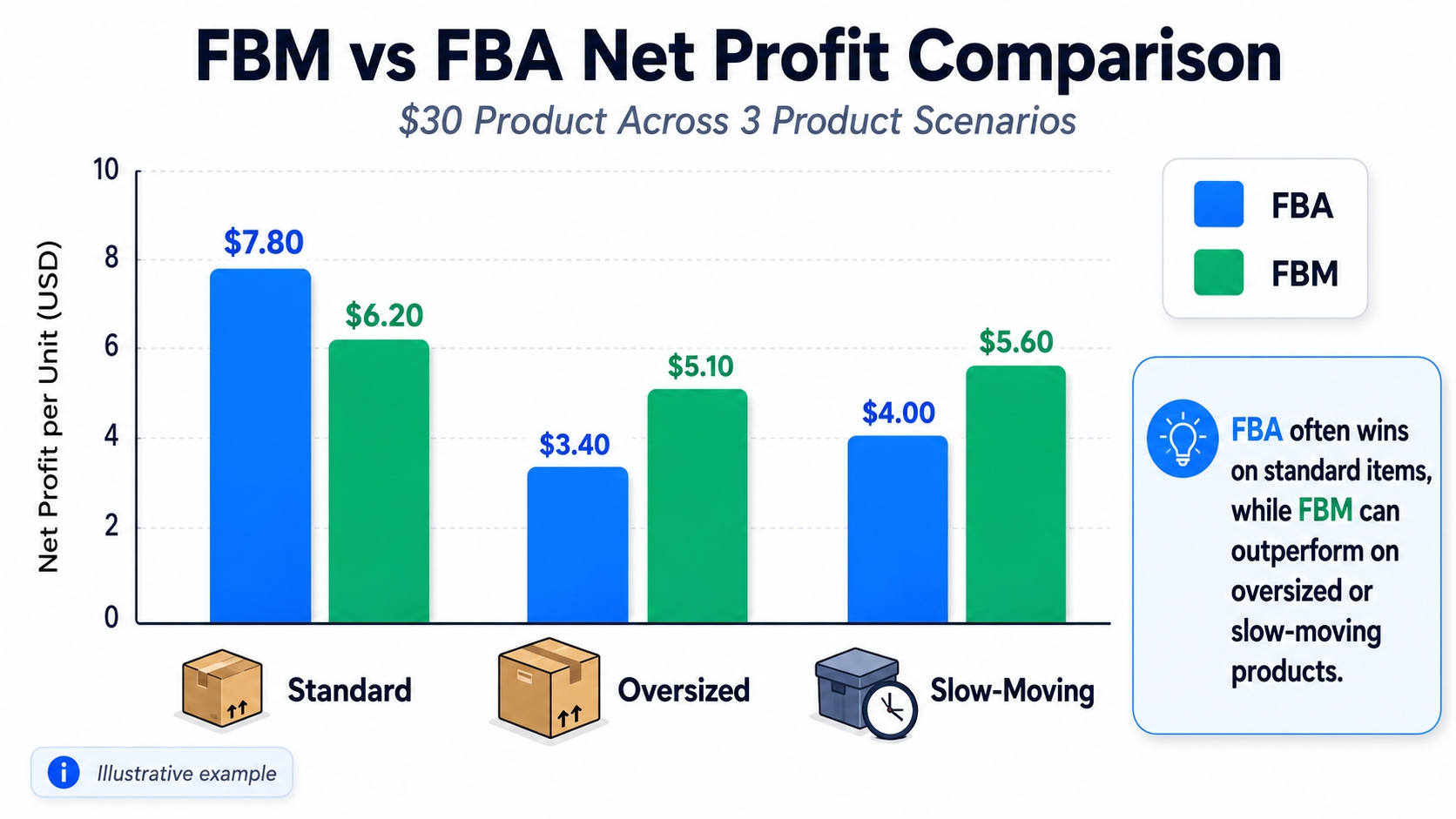
FBA offers convenience and Prime eligibility, but there are clear scenarios where FBM delivers higher net profit. The key is to run the numbers with both fulfillment methods in an FBM vs. FBA profit comparison. Below are three product types where self-fulfillment typically wins.
Oversized Products
Amazon charges steep fulfillment fees for oversized items, sometimes $10 to $25+ extra per unit compared to standard size. If you can pack and ship these yourself using freight or LTL carriers, you often undercut FBA costs significantly. For example, a 20-lb dog food bag might cost $18 in FBA fees, whereas your negotiated UPS Ground rate is $10. Plus, oversized inventory quickly racks up monthly storage fees in FBA warehouses, especially during Q4. By keeping such products in your own warehouse and shipping them FBM, you avoid both the fulfillment surcharge and the storage penalty.
Slow-Moving Products
Amazon imposes long-term storage fees (LTSF) on inventory that sits for more than 181 days. If you sell niche, seasonal, or low-velocity items, those fees can wipe out your margin. With FBM, you only ship items when they sell, eliminating storage costs entirely. Sure, you'll need space at home or a cheap self-storage unit, but that's often a fraction of FBA's per-cubic-foot rate. Before enrolling such products in FBA, run your Amazon FBM calculator to see if the freedom from LTSF makes self-fulfillment more profitable in the long run.
Custom or Fragile Products
Products that require special handling, such as hand-blown glass, artwork, assembled electronics, often suffer high breakage rates in Amazon's standard fulfillment process. FBA charges you for returns and damage, but more importantly, negative reviews from shattered products can kill a listing. With FBM, you can pack each item with custom-fitted foam and double-box, dramatically reducing damage. You can also include assembly instructions or a personalized note that enhances the customer experience. While labor costs are higher, the reduction in returns and boost in positive reviews often tilts the FBM vs FBA profit equation in your favor.
✅ When FBM typically wins:
- Oversized items where FBA fulfillment fees are disproportionately high
- Items with low turnover, avoiding long-term storage fees
- Products requiring special handling, assembly, or presentation
- Brands needing direct control over shipping speed and unboxing experience
Compare FBM With FBA Before Deciding
Profit isn't the only variable. Even when FBM shows a higher net margin, you must consider the operational and strategic trade-offs. Below, we examine three critical dimensions: same-price profitability, service-level impact, and Buy Box dynamics.
Same Price Comparison
If you sell an item at the exact same price under both models, which one leaves more money? In our earlier $30 example, FBM netted $10.40. Running the same item through FBA (assuming a standard size and $5.32 fulfillment fee plus $0.50 monthly storage prorated), net might be $8.80, where may exist a $1.60 difference. But if you have to pay yourself for that packing time, the gap may narrow. Use a FBM profit calculator and Amazon's Revenue Calculator side-by-side to get an apples-to-apples view.
Service-Level Impact
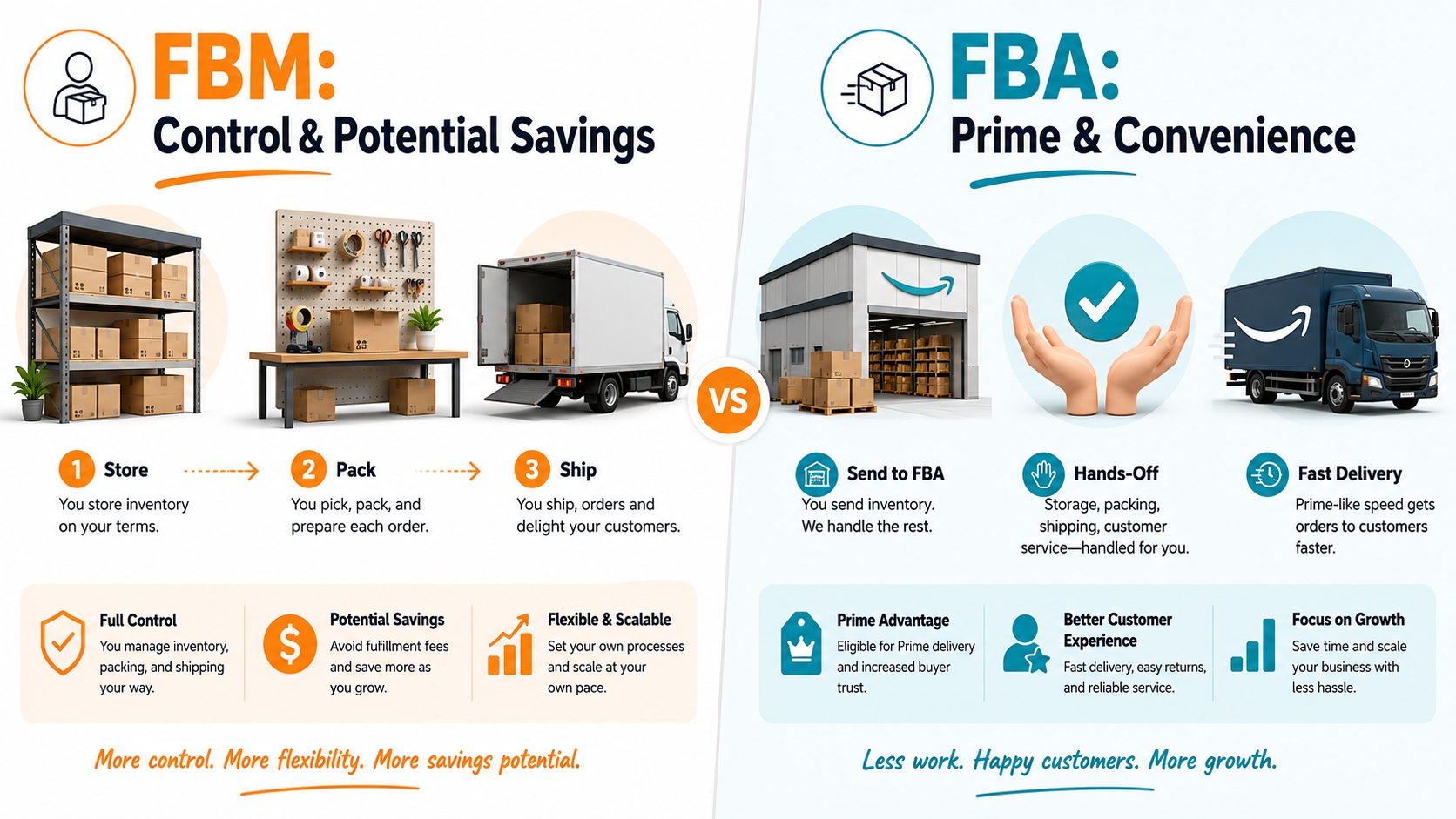
FBA comes with the Prime badge and fast, reliable shipping that customers trust. With FBM, you must meet Amazon's shipping standards, but unless you're using your own warehouse near major population centers and can ship same-day, you won't achieve Prime speeds. This can lower conversion rates and reduce buy-in from Prime-obsessed shoppers. On the flip side, FBM allows you to offer genuinely faster shipping in some cases (e.g., local courier delivery) or more flexible options like scheduled delivery for large items. Weigh the customer satisfaction impact alongside the dollars.
Buy Box and Customer Expectation Notes
Winning the Buy Box is harder with FBM. Amazon's algorithm heavily favors FBA offers, often requiring FBM sellers to price significantly lower to compete. Additionally, after-sale headaches like tracking inquiries and return requests fall entirely on you. If your seller metrics dip (late shipment rate, order defect rate), you risk losing inventory privileges. Before committing to FBM, honestly assess your ability to maintain stellar performance. Many experienced sellers use a hybrid approach: FBA for fast-moving, small items and FBM for the bulky or slow movers to maximize profitability while keeping Buy Box eligibility.
| Factor | FBM Advantage | FBA Advantage |
|---|---|---|
| Shipping speed | Custom, same-day possible | Prime 2-day, reliable |
| Cost for heavy items | Often lower | Higher fulfillment fees |
| Buy Box eligibility | Harder unless excellent metrics | Higher chance |
| Customer trust | Varies by seller rating | Amazon-backed returns |
| Labor overhead | Adds operational complexity | None, hands-off |
FAQ
What is an Amazon FBM calculator?
An Amazon FBM calculator is a digital tool that helps sellers estimate their net profit from fulfilling orders themselves (Fulfilled by Merchant). It factors in the selling price, Amazon referral fees, cost of goods, packaging, shipping, labor, returns, and other operational costs. The result is a per-unit profit figure that lets you directly compare FBM vs. FBA profitability and decide which fulfillment method makes sense for each product.
What costs should I include in an FBM calculator?
Include all direct and indirect expenses: product cost, Amazon referral fee (and monthly subscription if not already covered), packaging materials, carrier shipping rates, your labor time for pick/pack, return shipping and processing, customer service time, storage space, insurance, and any software subscriptions. The more granular you get, the more accurate your FBM profit projection will be.
Should labor cost be included in FBM profit calculations?
Yes, absolutely. Even if you're a one-person operation and don't write a paycheck, your time has value. Not including labor gives a skewed picture of profitability and can lead to overworking yourself for minimal returns. Track the time each order takes and assign an hourly rate (either what you'd pay someone else or your own target hourly wage) to see if the business model is sustainable.
How do shipping rates affect FBM profit?
Shipping is often the second-largest cost after product. A small increase in carrier rates can turn a profitable item into a loss. Rates vary by weight, dimensions, distance, and service level. To mitigate this, negotiate rates with carriers if you have volume, use dimensional weight optimization, and consider flat-rate boxes where possible. Always use average negotiated rates rather than published retail rates in your FBM calculator.
When is FBM more profitable than FBA?
FBM tends to be more profitable for oversized or heavy products where FBA fulfillment fees are high, slow-moving products that avoid long-term storage fees, and fragile or customized items where you can reduce damage and enhance experience. It can also be more profitable if you have established low-cost shipping and efficient packing operations. Run the numbers with both an FBM calculator and an FBA calculator to be sure.
Next Steps
- Plug your product data into our free Amazon FBM calculator to see your real margins.
- Explore the complete Amazon calculator guide for side-by-side FBA/FBM comparisons and advanced fee breakdowns.
References
By SellerSprite Success Team
The SellerSprite Success Team combines years of Amazon marketplace experience with data‑science expertise, helping sellers of all sizes dominate search results through proven operational strategies and cutting‑edge tooling.
Last updated: 2026-07-23