TL;DR: Amazon Black Friday Deals and Promotions should not start with the question, "How deep should I discount?" A stronger seller workflow begins with demand, margin, inventory, competitive pricing, keyword visibility, and promotion eligibility. Choose the deal format that fits the business goal, protect a minimum contribution margin, prepare listings and inventory before traffic increases, monitor performance during the event, and separate temporary Black Friday lift from demand that can continue after the promotion ends.
Key Takeaways
- ✓ A Black Friday discount is only useful if the economics still work. Model product cost, Amazon fees, fulfillment, advertising, promotional costs, returns, and the discounted selling price before committing to the offer.
- ✓ Amazon currently gives sellers several savings formats, including Promotions, Deals, Coupons, and Price Discounts. The right format depends on product eligibility, visibility needs, timing, inventory, and profit goals.
- ✓ Inventory planning matters as much as promotion planning. Too little stock can waste high-intent traffic, while excessive purchasing can leave sellers with expensive post-event inventory.
- ✓ Black Friday performance should be evaluated before, during, and after the event. Compare sales, BSR, keywords, price, ad efficiency, conversion conditions, and inventory against a pre-event baseline instead of judging success from revenue alone.
Table of Contents
- Quick Answer
- 2026 Black Friday and Cyber Monday Timing
- Amazon Promotion Types Sellers Can Consider
- Should Your ASIN Run a Black Friday Promotion?
- Set a Profit Floor Before Setting the Discount
- Plan Inventory for Demand Without Overcommitting
- What to Prepare Before Black Friday
- What to Monitor During the Event
- How to Analyze Performance After BFCM
- How SellerSprite Can Support Black Friday Planning
- Common Black Friday Promotion Mistakes
- The Bottom Line
- FAQs
- References
Marketplace note: This guide focuses on the Amazon US marketplace. Deal eligibility, promotional fees, submission windows, reference-price requirements, advertising policies, and available promotion types can change. Always confirm current requirements in Seller Central before scheduling a Black Friday or Cyber Monday campaign.
Quick Answer
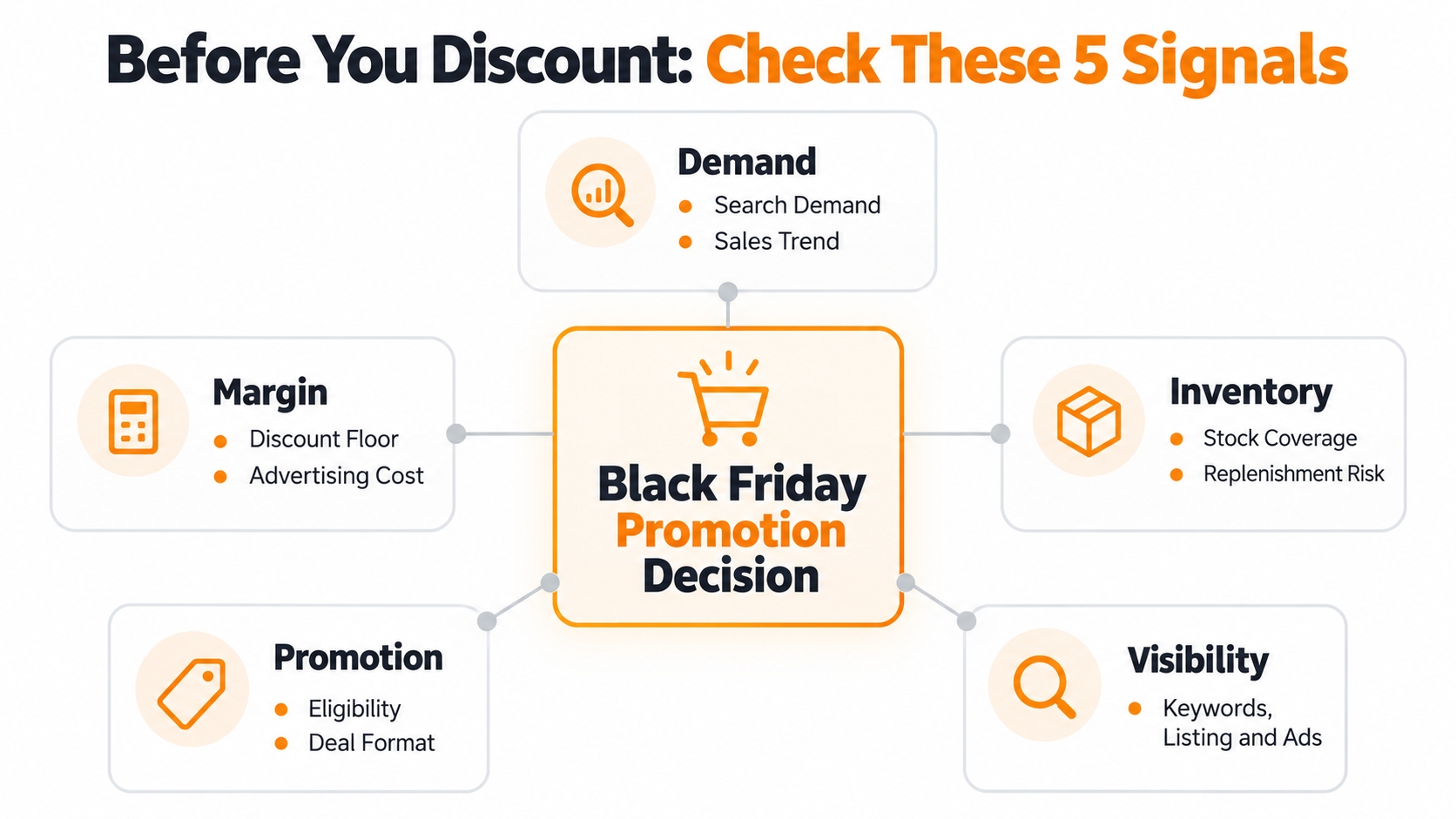
Amazon Black Friday Deals and Promotions are most effective when they are treated as an operations decision rather than a standalone pricing tactic. A seller should first identify which ASINs already have meaningful demand, calculate how much discount the unit economics can support, estimate inventory requirements, confirm promotion eligibility, and prepare advertising and listing content before traffic peaks.
The goal is not necessarily to offer the deepest discount in the category. It is to create enough value to compete for shopper attention while protecting inventory, margin, advertising efficiency, and the product's longer-term positioning.
The practical rule: Do not choose the discount first. Choose the business objective first, then determine whether a promotion is the right tool to achieve it.
2026 Black Friday and Cyber Monday Timing
Amazon's current 2026 US event calendar lists Black Friday on November 27, 2026 and Cyber Monday on November 30, 2026. Amazon also notes that event dates can change, so sellers should continue checking Seller Central and current Amazon event communications as the shopping period approaches.
Operationally, Black Friday planning should begin well before those dates. Deal submission windows, inbound inventory lead times, advertising preparation, listing changes, creative review, and replenishment schedules can all require advance planning.
Sellers should also think beyond a single Friday. Shopper activity can build before Black Friday, continue through the weekend and Cyber Monday, and extend into the broader holiday shopping period. The correct inventory and advertising plan therefore depends on the full demand window, not just one calendar day.
Amazon Promotion Types Sellers Can Consider
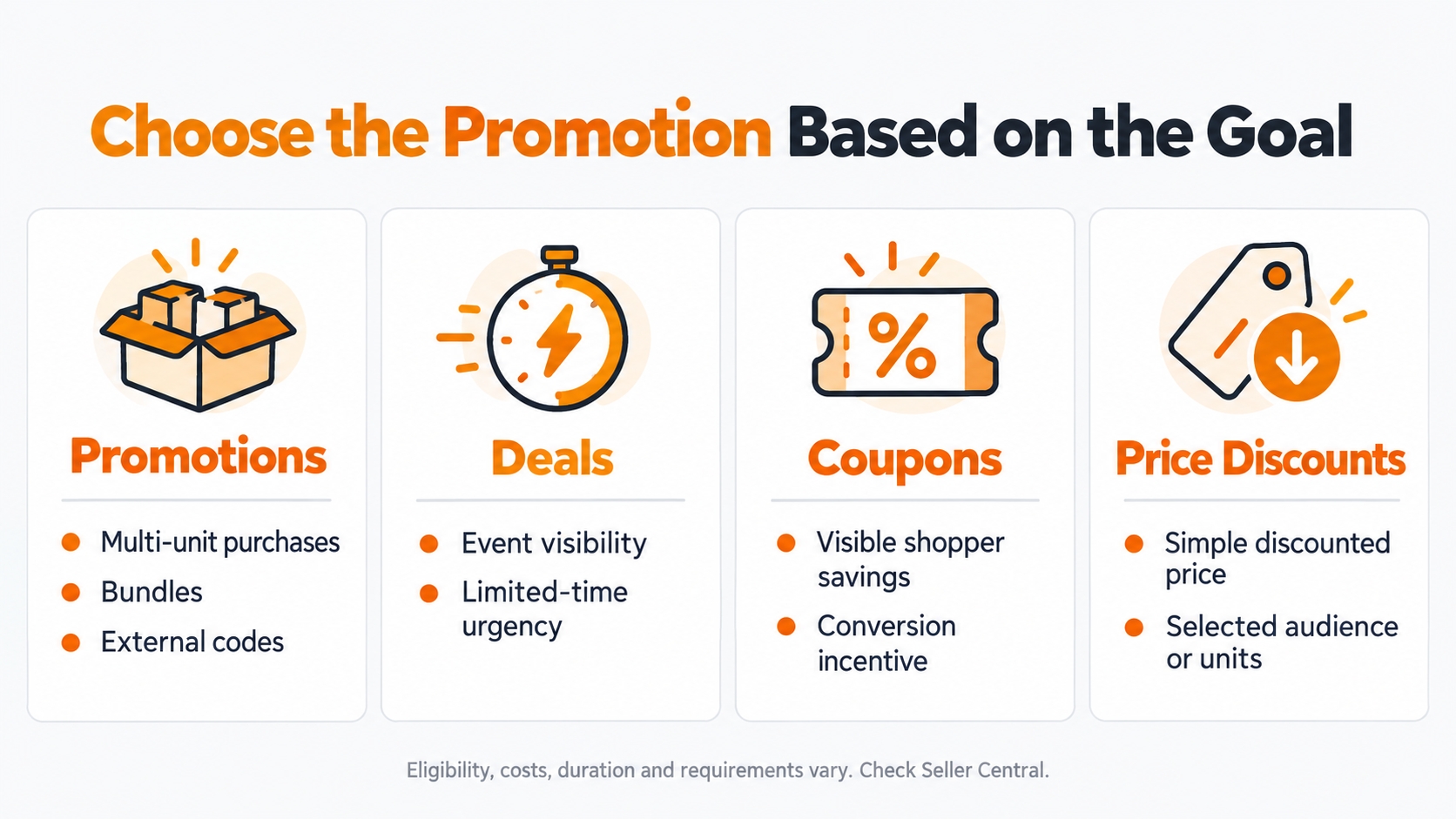
Amazon currently groups seller savings tools into four broad categories: Promotions, Deals, Coupons, and Price Discounts. They are not interchangeable. Each format creates a different shopper experience and can have different eligibility, duration, cost, visibility, and reference-price requirements.
| Promotion Type | How It Works | Useful When | Watch For |
|---|---|---|---|
| Promotions | Can include percentage-off offers, buy-one-get-one structures, and social media promo codes. | Encouraging multi-unit purchases, bundles, or external campaign traffic. | Discount stacking, margin, terms, and channel-specific execution. |
| Deals | Limited-time offers such as Lightning Deals and Best Deals for eligible products. | Products that qualify and can benefit from event-focused deal visibility. | Eligibility, scheduling, fees, required discounts, and available stock. |
| Coupons | Provide a percentage or fixed amount of savings that eligible shoppers can apply. | Creating visible savings around search results and product detail pages when eligible. | Redemption costs, eligibility, duration, and overlap with other discounts. |
| Price Discounts | Time-bound discounted pricing for eligible products and audiences. | Creating straightforward discounted pricing without requiring a coupon action. | Reference-price validation, SKU eligibility, duration, and unit limits. |
The best format is the one that fits the ASIN's economics and campaign objective. A seller trying to move excess inventory may make a different decision from a brand protecting premium positioning or testing whether a high-intent keyword segment responds to a temporary offer.
Should Your ASIN Run a Black Friday Promotion?
Not every ASIN needs a Black Friday deal. A promotion can increase shopper interest, but it can also compress margin, consume inventory faster than expected, raise advertising costs, or attract highly price-sensitive buyers who do not return at the normal price.
Before scheduling a promotion, evaluate five questions.
1. Does the Product Already Have Demand?
A discount can amplify an existing opportunity, but it cannot reliably create product-market fit. Review historical sales, keyword demand, category seasonality, competitor activity, and prior promotional periods to determine whether the ASIN already has meaningful shopper interest.
SellerSprite's Product Research workflow can help compare products using marketplace filters and historical signals before a seller commits inventory or promotional budget.
2. Is the Product Competitive at Its Normal Price?
If a listing struggles to convert before the event because of weak reviews, unclear images, poor positioning, or a major price-value mismatch, a Black Friday discount may temporarily hide rather than solve the underlying problem.
3. Can the Product Absorb the Discount?
Calculate the contribution margin after the proposed promotion, not before it. A campaign that creates impressive revenue but loses money on each incremental order may not be a successful promotion.
4. Can Inventory Support a Demand Spike?
Check available stock, inbound inventory, replenishment lead time, seasonal demand, and the cost of carrying unsold units after the event.
5. What Happens After the Discount Ends?
Black Friday traffic is temporary. The more strategic question is whether the event can introduce the product to relevant shoppers without making the regular price look unattractive once the promotion ends.
Set a Profit Floor Before Setting the Discount
The discount percentage is only one part of Black Friday economics. Sellers should model the full order contribution before committing to a deal.
Contribution margin after promotion =
Promotional selling price - product cost - inbound shipping - Amazon referral fees - fulfillment and storage costs - promotion-related costs - advertising cost - expected return or operating allowance
The exact model will differ by business, but the principle is consistent: decide the lowest acceptable economics before choosing the promotional price.
| Cost Layer | Question to Ask |
|---|---|
| Product and freight | What is the true landed cost per sellable unit? |
| Amazon fees | How do referral, fulfillment, storage, and other relevant fees affect the order? |
| Promotion cost | Are there deal, coupon, redemption, or other campaign costs to include? |
| Advertising | What happens if CPC rises during the event? |
| Returns and operations | Does higher order volume increase expected return, support, or fulfillment costs? |
Also check for unintended discount stacking. Multiple active promotions can sometimes create a larger effective discount than the seller intended. Review the final shopper price and campaign configuration before the event begins.
Plan Inventory for Demand Without Overcommitting
Black Friday inventory planning involves two competing risks: running out of stock while demand is strong and carrying too much inventory after the promotion ends.
A practical forecast should use at least three scenarios:
- Conservative: promotional lift is modest and normal demand patterns continue.
- Expected: the product receives the traffic and conversion response supported by historical evidence and current competitive conditions.
- Upside: visibility, advertising, deal exposure, or category demand exceeds the expected case.
Each scenario should include available inventory, inbound stock, lead time, expected daily unit demand, safety stock, post-event demand, and the financial cost of leftover inventory.
Inventory question: If demand is weaker than expected, can the remaining units still sell profitably after Black Friday? If demand is stronger than expected, how quickly can you replenish without disrupting the listing?
What to Prepare Before Black Friday
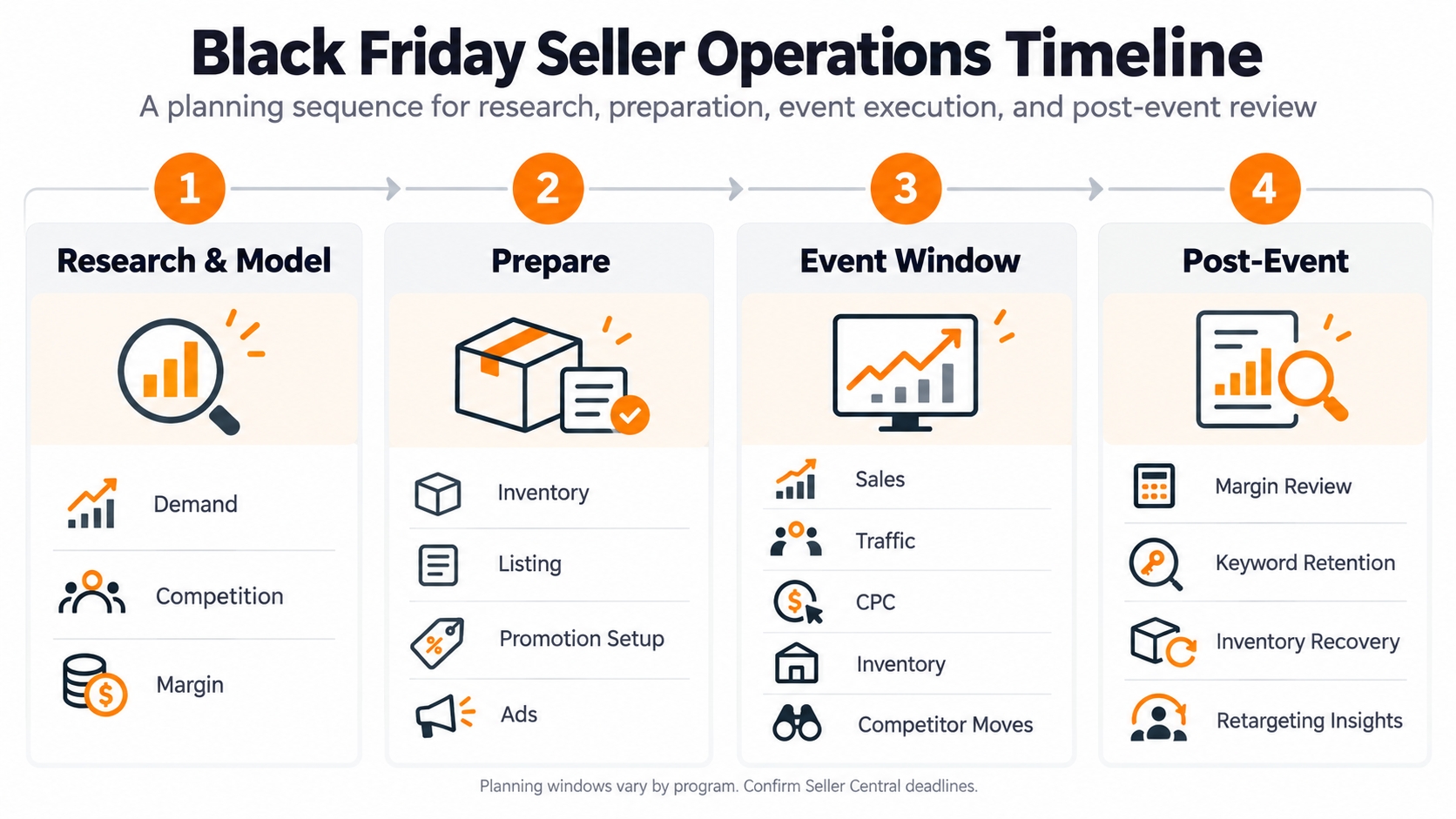
The most valuable Black Friday work usually happens before shoppers see the promotion. Sellers should establish a clean baseline, improve conversion friction, prepare inventory, and validate campaign economics before traffic accelerates.
Build a Pre-Event Baseline
Record normal selling price, sales estimates, BSR, organic keyword positions, advertising performance, rating, review count, conversion-related indicators, and inventory before the promotional period. Without a baseline, it is difficult to determine what actually changed during Black Friday.
Check Competitor Promotion Patterns
Review how major competitors normally price their products, whether they frequently use coupons, how their sales and rank move during discount periods, and whether their strongest keywords change during seasonal demand.
Remove Listing Friction
A promotion can attract clicks, but shoppers still evaluate the listing. Check that the title, images, bullets, variations, product specifications, A+ Content, reviews, price, and delivery expectations answer the questions that matter for the purchase.
Prepare Advertising Around the Promotion
Review keyword targeting, campaign budgets, search terms, product targeting, and negative keywords before the event. A Black Friday traffic spike can become expensive if broad or low-intent targeting absorbs budget without creating profitable orders.
Amazon's Black Friday and Cyber Monday advertising guidance also emphasizes that promotional messaging should accurately reflect the live offer. Pricing, savings claims, product details, and the landing-page experience should remain consistent.
What to Monitor During the Event
Black Friday is not the time to watch revenue alone. Monitor the signals that explain whether increased activity is profitable, sustainable, and coming from the traffic you intended to attract.
| Signal | What to Watch | Why It Matters |
|---|---|---|
| Unit sales | Change versus the pre-event baseline | Shows the scale of demand response. |
| Contribution margin | Profitability after discount and campaign costs | Prevents revenue growth from hiding margin erosion. |
| Advertising | CPC, spend, orders, search terms, budget depletion | High traffic can increase spend without improving economics. |
| Inventory | Units remaining and projected stock coverage | Helps avoid spending aggressively when stock is becoming constrained. |
| Keyword visibility | Important organic and paid keyword movement | Shows whether visibility changes extend beyond the promotion badge. |
| Competitor activity | Price, coupons, deals, stockouts, and ranking movement | Provides context for interpreting your own performance. |
Avoid reacting to every hourly fluctuation. Black Friday activity can be volatile, so prioritize changes that materially affect budget, inventory, profitability, or offer competitiveness.
How to Analyze Performance After BFCM
The event is not finished when the discount ends. The post-event period tells you whether Black Friday produced only temporary discounted volume or created insights that can improve the business afterward.
Compare the promotional period with the pre-event baseline across four layers.
1. Revenue vs. Profit
Calculate incremental revenue, but also review contribution margin after discounts, promotion costs, advertising, and fulfillment. Higher sales do not automatically mean a stronger financial result.
2. Promotional Demand vs. Normal Demand
Watch what happens when the normal price returns. If sales immediately fall back to or below the prior baseline, much of the event lift may have been promotion-dependent.
3. Keyword Visibility
Compare important organic keyword positions before, during, and after the event. Retained visibility can be more strategically useful than a temporary rank movement that disappears once the promotion ends.
4. Inventory Position
Determine whether inventory returned to a healthy level, became constrained, or remained too high. That result should inform the next holiday promotion and future purchasing decisions.
How SellerSprite Can Support Black Friday Planning
SellerSprite can support the research and monitoring parts of Black Friday planning by connecting product demand, keyword behavior, competitor movement, and historical product signals. The goal is not to predict exactly how many units Black Friday will produce, but to reduce the number of promotion decisions made without marketplace context.
Validate Which Products Deserve Promotional Investment
Use Product Research and category-level data to compare historical sales patterns, price ranges, competition, ratings, seasonality, and product concentration. This helps separate ASINs with existing demand from products that would rely too heavily on the discount itself.
Research Seasonal and High-Intent Keywords
Keyword Research and competitor keyword analysis can help identify which search terms matter for the product, how demand changes, and whether seasonal shopping language should influence listing, advertising, or campaign planning.
Compare Competitor Price and Performance Movement
Historical competitor data can provide context for discounting decisions. Instead of copying a competitor's Black Friday price, compare price movement with estimated sales, BSR, inventory conditions, ratings, and keyword visibility.
Track What Changes Before and After the Event
Use SellerSprite Product & Keyword Tracker to follow relevant product and keyword signals over time. A consistent baseline makes it easier to distinguish an event-driven spike from changes that remain after Black Friday.
Common Black Friday Promotion Mistakes
Black Friday magnifies both strong operations and weak ones. More traffic does not fix poor economics, unclear positioning, weak inventory planning, or inefficient advertising.
Choosing the Discount Before Calculating Margin
A competitor offering a deeper discount does not mean your product can profitably do the same. Start with your own economics.
Promoting Every ASIN
Products differ in margin, demand, inventory, conversion readiness, and strategic value. Prioritize ASINs where the promotion has a clear business purpose.
Ignoring Discount Stacking
Review all active deals, coupons, discounts, and promotions before launch so the final shopper price does not fall below the intended floor.
Increasing Ad Budgets Without Improving Targeting
A larger event budget can simply accelerate inefficient spend. Review search terms, targeting, conversion quality, and inventory constraints before scaling.
Waiting Until Black Friday to Fix the Listing
High-intent shoppers still need clear product information. Address image, copy, variation, review, price-value, and product-detail friction before the promotional period.
Judging Success From Revenue Alone
Compare revenue with margin, ad efficiency, inventory, keyword visibility, post-event sales, and the quality of the customers acquired during the campaign.
Using Misleading Black Friday Messaging
Promotional language should accurately reflect the active deal, its timing, the product being promoted, and the landing-page price. Avoid creating urgency or savings claims that are inconsistent with the live offer or current Amazon advertising requirements.
The Bottom Line
Amazon Black Friday Deals and Promotions work best when pricing is treated as one part of a larger seller operations system.
Demand determines whether the product deserves attention. Margin determines how much promotion the business can support. Inventory determines whether that demand can be fulfilled. Listing quality and advertising determine how effectively traffic converts. Historical and competitor data provide the context needed to interpret the result.
The objective is not simply to sell more units during one weekend. It is to use Black Friday as a controlled market test that protects economics, captures qualified demand, and produces better information for future inventory, pricing, keyword, advertising, and promotion decisions.
FAQs
When are Black Friday and Cyber Monday in 2026?
Amazon's current US event calendar lists Black Friday on November 27, 2026 and Cyber Monday on November 30, 2026. Amazon notes that event dates can change, so sellers should confirm the latest event information and Seller Central deadlines before finalizing campaigns.
What types of Black Friday promotions can Amazon sellers use?
Amazon currently provides several savings formats, including Promotions, Deals, Coupons, and Price Discounts. Available options, eligibility, costs, duration, reference-price requirements, and event-specific conditions can vary, so sellers should verify the current configuration in Seller Central.
How much should I discount my Amazon product for Black Friday?
There is no universal discount that works for every ASIN. Start with promotion eligibility and your minimum acceptable contribution margin, then compare historical pricing, competitor activity, shopper demand, inventory, and advertising costs before selecting the promotional price.
Should every ASIN run a Black Friday deal?
No. Some products may have insufficient margin, limited inventory, weak conversion readiness, or little evidence that a discount will create profitable incremental demand. Sellers should prioritize ASINs where the promotion has a clear operational and financial purpose.
Which metrics matter most during Black Friday?
Useful metrics include unit sales, contribution margin, advertising spend and CPC, keyword visibility, BSR, inventory coverage, price, competitor promotions, and post-event sales. The right mix depends on whether the primary goal is profitable growth, inventory reduction, acquisition, or visibility.
Can a Black Friday deal improve organic keyword ranking?
A promotional period may coincide with changes in sales and keyword visibility, but sellers should not assume that the discount itself caused an organic ranking improvement. Advertising, conversion, seasonality, competitor stock, search demand, and other factors can change at the same time. Compare keyword positions before, during, and after the event.
How can SellerSprite help with Amazon Black Friday planning?
SellerSprite can support product and market research, keyword demand analysis, competitor research, historical comparison, and ongoing product and keyword tracking. These workflows can help sellers establish a pre-event baseline and evaluate what changes during and after the promotion.
What should sellers analyze after Black Friday?
Compare promotional revenue with profit, post-event demand, keyword retention, advertising efficiency, inventory position, competitor movement, and the pre-event baseline. The most valuable result is often not the event-day sales total, but what the event reveals about price sensitivity, customer demand, and future operating decisions.
References
- Amazon: Guide to Running Seller Promotions, Deals, Coupons, and Discounts View
- Amazon: How to Drive Sales During Black Friday and Cyber Monday View
- Amazon Ads: Black Friday and Cyber Monday Advertising Tips View
- Amazon Ads: Event Days Advertising Policy View
- Amazon Ads: Amazon Business Shopping Events and 2026 Dates View
By SellerSprite Content Team
The SellerSprite Content Team combines Amazon marketplace research with practical data workflows to help sellers evaluate product demand, competition, keyword visibility, pricing, inventory risk, and marketplace opportunities.
Last updated: September 30, 2026