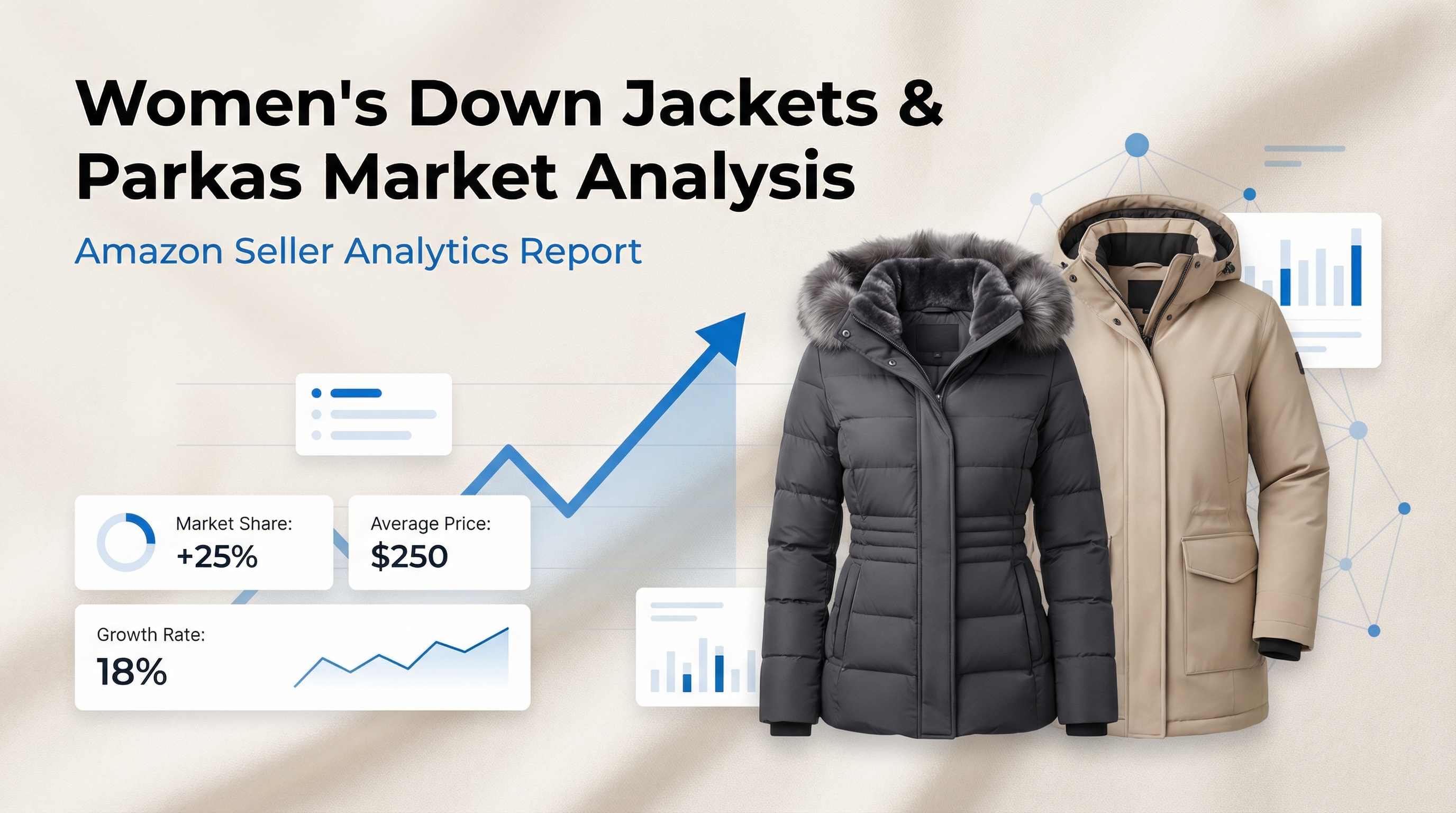
What this analysis will help you decide
Women's down jackets and parkas are a viable Amazon category, but not an easy one. The clearest opportunity is not at the very bottom of the market. It sits in the middle, where warmth, everyday wearability, and credible value come together. Sellers who win here usually do three things well: they enter before peak winter demand, position the product around a specific use case, and reduce buyer uncertainty through fit clarity, honest warmth claims, and stronger review trust. This analysis is designed to help you decide whether the niche fits your business and how to approach it with more discipline.
- Understand where demand and competition create room for a new offer
- See which product positions are easier to defend than a generic winter coat listing
- Identify the most common conversion, return, and review risks before sourcing
- Turn category observations into a more practical launch and optimization plan
Best for: Amazon sellers evaluating a seasonal outerwear niche, private label sellers deciding whether to enter women's winter apparel, and existing apparel sellers planning a more focused winter expansion.
Author and data background
This analysis is published by the SellerSprite Team and follows a category research logic built around seasonality, price structure, review concentration, keyword intent, competitor behavior, and buyer sentiment. The goal is not to replace product-level validation. It is to give sellers a more practical decision framework before they invest in sourcing, content production, and inventory.
For hands-on validation, this topic is best evaluated alongside SellerSprite tools such as Category Insights, Product Research, Keyword Research, Review Analysis, and Product Tracker. Together, these help sellers confirm whether the apparent opportunity in a niche is supported by real demand, manageable competition, and healthier listing economics.
Table of Contents
- 1. Is this category worth entering on Amazon?
- 2. When does demand peak, and when should sellers prepare?
- 3. What product positions have the clearest opportunity?
- 4. What creates conversion, returns, and review risk?
- 5. How should sellers think about profitability?
- 6. Which keywords reflect real buying intent?
- 7. What can sellers learn from competitor behavior?
- 8. Who is the core buyer, and what does she expect?
- 9. What do on-site and off-site signals say?
- 10. What should a practical market-entry plan look like?
- FAQ
1. Is this category worth entering on Amazon?
Question: Is women's outerwear still attractive for new or growing sellers, even though the market already looks crowded?
Answer: Yes, but only if the product enters with a clear role. Women's down jackets and parkas are not a casual-entry category. They attract real seasonal demand, but they also attract established outdoor brands, fashion labels, and aggressive private label sellers. That means generic entry is weak entry. A listing that simply says "winter coat" is unlikely to hold attention or defend margin for long. The more durable opportunity usually comes from sharper positioning, clearer customer language, and better expectation management.
This is why the category should be treated as a strategic niche rather than a broad apparel bet. Buyers in this space compare warmth, shape, length, hood design, pocket function, material feel, and real-life practicality. They are not only asking whether the product looks good. They are asking whether it feels believable for the winter problems they actually need to solve. Sellers who understand that early can still find room to compete, especially if they use category-level research first and do not skip validation. A sensible first step is to map the niche in Category Insights and compare specific listing clusters in Product Research before making a sourcing decision.
2. When does demand peak, and when should sellers prepare?
Question: Is this a category where sellers can wait until winter traffic is obvious, or does the opportunity begin earlier?
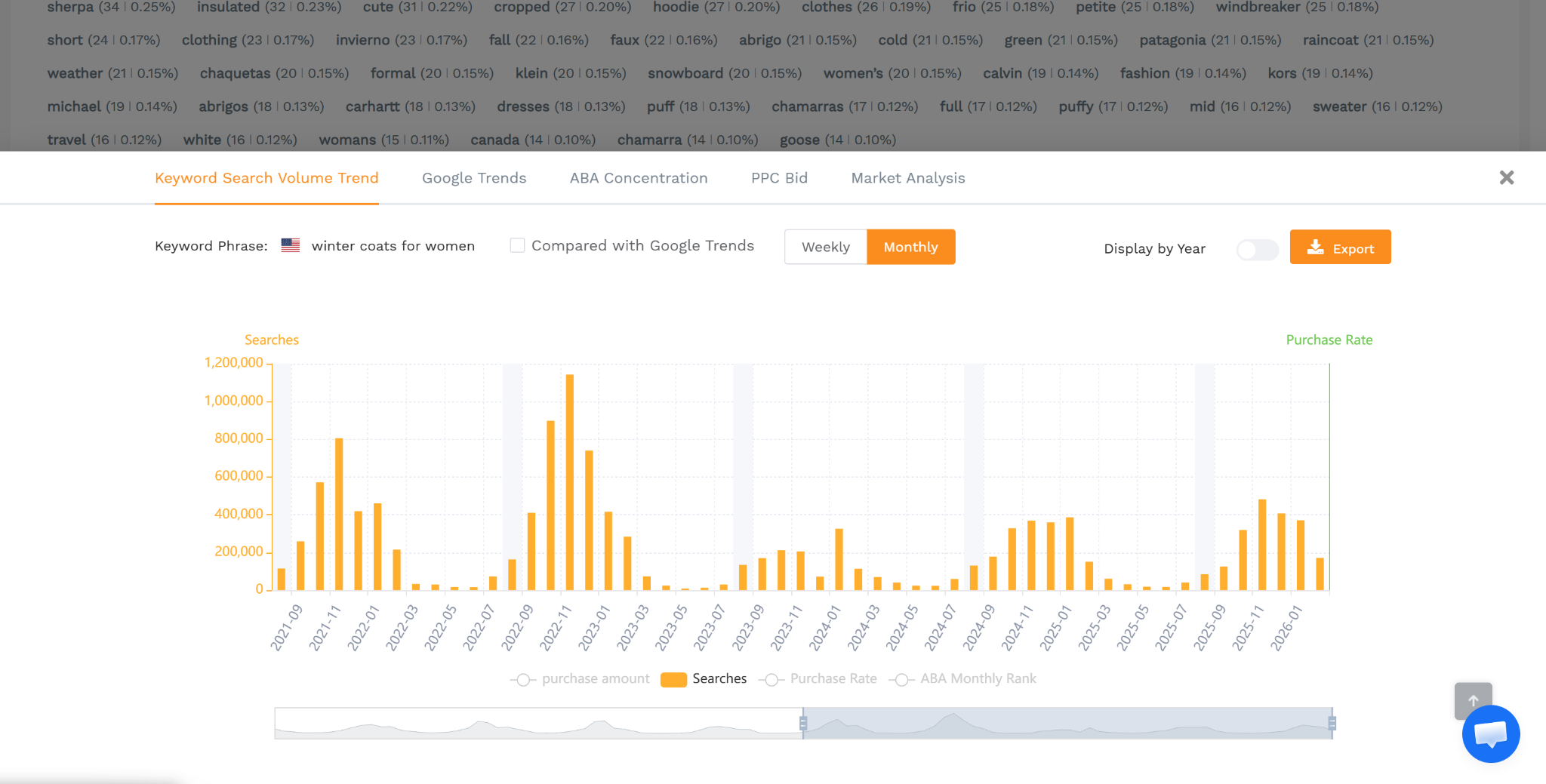
Answer: The opportunity begins earlier. Women's down jackets and parkas follow a classic cold-weather demand curve, but the most important commercial work happens before the traffic spike is visible. Search interest grows as temperatures drop, then intensifies around the holiday window and deep winter period. However, by the time the market feels obviously hot, the strongest listings have usually already indexed target terms, accumulated social proof, and stabilized inventory.
That makes timing one of the most important strategic variables in the entire category. Sellers who arrive late often face the most expensive clicks, the strongest competition, and the least room to correct listing weaknesses. Sellers who enter earlier can test price, improve images, refine targeting, and build review trust before the most intense part of winter begins. This is also where seasonality tools and historical trend comparisons become useful. A seller can use Keepa Trends alongside SellerSprite product tracking workflows to watch when rank movement, price changes, and demand surges begin to align.
3. What product positions have the clearest opportunity?
Question: What kind of product position is easier to defend than a generic women's winter jacket listing?
Answer: The clearest opportunity usually sits in products that connect practical winter protection with everyday style. This category is not purely technical, and it is not purely fashion-driven. Buyers want warmth, but they also want something flattering, wearable, and suitable for normal daily use. A long commuter parka, a quilted everyday puffer, a more polished urban winter coat, or a comfort-first lined style can all work if the product promise is easy to understand at a glance.
The strongest listings in this space usually do not try to please every winter buyer. Instead, they define a more precise use case and then support it consistently across visuals, copy, variation structure, and price. That is why the category often rewards focused offers more than broad catalog logic. A well-defined product family with sensible colors, a clear fit story, and a believable warmth claim will often feel safer to buy than a crowded variation listing that looks optimized for traffic rather than clarity.
Price positioning matters here as well. The most attractive zone is often the middle of the market, where the customer feels she is getting a serious winter garment without paying a premium technical-brand price. That middle position gives sellers more room to communicate value and less pressure to win through extreme discounting alone.
4. What creates conversion, returns, and review risk?
Question: What are the biggest reasons a winter outerwear listing converts well or fails after purchase?
Answer: Trust is the central variable. This category can convert well when the customer believes the product will actually perform. That belief comes from the full listing experience, including review quality, warmth, credibility, fit communication, photo accuracy, price logic, and brand coherence. In other words, conversion is not driven by demand alone. It is driven by confidence.
Return risk rises quickly when that confidence turns out to be misplaced. The most common issues are easy to predict: inaccurate fit expectations, warmth claims that feel overstated, bulkier-than-expected construction, zipper dissatisfaction, disappointing material feel, or a visual mismatch between the listing and the product in hand. Because outerwear purchases carry more emotional and practical weight than many small accessories, customers react strongly when the product fails to match the promise.
That is why listing clarity should be treated as a profit lever, not just a branding task. Honest warmth positioning, clear size guidance, stronger close-up detail images, and more realistic daily-use photography can all reduce preventable returns. For pre-launch validation, sellers should review competitor feedback clusters in Review Analysis and identify where review praise and complaint patterns repeat across the niche.
5. How should sellers think about profitability?
Question: Does a higher ticket category automatically mean healthier profit?
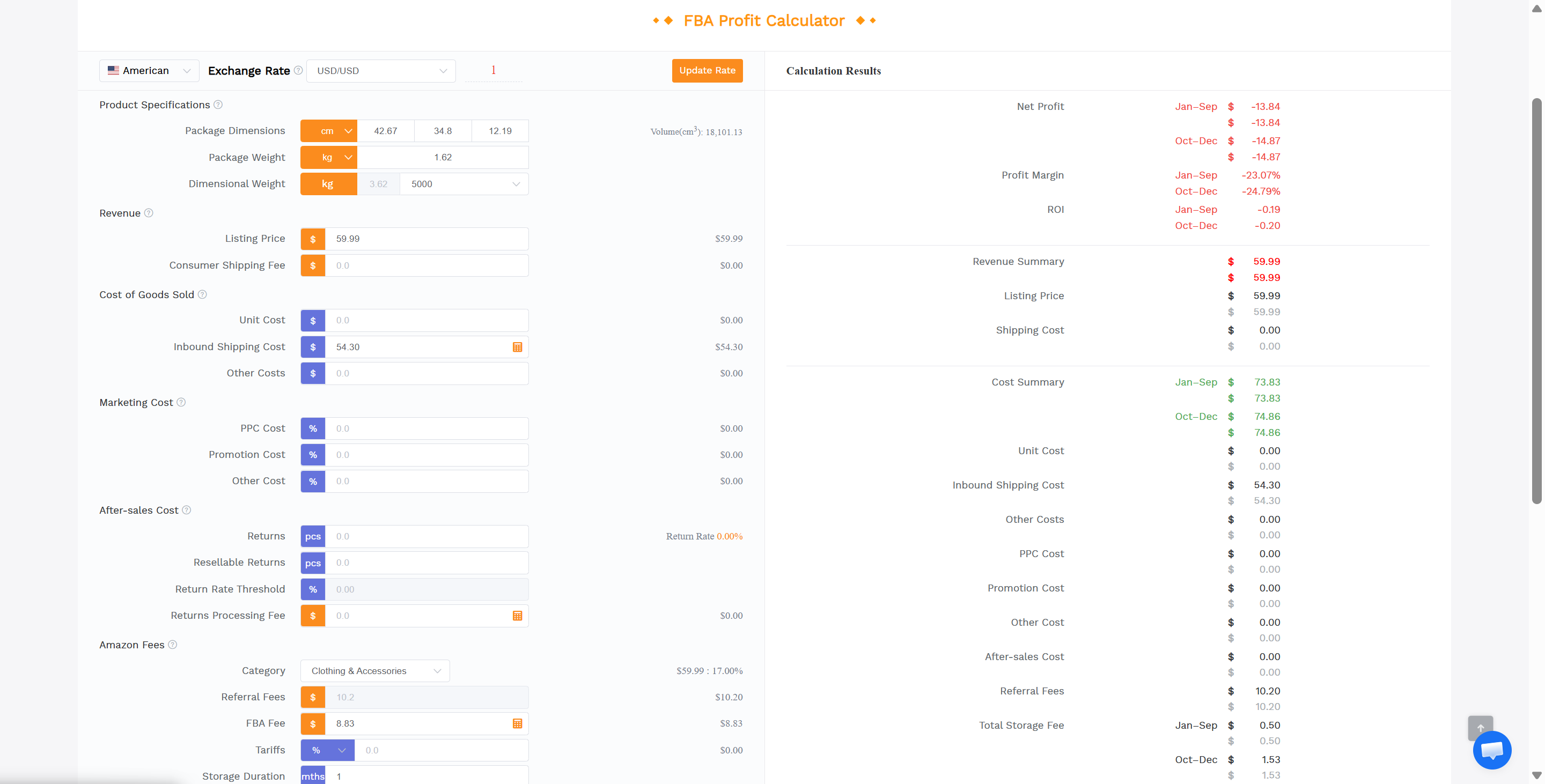
Answer: Not necessarily. Winter outerwear can look attractive because average selling prices are higher than many accessory categories, but the cost chain is also heavier. Material choices, insulation story, dimensional shipping, Amazon fees, returns, and peak-season advertising pressure all affect the real margin. A product with impressive revenue can still become a weak business if it relies on heavy discounting or absorbs too many quality-related returns.
The better way to protect profit is to build perceived value strong enough that the price feels justified. In this category, that often comes from better cut, more believable warmth messaging, improved hood or pocket design, cleaner visual presentation, and lower post-purchase friction. Sellers should check that margin logic before they increase commitment. If needed, they can pair research findings with SellerSprite's Profitability Calculator to pressure-test the financial side of the opportunity.
6. Which keywords reflect real buying intent?
Question: What kind of keyword structure matters most in women's down jackets and parkas?
Answer: Real buying intent in this category usually sits at the intersection of category language, practical modifiers, and scenario language. Broad terms such as women's winter coat or women's puffer jacket are important, but they are only the starting point. Buyers narrow quickly by length, hood type, weather resistance, warmth level, quilting, fit expectation, and lifestyle use. That means a good keyword strategy has to mirror the customer's decision path, not just chase the highest-volume head term.
Sellers should group terms into three layers. The first layer covers broad category discovery. The second covers product-defining attributes such as long, hooded, waterproof, quilted, or lined. The third covers everyday use cases such as commuting, travel, snow days, or daily winter wear. When these layers are aligned with image sequence and listing copy, the traffic they bring is more qualified and usually easier to convert. A practical workflow is to map market-level terms in Keyword Research, then validate which terms actually appear in strong competing listings and reviews.
7. What can sellers learn from competitor behavior?
Question: What do winning listings in this category usually do well over time?
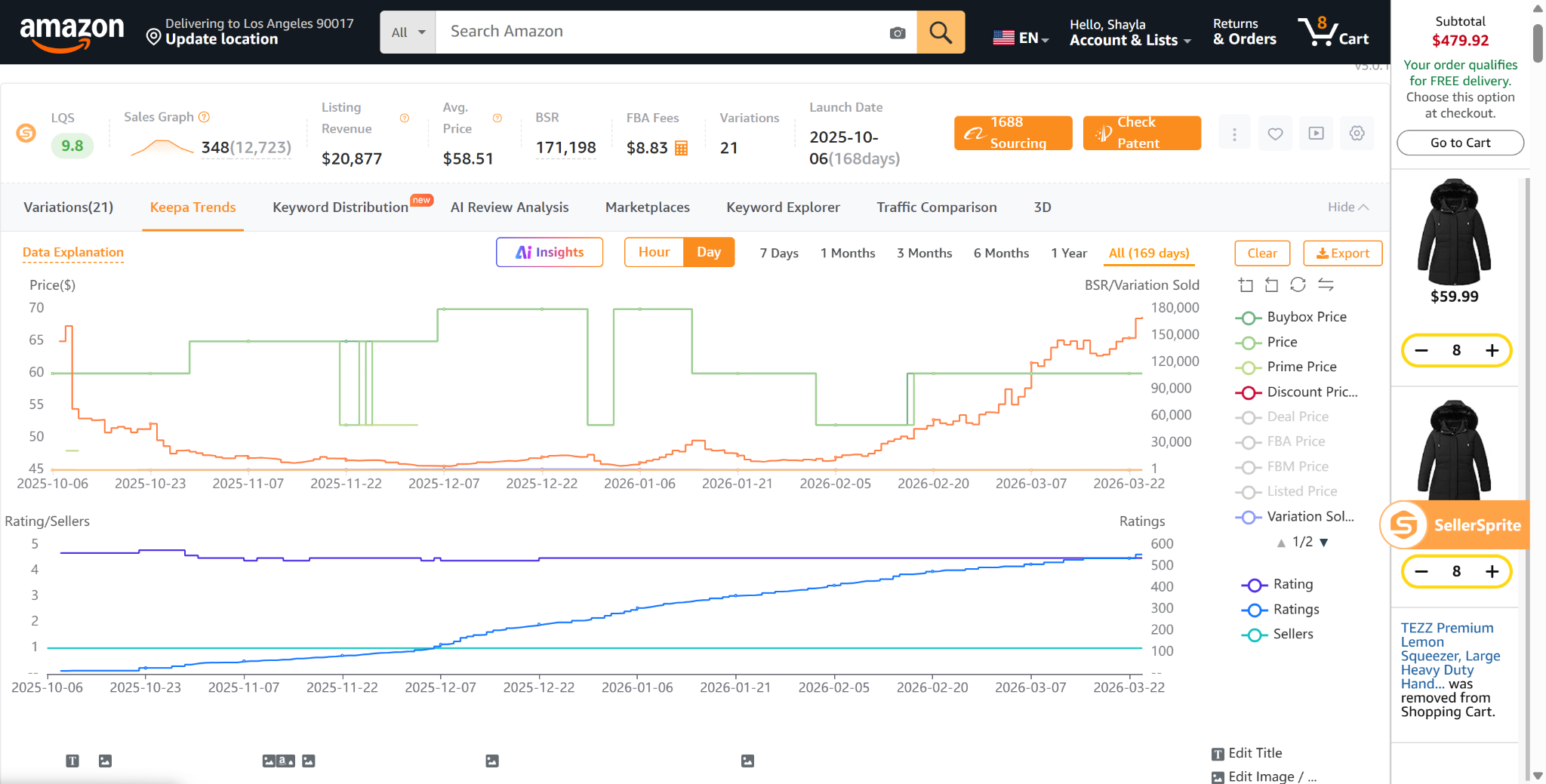
Answer: Stable winners usually look more disciplined than dramatic. They tend to avoid erratic pricing, maintain healthier inventory continuity, and build rank through consistent demand rather than constant discounting. Different aesthetics can succeed, but the product role is usually obvious. A customer can tell within seconds whether the listing is built for everyday warmth, a more polished commute, or comfort-driven cold-weather wear.
This is why competitor research should focus on pattern recognition, not imitation. Sellers should study how prices change through the season, how review growth compounds, how rank stabilizes, and how listing assets evolve. That is far more useful than copying a bestseller's surface appearance. A strong workflow is to shortlist direct competitors in Product Research, then monitor their movement through Product Tracker and Keepa Trends so that timing and pricing patterns are visible before launch.
8. Who is the core buyer, and what does she expect?
Question: What kind of shopper typically buys women's down jackets and parkas on Amazon?
Answer: The core buyer is practical, appearance-aware, and value-conscious. She wants real winter protection, but she also wants the product to fit daily life aesthetically. She compares features, but she also imagines the garment in motion, in her commute, on a trip, or during ordinary cold-weather routines. That mix of rational and emotional evaluation is one of the reasons this category is so sensitive to trust signals.
Age and location change the emphasis, but not the underlying logic. Some buyers care more about silhouette and styling flexibility, while others care more about coverage, comfort, and commuting practicality. Colder-state demand is naturally stronger, but the category is not limited to extreme climates. Many customers buy for travel, seasonal cold snaps, gifting, or general winter preparedness. That is why listings should avoid sounding either too technical or too fashion-only. The product has to feel usable in real life.
9. What do on-site and off-site signals say?
Question: What do review behavior and broader market conversations tell sellers to improve first?
Answer: On Amazon, positive sentiment usually centers on warmth, flattering fit, useful length, comfort, and the feeling that the product looks better or wears more easily than expected. Negative sentiment tends to cluster around predictable gaps such as inconsistent sizing, disappointing warmth, zipper issues, unexpected bulk, or a mismatch between the listing images and the delivered item. These are not random complaints. They are the most expensive expectation gaps in the category.
Off Amazon, the pattern becomes even more useful. Buyers repeatedly look for real-world proof. They want to know how the coat feels during normal daily use, whether it works for commuting, whether it looks bulky in motion, how it layers, and whether it is worth the price compared with better-known brands. For sellers, that means content should do more than present product facts. It should show use cases clearly and reduce guesswork. A good outerwear listing answers lifestyle questions before the customer asks them.
10. What should a practical market-entry plan look like?
A practical entry plan for this niche starts with narrowing the product role. Before any sourcing decision, the seller should be able to answer a simple question: what winter job is this coat meant to do, and for whom? If that answer is still vague, the product is usually not ready. Once the role is clear, the next step is to validate whether the price band, review landscape, and keyword structure support the idea rather than merely making it sound attractive in theory.
What new sellers should do first
Start by isolating one viable position rather than evaluating the whole outerwear market as a single pool. Compare only the listings that match your intended use case. Then, validate three things in order: demand timing, review risk, and realistic price acceptance. If the niche only works under aggressive discounting or depends on vague claims about warmth, it is probably not strong enough yet.
What established sellers should improve next
If you already sell in apparel, the fastest gains will often come from sharper segmentation and better communication rather than a full product reinvention. Review whether the listing says too little about fit, weather use, and silhouette. Check whether your variation logic helps or confuses. Then look at whether your image stack actually proves the product's value in real conditions. Many outerwear listings do not fail because the product is bad. They fail because the customer still feels uncertain after viewing the page.
Key Takeaways
- Women's down jackets and parkas are viable on Amazon, but only when the product enters with a clear use case and believable value.
- The best commercial position is often the middle of the market, not the cheapest end.
- Seasonality matters early. Sellers who prepare before peak winter traffic gain more room to rank, test, and convert.
- Conversion depends on trust. Fit guidance, honest warmth claims, and accurate visuals matter as much as raw demand.
- Review and return risk should be treated as part of margin planning, not as an afterthought.
- Sellers should use category, keyword, review, and competitor tools together before committing to sourcing and inventory.
FAQ
Are women's down jackets and parkas too competitive for new Amazon sellers?
They are competitive, but not impossible. The category becomes much harder when a seller enters with a generic offer. A clearer use case, a better fit story, and a stronger middle-market value proposition can still create room.
What price band is usually safer than competing at the bottom?
The safer position is usually a mass-premium band where the product feels serious and credible without crossing into premium technical-brand pricing. That range gives sellers more room to justify quality and protect margin.
What are the biggest return risks in this niche?
The most common risks are sizing mismatch, overstated warmth claims, unwanted bulk, zipper dissatisfaction, and a visible gap between listing expectations and the product received. Most of these can be reduced through better communication before purchase.
Which SellerSprite tools are most useful for this category?
Start with Category Insights and Product Research to validate the niche, then use Keyword Research and Review Analysis to understand buyer language and review risk. Product Tracker and Keepa Trends are useful for monitoring competitor movement over time.
Can this category work outside the coldest states?
Yes. Demand is stronger in colder regions, but many customers still buy for travel, seasonal weather changes, gifting, and everyday winter confidence. The listing should feel practical for real life, not only for extreme weather.
References
- SellerSprite Category Insights
- SellerSprite Product Research
- SellerSprite Keyword Research
- SellerSprite Review Analysis
- Keepa Trends Guide
Turn Category Data Into Better Product Decisions
Use SellerSprite to validate seasonal demand, uncover profitable keyword opportunities, and monitor competing listings before you launch your next winter apparel product.