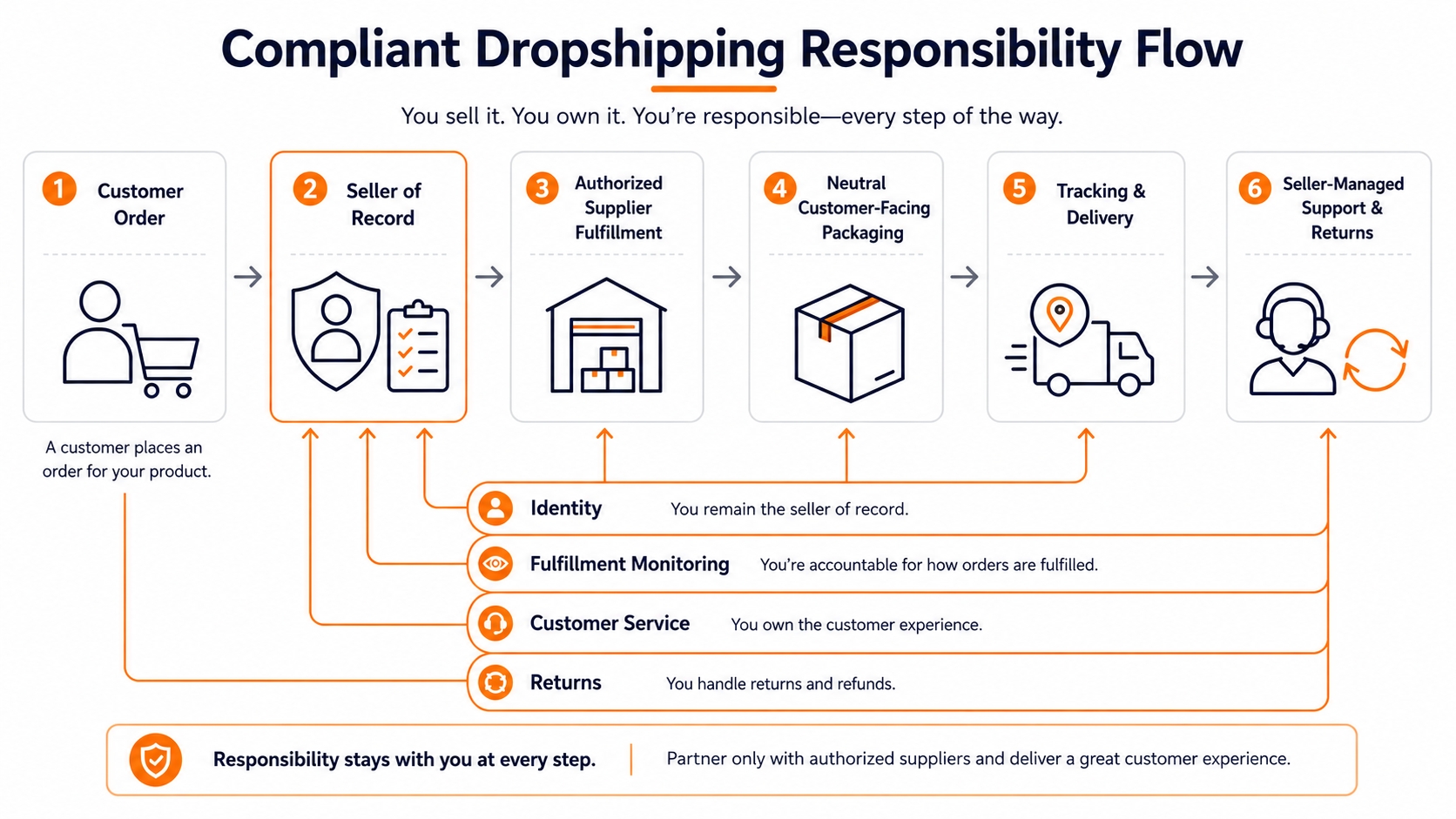
Amazon dropshipping is allowed only when your business remains visibly and operationally responsible for the order. A supplier may fulfill the parcel, but you must remain the seller of record, prevent another retailer or supplier identity from appearing in customer-facing materials, manage returns and customer service, and comply with all other applicable Amazon policies and laws.
Under Amazon's Drop Shipping Policy, the seller must be clearly identified as the seller of record, remove third-party seller or retailer identifiers from packing slips, invoices, external packaging, and other customer-facing materials, and remain responsible for returns. Amazon's public guidance also places customer service and broader policy compliance on the seller. Supplier failure does not transfer those obligations away from the Amazon account owner.
Key takeaways
- Seller of record is the central test. The customer-facing transaction must identify your business, not another retailer, marketplace seller, or supplier.
- Packaging compliance must be verified physically. A supplier promise is not enough; inspect actual parcels, inserts, invoices, labels, and return documents.
- Supplier risk becomes account risk. Stock errors, late shipment, invalid tracking, substitutions, damaged parcels, and failed returns can affect your customer experience and seller performance.
- Dropshipping is not a separate Amazon selling plan. It is an inventory and fulfillment arrangement that normally operates through merchant fulfillment.
- Use a controlled launch. Test the supplier and order flow, define pause rules, and validate contribution margin before exposing the offer to meaningful traffic.
Dropshipping describes who holds inventory and fulfills the order. It does not transfer the Amazon seller's obligations to the supplier. The supplier may control the warehouse, packaging line, carrier handoff, and first physical inspection of the parcel, while the seller remains responsible for the offer, product accuracy, customer promise, support, returns, and policy compliance.
That split creates the defining risk of Amazon drop shipping: the account owner is judged on work performed by a business it does not fully control. A compliant model therefore needs more than a product feed and purchase-order automation. It needs a documented supplier agreement, customer-facing identity controls, tested order and return flows, operational monitoring, and a pause mechanism.
| Control area | What the seller must control | Evidence to retain | Primary failure risk |
|---|---|---|---|
| Seller identity | Your business is the only seller identified to the customer in connection with the product and shipment. | Supplier agreement, approved document templates, package photos, and test-order records. | Another retailer, supplier, or marketplace seller appears on the parcel or paperwork. |
| Order execution | Inventory status, handling time, product identity, tracking, delivery promise, and substitution rules remain accurate. | Inventory-feed logs, order acknowledgments, tracking events, carrier exceptions, and incident records. | The supplier accepts an order it cannot fulfill correctly or on time. |
| Returns and support | The seller owns customer communication, return acceptance, refund decisions, escalation, and service recovery. | Return instructions, service-level agreement, support logs, refund records, and disposition process. | The customer is routed to a supplier that does not meet Amazon's service expectations. |
| Product compliance | The listed product, supplier source, condition, claims, documentation, and target-market requirements remain valid. | Invoices, authorizations, specifications, test reports, certifications, and change notices. | The supplier changes the item, source, packaging, or documentation without approval. |
Is dropshipping allowed on Amazon in 2026?
Yes, Amazon's public seller guidance states that dropshipping is allowed when the seller follows Amazon's Drop Shipping Policy and the laws and regulations that apply in the countries or regions where the business sells. The permission is conditional. A business cannot assume that every arrangement described by a supplier as "dropshipping" is acceptable.
The policy focuses on the customer's understanding of who sold the product and who is responsible when something goes wrong. A third party may ship on your behalf, but the shipment cannot present another seller or retailer as the seller. You must also retain responsibility for returns and comply with the rest of your seller agreement and Amazon policies.
Amazon states that violations may restrict the seller's ability to use its Merchant Fulfilled Network. That makes dropshipping a fulfillment-risk decision, not merely a low-inventory sourcing tactic. Review the current Amazon Drop Shipping Policy inside Seller Central before approving a supplier or changing an existing workflow.
Amazon does not certify a supplier merely because that supplier claims to serve Amazon sellers. The account owner must verify the actual contract, parcel, documentation, tracking, returns, and customer experience.
What does seller of record mean in Amazon dropshipping?
In practical terms, the seller of record is the business presented to the customer as the seller and accountable for the transaction. The supplier is a fulfillment provider. It should not appear to the customer as a competing retailer, an alternate seller, or the party that owns the customer relationship.
Amazon's public dropshipping explainer describes seller-of-record status as including a supplier agreement that identifies the seller, ownership of the products before customer purchase, responsibility for setting the price, recording the purchase as revenue, and handling sales tax. The formal Seller Central policy emphasizes exclusive seller identification on customer-facing materials, removal of third-party identifiers, return responsibility, and compliance with the seller agreement.
The operational lesson is that seller of record is not achieved by changing one logo on a packing slip. Your contracts, transaction records, product rights, tax treatment, support process, refund workflow, and parcel presentation need to tell the same story. Ownership, tax, and legal characterization can depend on jurisdiction and contract terms, so obtain qualified legal or tax advice where needed.
Ask whether a customer opening the parcel, reading every document, requesting a return, or seeking help would consistently identify your business as the seller. Any conflicting retailer name, supplier contact, invoice, receipt, branding, or support route is a control failure that requires correction before launch.
What does Amazon's Drop Shipping Policy require?
Amazon's public policy and seller guidance establish a small number of non-negotiable controls. The table below separates those controls from the additional operating practices SellerSprite recommends for making the arrangement auditable and resilient.
| Policy area | Official requirement or prohibition | Operational interpretation | Recommended evidence |
|---|---|---|---|
| Supplier agreement | The supplier agreement must identify you as the seller of record and the only seller identified in connection with the product. | The contract should govern packaging, documentation, substitutions, fulfillment, returns, and change control, not merely pricing. | Signed agreement, approved templates, responsible contacts, version date, and amendment history. |
| Customer-facing identity | Remove packing slips, invoices, external packaging, and other information that identifies a different seller or third-party supplier. | Audit the entire unboxing path, including labels, tape, inserts, receipts, return documents, QR codes, and customer-service details. | Dated photos and video of test orders from multiple facilities, regions, and package types. |
| Returns | The Amazon seller remains responsible for accepting and processing customer returns. | Define who issues labels, receives parcels, inspects items, communicates decisions, sends refunds, and records disposition. | Return map, service-level agreement, test return, inspection standard, refund log, and escalation record. |
| Other obligations | The seller must comply with the seller agreement, all applicable Amazon policies, and relevant laws and regulations. | Dropshipping approval does not override category, product-safety, intellectual-property, communication, shipping, pricing, or tax requirements. | Policy register, category approval, invoices, product documents, tax advice, and dated compliance review. |
A common prohibited pattern
A high-risk pattern is purchasing from another online retailer after receiving an Amazon order and directing that retailer to ship its normal customer parcel to the buyer. When the other retailer, marketplace seller, or supplier appears on the packing slip, invoice, receipt, external packaging, or included materials, the customer sees a seller identity that conflicts with the Amazon offer.
Removing one invoice is not enough if the box, return label, insert, branded tape, warranty card, email, or support instruction still identifies another seller. The control needs to cover the full physical and digital order experience.
Build supplier controls before listing a product
The supplier relationship is the operating core of Amazon dropshipping. A broad catalog, attractive unit price, or fast integration has little value when the supplier cannot maintain compliant identity, accurate inventory, correct products, valid tracking, dependable delivery, and a usable return route.
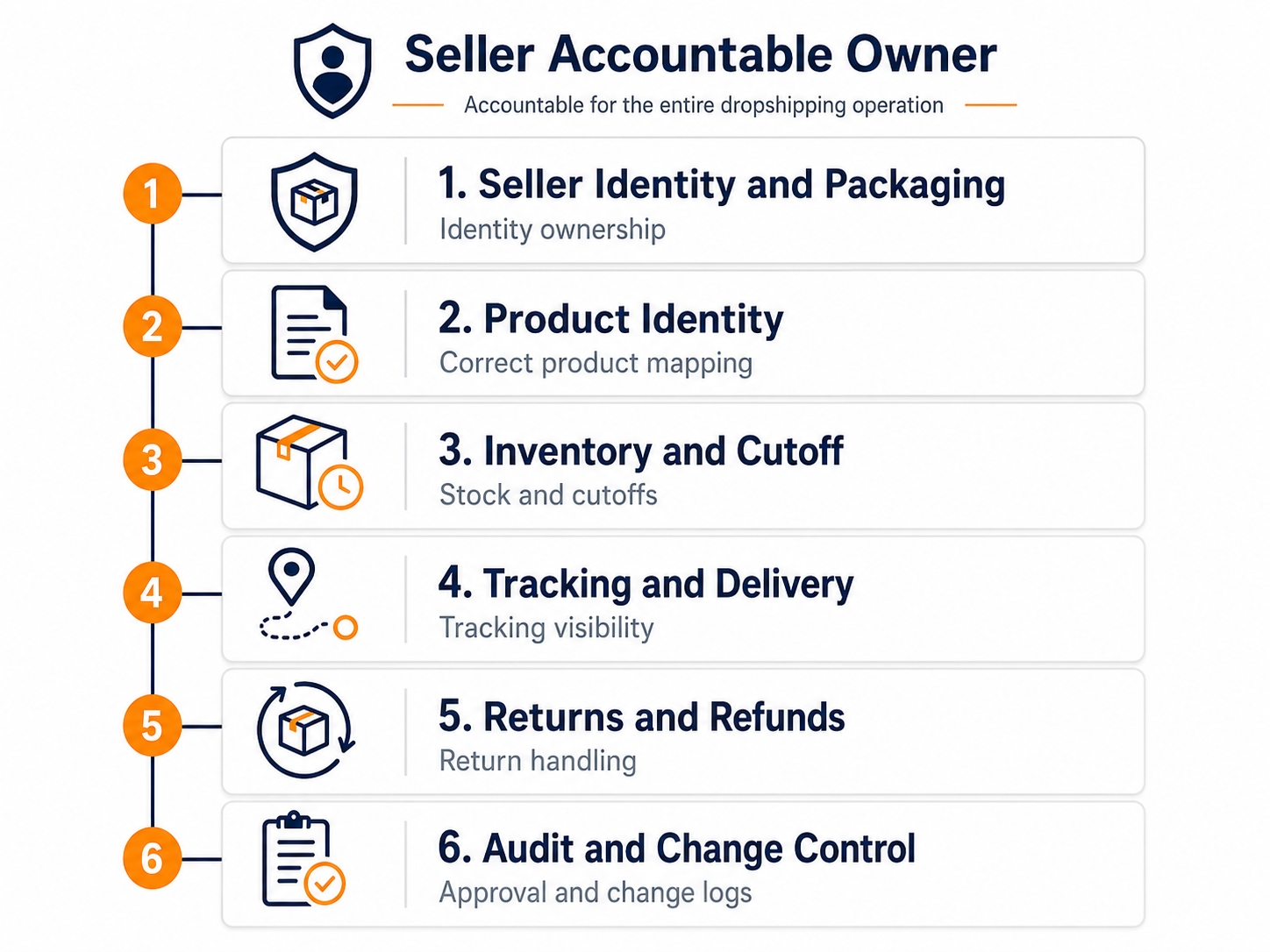
Start with written controls. The following items are editorial operating recommendations rather than a verbatim reproduction of Amazon policy. Their purpose is to make the official obligations testable and assignable.
Identity and packaging
Specify the seller name, approved packing slip, exterior packaging, inserts, invoice treatment, return details, and prohibited third-party identifiers.
Product identity
Prohibit substitutions without written approval. Map supplier SKUs to exact ASIN, model, size, color, quantity, condition, and included accessories.
Inventory and cutoff
Define feed frequency, safety stock, order acceptance deadlines, blackout periods, cancellation handling, and who pauses an offer when data becomes unreliable.
Tracking and delivery
Specify supported carriers, tracking deadlines, delivery regions, exception notification, damaged-parcel handling, and peak-season capacity.
Returns and refunds
Document return addresses, label creation, receipt confirmation, inspection, restocking, disposal, replacement, refund evidence, and escalation timing.
Audit and change control
Reserve rights to test orders, inspect documents, review facilities, approve subcontractors, receive incident notices, and reapprove material changes.
Do not rely on a verbal assurance. A supplier may understand general ecommerce fulfillment while still using retail-branded packaging, automated invoices, substitutions, unsupported carriers, or return processes that conflict with your Amazon obligations.
Run end-to-end test orders before sending live traffic
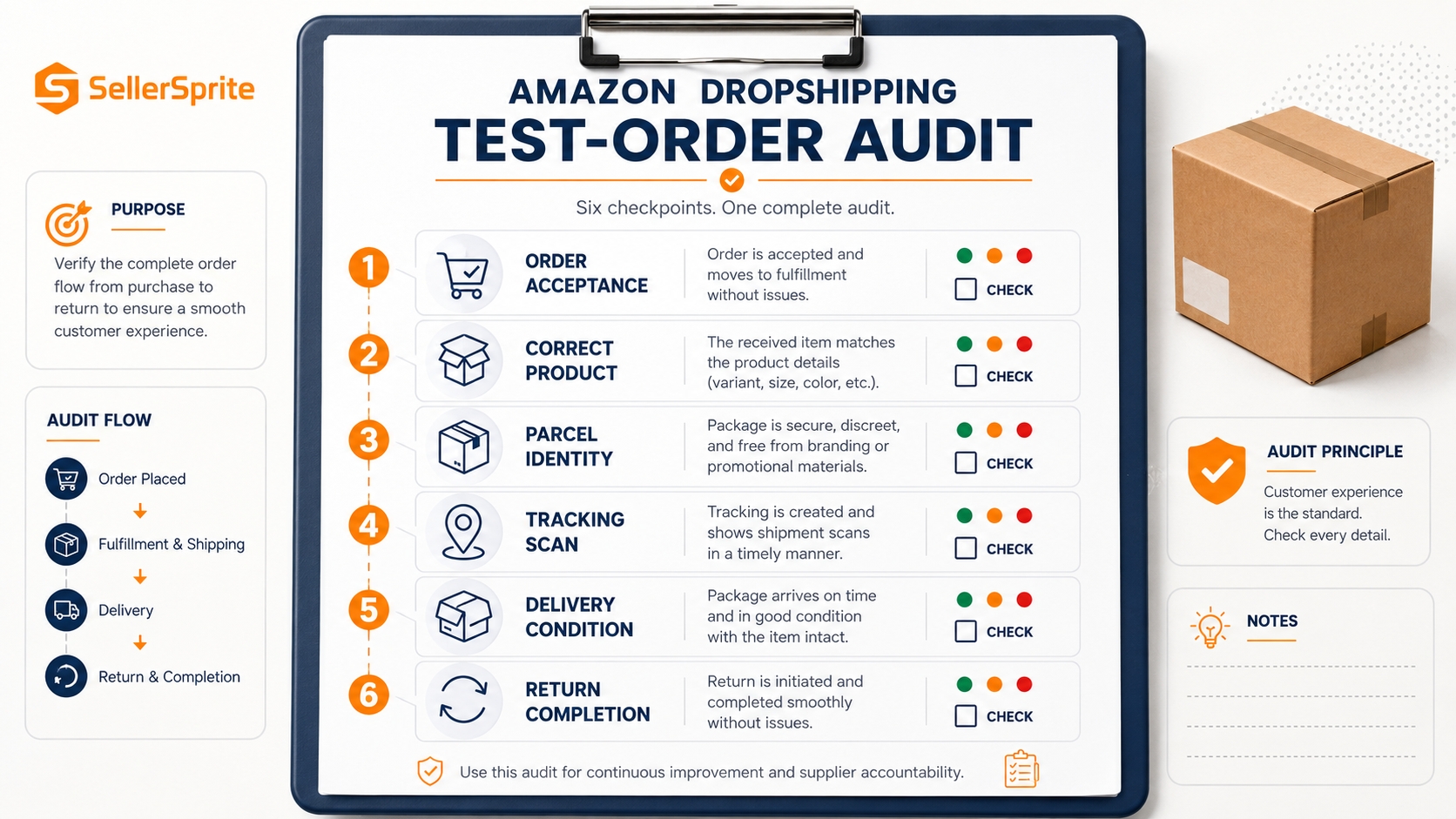
A document review cannot reveal every failure in the real parcel and data flow. Place authorized test orders that follow the same workflow a customer order will use. Test more than one product, fulfillment facility, destination, and package type when those variations exist.
The goal is not only to confirm that a parcel arrives. It is to verify that the correct product arrives in the promised condition, the seller identity is consistent, tracking is usable, customer-facing materials are compliant, and the return can be completed without improvisation.
| Test point | What to inspect | Evidence to save | Failure response |
|---|---|---|---|
| Order acceptance | SKU mapping, quantity, address transfer, order timestamp, acceptance, cutoff, and cancellation behavior. | Order IDs, timestamps, supplier acknowledgment, and any integration logs. | Correct mapping or timing before listing. Do not allow manual workarounds to become the permanent process. |
| Product received | Exact model, variation, quantity, condition, accessories, instructions, expiration, serial data, and product claims. | Unboxing video, product photos, identifiers, batch or lot information, and inspection notes. | Block substitutions, correct listing mapping, and investigate product-quality or authenticity issues. |
| Parcel identity | Exterior box, labels, tape, packing slip, invoice, receipt, insert, QR code, warranty information, and return document. | Clear photos of every side, every included document, and the return instructions. | Pause approval until every conflicting seller or supplier identifier is removed. |
| Tracking and delivery | Tracking validity, first scan, carrier movement, promised date, delivery confirmation, damage, and regional variation. | Tracking history, delivery photo where available, actual transit time, and exception log. | Revise handling promise, carrier method, supported regions, or supplier capacity before launch. |
| Return test | Return authorization, label, address, receipt, inspection, status update, refund evidence, and disposition. | Messages, label, tracking, receipt timestamp, inspection record, refund timestamp, and final disposition. | Do not launch until responsibility, timing, and evidence are clear to every owner. |
How to start dropshipping on Amazon with a compliance-first workflow
Amazon's public explainer organizes the starting process around creating a seller account, researching products, establishing supplier relationships, listing and promoting products, and coordinating orders. The workflow below adds policy gates and evidence requirements so each step produces a defensible go or no-go decision.
Choose the selling account and operating model
Register the Amazon selling account, confirm the marketplace, and document whether the product will be dropshipped, stocked for conventional FBM, sent to FBA, or managed through a hybrid. The selling plan and fulfillment arrangement are separate decisions.
Research products that fit supplier-controlled fulfillment
Assess demand and competition, then screen for operational fit. Products with temperature requirements, dangerous-goods constraints, fragile packaging, short shelf life, high customization, complex installation, or frequent returns may require control the supplier cannot reliably provide.
Validate rights, restrictions, and documentation
Confirm that the product can be sold in the category and marketplace, that your supply is legitimate, and that invoices, authorizations, specifications, safety records, certifications, and intellectual-property checks are available where relevant. Dropshipping permission does not waive product-level requirements.
Qualify and contract the supplier
Review facilities, systems, regions, carriers, product sources, capacity, packaging, returns, and subcontractors. Put seller-of-record identity, service expectations, evidence, incident notification, audit rights, and change approval in writing.
Run test orders and close every control gap
Test the complete order, parcel, tracking, delivery, support, and return flow. Repeat tests after a facility, packaging, document, system, carrier, or subcontractor change. A pass from one product and location does not prove every route is controlled.
Create an accurate listing and contribution model
Match the exact product or create an accurate listing. Build price from supplier cost, Amazon fees, shipping, advertising, returns, support, software, error allowance, and cash timing. Confirm that the listing promise is supportable in every active destination.
Launch a controlled offer with written pause rules
Begin with limited exposure. Monitor order acceptance, stock synchronization, tracking, delivery, cancellations, returns, support themes, product accuracy, and margin. Pause when the evidence no longer supports the customer promise rather than waiting for a repeated failure pattern.
Monitor the live operation and define pause rules
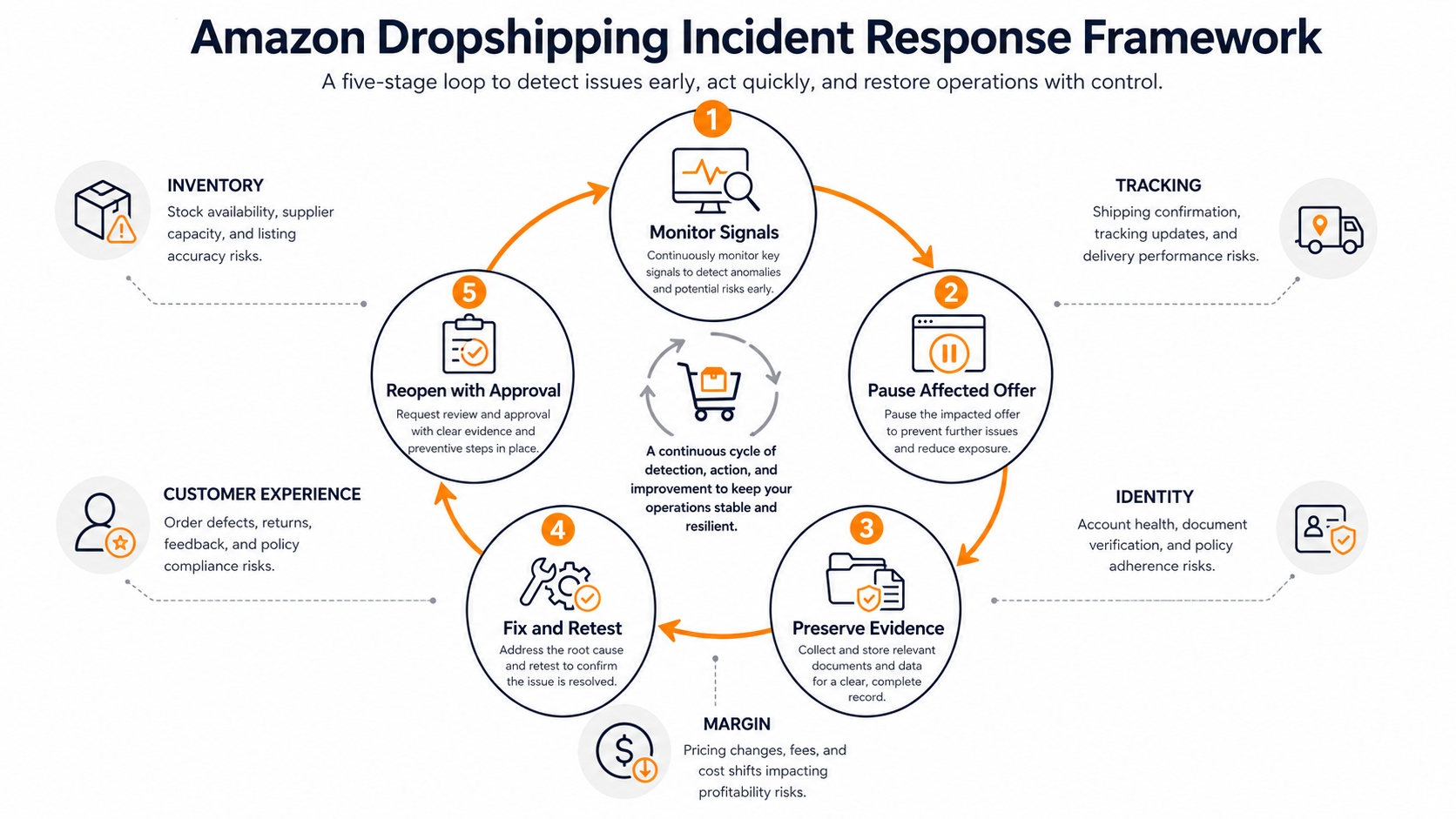
A supplier can pass onboarding and still fail later because inventory, staffing, packaging, carrier service, facilities, products, or systems change. Monitoring should therefore connect each customer promise to an observable signal and a named owner.
Do not copy arbitrary thresholds from another business. Set limits using current Amazon performance requirements, your listing promise, product risk, supplier capacity, and your tolerance for customer harm. Record the source and review date for every threshold.
| Signal | What to monitor | Pause or review trigger | Immediate action |
|---|---|---|---|
| Inventory accuracy | Feed age, available quantity, safety stock, rejected orders, unexpected substitutions, and facility-level differences. | The feed is stale, order acceptance becomes uncertain, or the supplier cannot confirm the exact SKU. | Reduce quantity or pause the offer, confirm stock, and correct the integration before reopening. |
| Handling and tracking | Acceptance time, shipment confirmation, valid tracking, first scan, carrier exceptions, and delivery promise. | Tracking or handling no longer supports the active promise or current Amazon requirements. | Pause affected regions or methods, investigate the root cause, and update the promise only when permitted and accurate. |
| Identity compliance | Packaging versions, documents, labels, inserts, return details, facility changes, and subcontractors. | Any customer-facing material identifies another seller, retailer, or supplier. | Stop affected fulfillment, preserve evidence, correct the source, and repeat test orders before reopening. |
| Customer experience | Wrong items, damage, late delivery, missing parts, support contacts, returns, refunds, and repeat themes. | A recurring problem suggests a product, packaging, supplier, facility, listing, or carrier failure. | Protect customers, isolate the cause, assign an owner, and confirm the fix with a clean test window. |
| Contribution margin | Actual supplier price, shipping, Amazon fees, advertising, returns, refunds, support, software, and error costs. | The live cost structure no longer meets the preapproved downside or break-even rule. | Reprice where appropriate, renegotiate, change fulfillment, or stop the offer rather than scaling unprofitable sales. |
Customer service, returns, and review feedback remain your responsibility
A dropshipping supplier may receive a returned parcel or provide product information, but the Amazon seller must own the customer-facing process. Define who monitors messages, diagnoses issues, authorizes remedies, creates return instructions, confirms receipt, issues refunds, and escalates safety, authenticity, or product-quality concerns.
Avoid sending the customer to an unknown supplier or manufacturer as the only support route. The customer should not need to resolve the commercial relationship between you and your fulfillment provider. Supplier evidence can support your decision, but the seller must maintain the case record and ensure the outcome follows current Amazon requirements.
Delivery failures, wrong products, packaging confusion, and return friction may also reveal that the current fulfillment structure is a poor fit for the product or customer promise. Use the broader framework for choosing how to sell and fulfill products on Amazon to reassess sourcing, fulfillment, unit economics, and launch controls before scaling further.
Keep the datasets separate. A product review, seller feedback, buyer message, return reason, carrier exception, and supplier incident may describe the same root cause, but each has different context and handling rules. Correlate themes without treating one record as proof of every other event.
How much does Amazon dropshipping cost?
Amazon's public explainer says there is no separate Amazon fee category specifically for dropshipping. Normal selling-plan fees, referral fees, and charges for optional Amazon programs can still apply. The supplier and operating model then add costs that may be less visible than inventory ownership.
Low upfront inventory does not mean low total risk. Per-order supplier pricing, shipping, remote-area surcharges, returns, reshipments, customer support, software, feed management, financing, chargebacks, product errors, and emergency fulfillment can absorb the apparent margin. Model the downside case before launch and replace estimates with actual invoice and order data as soon as it becomes available.
Contribution per order = Selling price minus Amazon selling fees, supplier product cost, shipping, advertising, promotions, returns allowance, refunds, support, software, payment or financing costs, and other variable operating costs.
| Cost layer | Include | Common omission |
|---|---|---|
| Amazon selling | Selling-plan allocation, referral fee, category-specific charges, refunds, and optional program costs. | Using one generic fee percentage without checking the actual product and marketplace. |
| Supplier and shipping | Product price, pick and pack, packaging, shipping, surcharges, insurance, tracking, return handling, and restocking. | Treating the catalog product price as the complete fulfilled cost. |
| Demand generation | Advertising, promotions, creative, listing work, pricing tests, and traffic acquisition. | Assuming marketplace exposure creates profitable traffic without acquisition cost. |
| Errors and after-sales | Cancellations, wrong items, late delivery, damage, reshipments, refunds, returns, support, and unrecoverable product cost. | Modeling every accepted order as a full-price, error-free sale. |
| Systems and governance | Integration, inventory feeds, monitoring, audit orders, compliance review, insurance, accounting, and professional advice. | Treating controls as free because no inventory is stored internally. |
Amazon dropshipping vs FBA vs conventional FBM
Dropshipping, FBA, and FBM are related but not equivalent. FBA means inventory is sent to Amazon's fulfillment network for eligible orders. FBM means the seller is responsible for merchant fulfillment, which may be performed internally or through a logistics provider. Dropshipping is a supplier arrangement in which a third party fulfills after the seller receives the customer order.
A dropshipped Amazon order is generally merchant fulfilled, but not every FBM order is dropshipped. The best choice depends on inventory ownership, capital, control, dimensions, demand stability, delivery expectations, product risk, return complexity, and total operating cost.
| Dimension | Dropshipping | FBA | Conventional FBM |
|---|---|---|---|
| Inventory position | The supplier holds inventory and fulfills after the seller receives the order, subject to the commercial agreement. | The seller procures inventory and sends eligible units into Amazon's fulfillment network. | The seller owns or controls stock in its own facility or a contracted logistics location. |
| Physical control | Lowest direct control over storage, picking, parcel presentation, and carrier handoff. | Amazon performs storage, packing, shipping, customer service, and returns for enrolled inventory. | The seller or its logistics provider controls stock, packaging, shipping, and operational processes. |
| Capital profile | Can reduce upfront inventory commitment, but per-order cost and supplier dependency may be higher. | Requires inventory procurement and inbound placement before customer sales. | Requires inventory, storage, labor, systems, packaging, and shipping capacity. |
| Primary risk | Supplier identity, stock accuracy, substitutions, tracking, delivery, returns, and account exposure. | Inventory commitment, storage, aged stock, inbound planning, and service costs. | Capacity, labor, shipping performance, service consistency, and inventory accuracy. |
| Best-fit question | Can the supplier execute your customer promise and identity controls on every order? | Does the product justify inventory investment and Amazon fulfillment costs? | Can your operation maintain shipping and service performance at the expected volume? |
Where SellerSprite fits in an Amazon dropshipping workflow
SellerSprite can support marketplace research and scenario planning before a seller commits to an offer. It does not certify a supplier, approve a seller-of-record contract, inspect a parcel, determine whether Amazon considers a workflow compliant, or replace Seller Central as the policy source of truth.
Keep marketplace estimates separate from supplier evidence and live account performance. Demand can be attractive while the fulfillment model remains unsuitable, and a compliant supplier does not guarantee profitable demand.
SellerSprite estimates can help prioritize product and keyword research. They cannot demonstrate supplier reliability, establish legal ownership, prove policy compliance, or guarantee that the Amazon offer will convert profitably.
Common Amazon dropshipping policy failure patterns
Most failures are not caused by the abstract idea of third-party fulfillment. They occur when the seller cannot prove or control the customer-facing transaction. Treat the patterns below as investigation prompts rather than a complete policy list.
| Failure pattern | Why it is risky | Safer operating control | Evidence to check |
|---|---|---|---|
| Retail-branded parcel reaches the customer | The package identifies another retailer or seller and conflicts with seller-of-record requirements. | Approve neutral or seller-identified packaging and verify it through repeated test orders. | Exterior photos, packing slip, invoice, receipt, inserts, labels, and return documents. |
| Supplier substitutes a similar product | The delivered item may not match the ASIN, condition, listing claims, compatibility, or documentation. | Prohibit substitutions and require exact SKU confirmation before order acceptance. | SKU map, product photos, identifiers, order record, and supplier change log. |
| Inventory feed is accepted without safeguards | Stale or aggregated data can produce cancellations, overselling, and last-minute substitutions. | Use feed-age monitoring, safety stock, facility checks, and automatic or manual offer pauses. | Feed timestamps, rejected orders, cancellation causes, and facility availability. |
| Return responsibility is vague | The customer may receive conflicting instructions, delayed refunds, or no accountable owner. | Map the return from authorization through receipt, inspection, refund, and disposition, then test it. | Return SLA, address, label, receipt log, inspection, refund timing, and escalation record. |
| Supplier change is not revalidated | A new facility, packaging template, carrier, subcontractor, or source can invalidate the original test. | Require advance notice and repeat relevant test orders before approving the change. | Change notice, approval, test results, affected SKUs, facility, date, and owner. |
Amazon dropshipping compliance checklist
Validate the offer before you validate the traffic
Use marketplace data to identify potential products, then require supplier evidence, test orders, policy review, and complete unit economics before scaling a dropshipped Amazon offer.
Frequently asked questions
Is dropshipping allowed on Amazon?
Yes, Amazon's public guidance says dropshipping is allowed when the seller follows the Drop Shipping Policy, remains the seller of record, removes other seller or supplier identifiers from customer-facing materials, accepts responsibility for returns, and complies with other applicable Amazon policies and laws. The exact supplier arrangement still needs to be reviewed and tested.
Can another retailer ship directly to my Amazon customer?
A common policy violation occurs when another retailer ships directly and the customer-facing parcel or documents do not identify you as the seller of record, or when the other retailer or another party appears on packing slips, invoices, external packaging, or related materials. Do not use a retailer's normal branded consumer shipment as your untested Amazon fulfillment process.
Who handles returns in Amazon dropshipping?
The Amazon seller remains responsible for accepting and processing returns. A supplier or logistics provider may perform agreed physical tasks, but the seller should own the customer communication, evidence, timing, refund decision, escalation, and compliance with Amazon's current return requirements.
Is Amazon dropshipping the same as FBA?
No. With FBA, the seller procures inventory and sends eligible units into Amazon's fulfillment network, where Amazon stores, packs, ships, and handles customer service and returns for those units. In dropshipping, a third-party supplier holds or controls inventory and fulfills the seller's customer order under the seller's responsibility.
Do I need an LLC to start dropshipping on Amazon?
Amazon's public explainer says an LLC is not required simply to begin dropshipping, although a formal business structure may have operational, tax, liability, banking, or growth implications. Requirements vary by location and situation. Follow Amazon's registration instructions and obtain qualified legal and tax advice for your jurisdiction.
Can SellerSprite verify that my dropshipping supplier is compliant?
No. SellerSprite can support product, category, keyword, competitor, and profitability research. It cannot inspect your supplier contract or parcel, certify seller-of-record status, approve a supplier, determine Amazon policy compliance, or guarantee account outcomes. Use current Amazon policy, authorized test orders, documented supplier controls, and qualified professional advice.
References
- Amazon Seller Central: Drop Shipping Policy
- Amazon: How to dropship on Amazon
- Amazon: How to sell on Amazon in 2026
- Amazon: FBA vs FBM
Scope and limitations: Unless a source states otherwise, Amazon policy and program references in this article relate to US public pages reviewed on September 2, 2026. Marketplace, account, product, category, fulfillment, contract, and legal requirements can differ. SellerSprite and other third-party data are estimates and research inputs, not proof of supplier compliance, customer demand, revenue, or profitability. This article is educational and is not legal, tax, accounting, insurance, intellectual-property, or financial advice.