TL;DR: Choosing the right competitors is critical for accurate reverse ASIN results on Amazon. A well-curated ASIN set ensures you uncover real buyer intent, avoid misleading keywords, and build effective SEO and PPC strategies.
Key Takeaways
- Reverse ASIN accuracy depends entirely on the quality of your competitor ASIN selection.
- Competitors aren't just top sellers; they must match your product's use case, price, specs, audience, and fulfillment model.
- Use a balanced set of 3-10 ASINs across three tiers: peers, aspirational brands, and lower-authority sellers.
- Avoid category giants, bundles, sponsored-heavy listings, and mismatched variations that distort keyword data.
- Always validate your ASIN set with sanity checks: keyword overlap, SERP alignment, and offer relevance.
Table of Contents
- Why Competitor Selection Is the Make-or-Break Factor in Reverse ASIN Results
- What Counts as a "Competitor" on Amazon (It's Not Always the Same Category)
- Define Your Reverse ASIN Objective (So You Pick the Right Competitors)
- The 5 Core Criteria for Picking "Right-Fit" Competitor ASINs
- Step-by-Step: How to Find Competitor ASINs the Smart Way (Not Guessing)
- Avoid These ASIN Types (They Distort Reverse ASIN Keyword Results)
- How Many Competitors Should You Use? (And How to Build a Balanced Set)
- Strategy Layer: Competitor Selection for Different Goals (SEO vs. PPC vs. Gap Analysis)
- Sanity Checks: How to Know You Picked the Right Competitors
- Mini Walkthrough: Example Competitor Selection (Template You Can Copy)
- Common Mistakes (And How to Avoid Them)
- FAQ
- References
Note on marketplaces: This guide is specifically optimized for the US market.
Why Competitor Selection Is the Make-or-Break Factor in Reverse ASIN Results
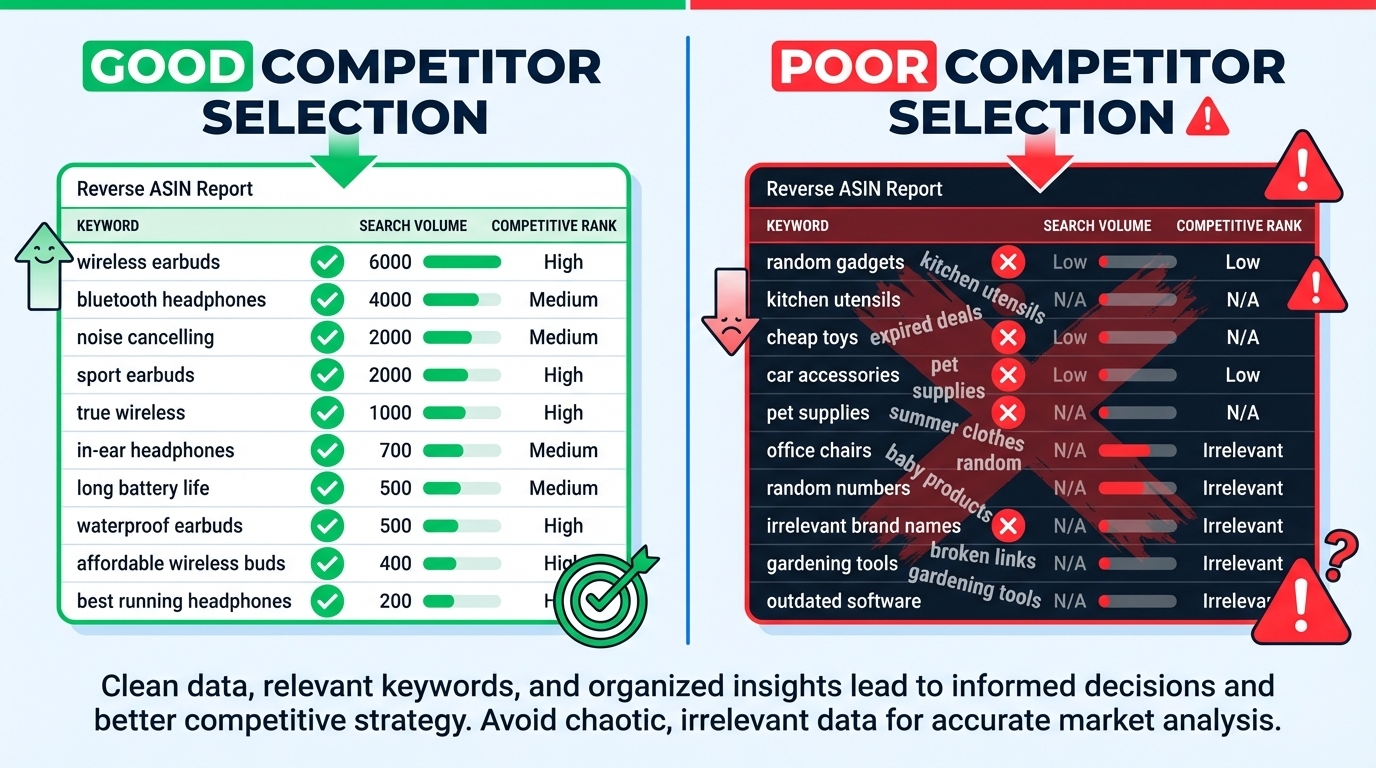
Reverse ASIN lookup is only as good as the data it analyzes. And that data starts with your competitor ASIN selection. If you pick the wrong ASINs, you'll get misleading keyword insights, wasted ad spend, and flawed SEO strategies.
Reverse ASIN is only as accurate as your ASIN set
Reverse ASIN tools extract keywords from top-ranking listings. But if those listings aren't true competitors, say, a $200 premium product next to your $30 budget version, the keyword overlap will be minimal or irrelevant. Your tool can't fix bad inputs.
"Wrong competitors" create wrong keywords (and wasted SEO/PPC work)
Imagine targeting "durable dog leash" but your reverse ASIN set includes luxury leather leashes. You'll see keywords like "handmade," "artisan," or “gift for dog lover”, none of which match your nylon, value-focused product. This leads to misaligned content and poor conversion.
The goal: build a competitor set that mirrors your buyer's intent
Your ideal ASIN set reflects how real shoppers discover and compare products like yours. It should represent the same use case, price sensitivity, and customer expectations. This ensures the extracted keywords reflect actual search behavior in your niche.
Definition: Reverse ASIN Competitor Selection
The process of identifying and selecting Amazon listings that closely match your product in use case, price, specs, and audience to ensure accurate keyword extraction and competitive intelligence.
If your results look weird, it's usually because…
- You included a brand that dominates unrelated categories.
- Your ASINs span multiple price tiers or use cases.
- You mixed single units with multi-packs or bundles.
- One listing uses heavy sponsored ads, skewing organic intent.
- The ASINs don't all appear for your primary keyword.
What Counts as a "Competitor" on Amazon (It's Not Always the Same Category)
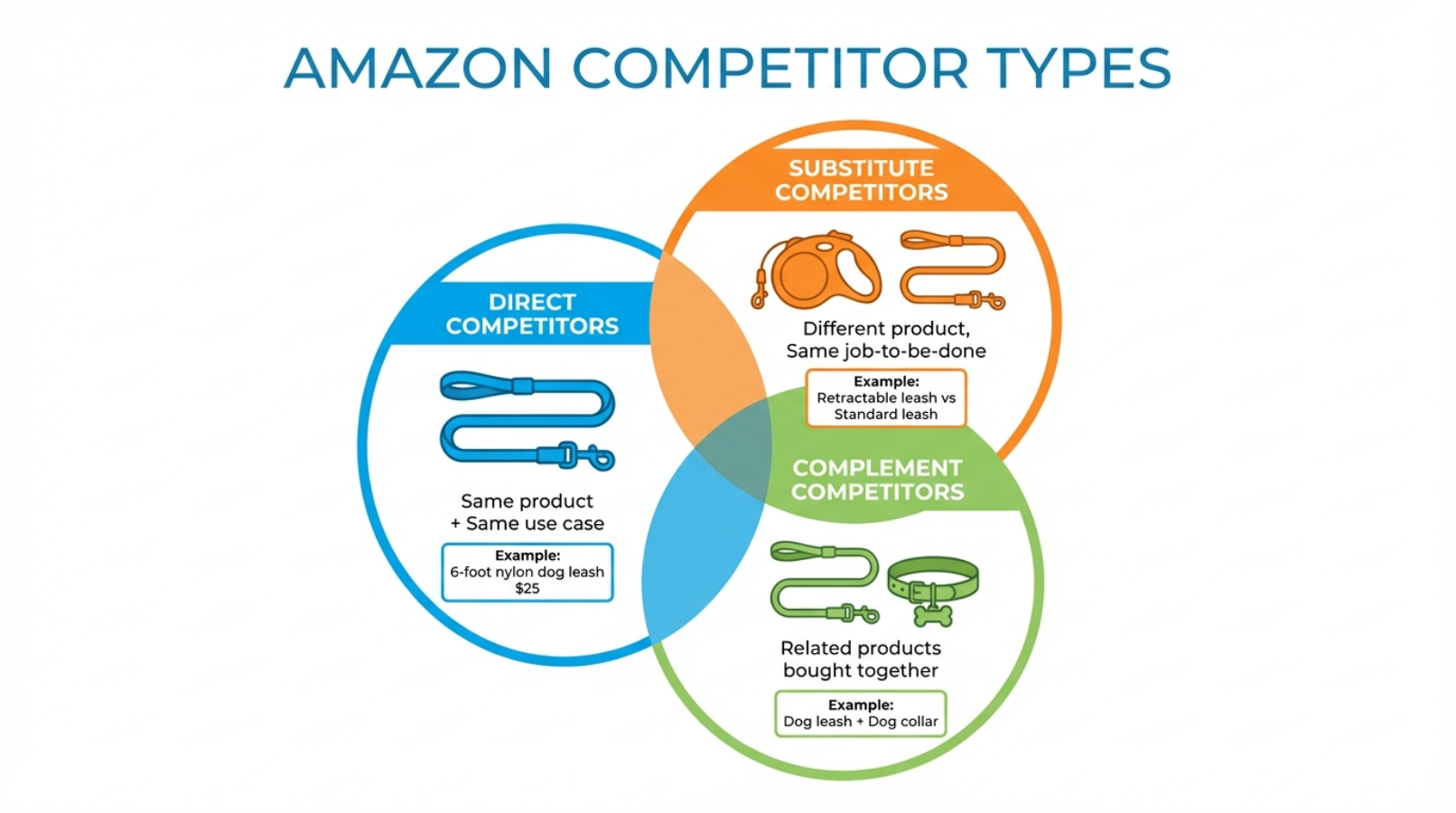
On Amazon, competition isn't just about being in the same category. Buyers often compare different types of products that solve the same problem. Understanding these layers helps you build a smarter ASIN set.
Direct competitors (same product + same use case)
These are listings that offer nearly identical products: same function, specs, and use case. For example, two 6-foot nylon dog leashes priced around $25. These are your most important competitors for SEO and keyword mapping.
Substitute competitors (different product, same job-to-be-done)
These solve the same customer need but with a different product. For example, a retractable leash vs. a standard leash. They may appear in "Customers also viewed" and compete for the same search terms. Include them when expanding PPC long-tail keywords.
Complement competitors (related products you might appear next to)
These are products often bought together, like a dog leash and collar. While not direct competitors, they can appear in recommendations and influence buyer behavior. Generally exclude them from reverse ASIN unless validating product bundles.
When to include each type (SEO vs. PPC vs. product validation)
For SEO keyword mapping, focus on direct competitors. For PPC expansion, include substitutes to capture adjacent intent. For product validation, include leaders, mid-tier, and challengers across all types to assess niche viability.
Define Your Reverse ASIN Objective (So You Pick the Right Competitors)
Your goal determines which ASINs to include. A mismatch here leads to irrelevant data. Here's how to align your ASIN selection with your objective.
Objective A: listing SEO keyword mapping
One-line objective: Identify keywords used by top-ranking, closely-matched listings to optimize your title, bullet points, and backend.
ASIN selection rules: Only direct competitors with similar price, specs, and use case. Exclude bundles, premium brands, and substitutes.
Objective B: PPC expansion and harvesting
One-line objective: Discover long-tail and adjacent keywords from broader competitor sets to expand ad targeting.
ASIN selection rules: Include direct and substitute competitors. Add listings with high "also viewed" overlap to capture buyer journey keywords.
Objective C: keyword gap analysis and positioning
One-line objective: Find keywords your competitors rank for but you don't, to identify content or targeting gaps.
ASIN selection rules: Include top 3 winners + your closest 3 peers. Focus on organic visibility, not sponsored rankings.
Objective D: product idea validation (niche feasibility)
One-line objective: Assess if a product idea has enough demand and room for competition.
ASIN selection rules: Include leaders, mid-tier sellers, and new entrants. Look for consistent keyword themes and pricing patterns.
The 5 Core Criteria for Picking "Right-Fit" Competitor ASINs
Use these five criteria to filter out poor-fit ASINs and build a high-signal dataset. Apply them like a checklist before running any reverse ASIN lookup.
Same primary use case (what the buyer is trying to accomplish)
Does the product solve the same problem? A portable phone charger and a wall charger both power devices, but their use cases differ. Only include ASINs with matching core functionality.
Similar price band (don't compare premium vs. budget unless intentional)
Price signals quality and intent. A $10 vs. $50 coffee mug attracts different buyers. Stay within ±20% of your price unless testing market tiers.
Same format/specs that matter (size, pack count, compatibility, material)
A 6-pack of socks isn't comparable to a single pair. A USB-C cable won't share keywords with a Lightning cable. Match specs that impact buyer decisions.
Same target customer (audience and context)
Is it for pet owners, travelers, or office workers? A dog leash marketed for hiking isn't the same as one for urban walks. Audience context shapes keyword language.
Same fulfillment + promise level (Prime/FBA vs. FBM can change intent)
FBA/Prime listings often rank higher and attract buyers expecting fast shipping. FBM sellers may target different keywords like "budget" or "import." Match fulfillment models when possible.
60-Second Competitor Checklist
- ✅ Same use case?
- ✅ Similar price (±20%)?
- ✅ Matching specs (size, pack, compatibility)?
- ✅ Same target customer?
- ✅ Same fulfillment (FBA/Prime)?
Step-by-Step: How to Find Competitor ASINs the Smart Way (Not Guessing)
Stop guessing. Follow this repeatable process to build a data-driven ASIN set.
Start from the SERP: search your primary keyword and collect top results
Capture Page 1 + top of Page 2 (because Amazon rotates)
Amazon personalizes search results. Scroll to page 2 to capture more variety. Collect ASINs from organic positions, not just sponsored ads.
Use "Customers also viewed / bought" as a competitor discovery layer
Visit top listings and scroll down. Products in "Customers also viewed" are behaviorally linked. These are strong candidates for inclusion, especially for PPC expansion.
Filter out lookalikes that will contaminate your dataset
Bundles, multi-packs vs. singles, different feature tier, different category path
Remove ASINs that are clearly different: 12-packs vs. singles, waterproof vs. standard, or products in unrelated categories. These skew keyword relevance.
Build a short list (3-10 ASINs) with notes (why each one is included)
Create a simple table to document your selection rationale.
| ASIN | Price | Key Differentiator | Why Included |
|---|---|---|---|
| B08XYZ1234 | $24.99 | Reflective stitching | Top organic rank, same use case and price |
| B08ABC5678 | $26.50 | Ergonomic handle | High "also viewed" overlap, direct competitor |
| B08DEF9012 | $22.00 | Lightweight design | Lower price tier, realistic win |
Avoid These ASIN Types (They Distort Reverse ASIN Keyword Results)
Certain ASINs act as noise in your dataset. Exclude them to improve data quality.
Category giants / household brands (they rank for everything)
Brands like Anker or Philips appear for thousands of keywords, many unrelated to your niche. Their dominance skews frequency data.
Out-of-position products (wrong use case, wrong audience)
A product that ranks but doesn't fit, like a car charger in a phone battery search, which adds irrelevant keywords.
Variations that don't match your hero SKU (size/color pack mismatch)
Don't include a 10-pack if you sell singles. The keyword intent shifts to bulk, wholesale, or refill.
Sponsored-heavy listings (ads may mask true organic intent)
Listings that rely on ads often don't reflect organic search behavior. Their keyword strategy may be ad-focused, not content-driven.
Listings with temporary advantages (deep coupons, outlier promos)
Short-term discounts can spike rankings artificially. These aren't sustainable competitors.
ASIN Types to Avoid in Reverse ASIN
- ❌ Household brand leaders (e.g., Anker, Philips)
- ❌ Bundles or multi-packs (unless you sell them too)
- ❌ Sponsored-only top rankings
- ❌ Products in wrong category or use case
- ❌ Listings with <50% price match to yours
How Many Competitors Should You Use? (And How to Build a Balanced Set)
Too few ASINs limit data. Too many introduce noise. The sweet spot is 3-10.
The "3–10 ASIN rule" (and when to expand)
Start with 5-7 ASINs. Expand only if you're doing broad gap analysis or validating a new niche.
Build a balanced set across three tiers
Tier 1: close-position peers (most important)
2-3 ASINs that match your product exactly in price, specs, and position.
Tier 2: slightly higher authority (aspirational)
1-2 ASINs from stronger sellers to identify growth opportunities.
Tier 3: slightly lower authority (realistic wins)
1-2 ASINs you can realistically outperform.
Keep the set stable long enough to learn (avoid constant swapping)
Run your reverse ASIN analysis over 4-6 weeks with the same set to spot trends. Frequent changes prevent meaningful insights.
Balanced Competitor Set Formula
3 Peer ASINs + 2 Aspirational + 2 Realistic Wins = 7 Total
Strategy Layer: Competitor Selection for Different Goals (SEO vs. PPC vs. Gap Analysis)
Tailor your ASIN selection based on your strategic goal.
For SEO keyword mapping: pick the most "buyer-intent aligned" ASINs
Focus on organic visibility and content quality. Use only direct competitors with strong on-page SEO.
For PPC: include substitutes and adjacent intent to expand long-tails
Capture broader search behavior. Use "also viewed" data to find long-tail opportunities.
For keyword gap analysis: include the top winners + your closest peers
Gap types: "missing keywords", "weak clusters", "dominated head terms"
Compare your keyword profile against leaders to find gaps in coverage, strength, or positioning.
For product validation: include leaders, mid-tier sellers, and challengers
Assess market saturation, pricing, and keyword consistency to determine if the niche is viable.
Sanity Checks: How to Know You Picked the Right Competitors
Before trusting your reverse ASIN data, run these checks.
Keyword overlap check: do multiple ASINs share the same core clusters?
If top ASINs all rank for "durable dog leash 6ft," that's a strong signal. If keywords are all over the place, your set is too broad.
SERP alignment check: do your chosen ASINs appear for your primary keyword?
Search your main keyword. If your ASINs don't show up organically, they're not real competitors.
Offer alignment check: does your product realistically match buyer expectations?
If your product is budget-friendly but all competitors are premium, you're targeting the wrong set.
"Weird results" troubleshooting (what to fix first)
If results are messy, first remove outliers, then recheck price and use case alignment.
If your reverse ASIN results are messy, check…
- Are all ASINs in the same price band?
- Do they serve the same use case?
- Are there bundles or multi-packs?
- Is one ASIN a category giant?
- Do they all appear for your main keyword?
Mini Walkthrough: Example Competitor Selection (Template You Can Copy)
Let's walk through a real example.
Start with one primary keyword → collect 15 ASINs
Search "6ft dog leash nylon" and collect top 15 organic results.
Apply the 5 criteria → reduce to 8
Remove 7 that fail price, use case, or spec checks.
Split into tiers → final 5-ASIN set
3 peers, 1 aspirational, 1 realistic win.
Run reverse ASIN → evaluate overlap and clean the list
Check for consistent keyword clusters. Remove any ASIN that introduces noise.
Common Mistakes (And How to Avoid Them)
Even experienced sellers make these errors.
Picking only best-sellers (not closest competitors)
Best-sellers may not be your real competitors. Focus on relevance, not rank.
Mixing different product formats (single vs. bundle, different compatibility)
This contaminates keyword data. Keep formats consistent.
Ignoring price band (keyword intent shifts with price)
A $10 and $50 product attract different search terms. Match price ranges.
Constantly changing ASIN sets (no stable baseline)
You can't track progress if the benchmark keeps shifting. Lock in your set for at least a month.
FAQ
How do I choose the right competitors for reverse ASIN analysis on Amazon?
Select ASINs that match your product in use case, price (±20%), specs, target customer, and fulfillment (FBA/Prime). Use 3-10 ASINs, including peers, aspirational brands, and realistic wins. Avoid category giants, bundles, and sponsored-heavy listings.
What tools can I use to perform reverse ASIN research for Amazon listings?
SellerSprite's Reverse ASIN tool allows you to extract keywords from any ASIN. Other tools include Helium 10, Jungle Scout, etc. SellerSprite offers high data accuracy and intuitive filtering.
Why is selecting accurate competitors important for reverse ASIN strategy?
Inaccurate competitors lead to irrelevant keywords, wasted SEO/PPC efforts, and flawed market insights. Your reverse ASIN data is only as good as the ASIN set you provide.
Should I include my own ASIN in the competitor set?
No. Reverse ASIN analysis is for understanding competitors. Including your own ASIN doesn't add value and may skew data interpretation.
What if my niche is dominated by one big brand?
Focus on smaller competitors and emerging sellers. Use substitute products and long-tail keywords to find whitespace. Avoid including the dominant brand unless analyzing market-wide intent.
Next Steps
- Review your current ASIN set using the 5 Core Criteria.
- Run a Reverse ASIN lookup with a refined competitor set.
- Explore the Reverse ASIN Strategy Guide for advanced tactics.
References
- Reverse ASIN Strategy Guide View
- How to Perform Reverse ASIN Search View
- Validate Product Ideas Using Reverse ASIN Data View
By SellerSprite Success Team
The SellerSprite Success Team combines hands-on Amazon selling experience with data science expertise. We've helped thousands of sellers optimize their keyword strategies, from new entrants to enterprise brands. Our insights are grounded in real-world testing, reverse ASIN analysis, and continuous tool innovation.